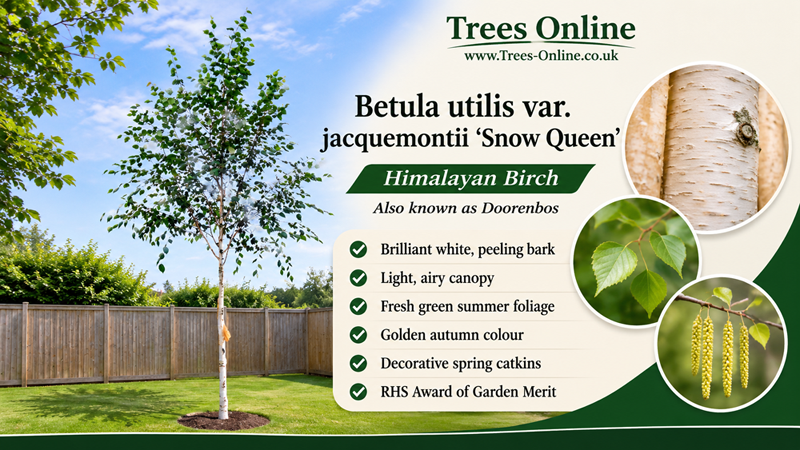
Potted Betula Snow Queen or Doorenbos – Young and Mature Himalayan Birch Trees
We also sell cheaper bare root and rootball Betula Snow Queen trees during November to March.
In our opinion, Snow Queen is a much more attractive tree than ordinary Silver Birch. This is an elegant, medium-sized deciduous tree with spectacular, brilliant white peeling bark, often developing its distinctive colour within the first few years. This can peel back to reveal slightly warmer colours underneath and is a great contrast against evergreen plants.
Its oval crown and ascending branches give Snow Queen a graceful appearance, while its dark green leaves turn beautiful shades of golden yellow in autumn. Eventually reaching around 14 m tall with a spread around 8 m.[1][2]
With the Award of Garden Merit, it explains why it is popular in public parks and gardens. We definitely suggest you get one. By that we mean buy one from us, not steal one from your local public parks and gardens.[1][2]
Spring brings fresh green leaves and slender male catkins, which can reach 15 cm long. Through summer, the foliage creates an attractive, airy canopy that provides light shade without giving the garden the feeling of sitting underneath a large green umbrella.[1]
Why Buy Potted Betula Snow Queen Trees?
The biggest advantage of buying a potted Snow Queen is that they can be planted throughout the year, and you can leave them in the pots for up to a season until you are ready to plant. Autumn and winter are generally easier because the trees require less watering during establishment.[3]
Mature Potted Snow Queen Birch – An Immediate Garden Feature
If you would rather not wait years for a smaller tree to become an impressive feature, our larger and mature potted Betula Doorenbos trees offer a more immediate impact. For the mature options, you have the choice of standard, feathered and multi-stem.
Feathered: Usually one central stem with side branching for most of it.
Standard e.g. 6-8cm girth: Usually around 200cm of single clear straight stem
Multi-stem: Hardly any clear stem before branching starts
For a particularly striking display, plant several Snow Queen birches together. Their white trunks create a wonderful contrast with surrounding foliage, especially when the low winter sunlight catches the bark. The RHS recommends birches both as individual specimens and in groups for ornamental effect.[2]
Planting and Caring for Potted or Mature Betula Snow Queen
Snow Queen is not a particularly fussy tree. It grows in full sun or partial shade, in exposed or sheltered positions, and tolerates chalk, clay, loam and sandy soils, whether acidic, neutral or alkaline. It prefers moist, well-drained ground and is hardy to below -20°C. In short, unless your garden resembles a permanent swamp, Snow Queen should be quite happy there.[1][2]
Potted Snow Queen trees can be planted throughout the year, avoiding frozen, waterlogged or excessively dry ground. Autumn and winter are generally easiest. Water the pot before planting, dig a hole wider but no deeper than the rootball, remove the container and loosen any circling roots. Plant at the original soil level, backfill, firm gently and water thoroughly.[3]
Apply mulch around the base, keeping it clear of the trunk. Water regularly during the first growing season and during prolonged dry spells over the following two years, particularly after spring or summer planting. Larger mature specimens may require staking while establishing.[3][4]
Once established, Snow Queen needs little pruning. Remove damaged, dead or diseased branches when necessary, preferably in early winter. Avoid unnecessary cutting in late winter or spring when birches can bleed sap. Its natural shape is part of its charm, so there is rarely any need to start attacking it with a chainsaw.[4]
Keeping Your Snow Queen Birch Bark Beautifully White
One of the more unusual advantages of owning a white-barked birch is that you can actually clean its trunk.
Over time, dirt and algae can dull the brilliant white surface, particularly in damp or shaded gardens. The Royal Horticultural Society recommends gently cleaning the bark with warm water and a soft sponge to restore its natural brightness.[4] Non-yellowing gloss white paint is very unlikely to save you a job. We are talking to the blokes looking to save a few hours on house-hold jobs.
There is no need to scrub away the naturally peeling layers or attempt to remove firmly attached bark. A gentle clean is all that is required, and excessive rubbing could damage the living tissue beneath the surface.[2][4]
Show sources
[1] Royal Horticultural Society – Betula 'Snow Queen'
Cultivar description, botanical synonyms, RHS Award of Garden Merit, mature dimensions, foliage, catkins, soil, exposure, hardiness and propagation.
[2] Royal Horticultural Society – Birch Trees for Winter Interest
White peeling bark, mature height, autumn colour, ornamental uses, planting groups and the Doorenbos name.
[3] Royal Horticultural Society – Planting Trees and Shrubs
Container-grown planting seasons, planting depth, preparing roots, watering, mulching and staking.
[4] Royal Horticultural Society – How to Grow Birch
Birch cultivation, aftercare, pruning, bark cleaning and propagation.