Mature Sessile Oak, Quercus Petraea Options Explained
- Girth 8–10cm: Feathered (branches for most of the trunk), approximately 240–300cm tall.
Heights are given as a very rough guideline and can vary considerably depending on species and nursery, as growing conditions differ between suppliers. Trees may also have been pruned prior to dispatch, so girth is the only guaranteed specification. Trees over 5.5m may incur a delivery surcharge depending on location and species; this will always be confirmed with you before the order is progressed.
Mature Bare Root Quercus Petraea, Sessile Oak Aka Durmast Oak, Irish Oak
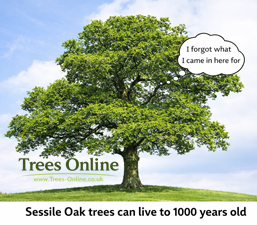
Our mature bare root Sessile Oak Quercus Petraea is one of Britain’s most valuable native trees because its value increases as it ages. Many trees peak early and then simply exist; a mature oak improves with time. As it grows, it becomes a richer habitat, a stronger landscape anchor, and a longer-term store of carbon and biodiversity. That is why Sessile Oak Quercus Petraea is a classic choice for estates, parkland, large gardens, rewilding schemes, and native woodland planting.
The Sessile Oak is very long-lived (500-1000 years), and acorns sprouted during the Black Death (aka a “very bad cold” according to 15th-century conspiracy theorists) can still be alive today. They started growing back when tree huggers were less handsy and known as tree wavers. At the current rate of progression, tree kissing can’t be far off. Some Sessile oaks have been around for so long, you can see hug wear marks.
Sessile Oak, Quercus Petraea ultimately develops a tall trunk and broad crown, reaching a mature height of 20-40m. Compared with English Oak, it commonly shows a more upright trunk and slightly straighter branching, giving it a clean, architectural outline when given adequate space.
Where oak earns its reputation is what happens over decades. As Sessile Oak matures, bark becomes more fissured, limbs thicken, and natural features develop that wildlife depends on. Older oaks can form crevices, cavities, deadwood, and sheltered micro-habitats that simply cannot be created quickly with fast-growing, short-lived species. In plain terms: an oak isn’t just a tree — it becomes an ecosystem.
Features and benefits
- Native UK oak species with strong long-term landscape value
- Very long-lived tree capable of lasting for centuries
- Upright, classic form suited to open planting where it can develop naturally
- High wildlife value, supporting a wide range of invertebrates, birds, and mammals
- Low maintenance once established, with little routine pruning required
- Compounding habitat value: older oaks provide veteran features (cavities, deadwood, fissured bark) that many species rely on
- Long-term carbon value: not the fastest starter, but exceptional for steady biomass and long-lived carbon storage over centuries
- Estate and rewilding staple: provides structure, continuity, and a focal canopy while other species cycle around it
- Hard to replace: a mature oak’s ecological role cannot be recreated within a human lifetime once lost
If you want a tree that feels like a genuine investment in the landscape, our mature bare root Sessile Oak Quercus Petraea is exactly that: a legacy tree designed to outlast generations.
Planting Mature Bare Root Sessile Oak Quercus Petraea
Mature Bare root Sessile Oak Quercus Petraea should be planted during the bare root season (typically late autumn to early spring) while the tree is dormant. This helps reduce transplant shock and supports strong root establishment.
Soil and site
- Drainage: Sessile Oak naturally favours moist to well-drained ground. Avoid sites where water sits around the roots for long periods.
- Soil type: Typically performs best on loam, sandy soils, and lighter clays that do not compact heavily.
- Soil pH: Often associated with moderately acidic soils and upland/western oak woodland conditions, but it can also establish on neutral and alkaline ground where drainage and rooting depth are good.
- Light: Choose an open, sunny position for the best long-term crown development.
- Space: Allow plenty of room. Sessile Oak, Quercus Petraea becomes a large tree and is not suitable for tight spaces or planting close to buildings, drains, or boundaries.
- Wind exposure: Stake in exposed sites to prevent wind-rock while roots establish. A stable root plate early on is key for long-term form.
Planting overview: Keep roots protected from drying wind and sun during planting. Dig wide, plant to the original soil mark, backfill firmly (not compacted), and water in. Mulch helps retain moisture and reduces grass competition in the first few seasons.
During the first growing season, water in prolonged dry spells. Once established, our mature bare root Sessile Oak, Quercus petraea is largely self-sufficient, with watering mainly needed only in exceptional drought during its early years.
Pruning Mature Bare Root Sessile Oak Quercus Petraea
Pruning needs for Sessile Oak Quercus Petraea are usually minimal. Oaks naturally form strong frameworks, so the aim is typically to let the tree develop its structure naturally.
- Remove dead, damaged, or crossing branches as needed.
- Carry out only light formative pruning when young, if required.
- Avoid heavy pruning unless essential. If pruning is needed, dormant-season work (late autumn/winter) is commonly preferred.
In most settings, our mature bare root Sessile Oak Quercus Petraea looks best when allowed to develop its characteristic tall trunk and broad crown without excessive intervention.
Allegedly Interesting Information About Mature Bare Root Sessile Oak Quercus Petraea
- “Sessile” refers to being stalkless — the acorns sit directly on the twig rather than hanging on long stalks.
- Compared with English Oak, sessile oak typically has longer leaf stalks and shallower lobes.
- The flowers are not showy: male flowers are catkins, and female flowers appear as tiny red buds — all wind-pollinated.
- Heavy acorn crops can occur in mast years, often cited as roughly every 5–10 years (variable by site and conditions).
- It was declared the national tree of Ireland in 1990.
- Oak supports an enormous web of life: it is associated with over a thousand invertebrate species, and acorns are taken by wildlife, including squirrels and badgers.
- Sessile oak can hybridise with English oak, so intermediate trees do occur.
- One reason our mature bare root Sessile Oak Quercus Petraea is so valuable is that the best habitat comes later: fissured bark, crevices, deadwood, and occasional cavities build up over decades.
- Fast-growing trees can look “finished” quickly; an oak spends its first years getting started and then quietly becomes more important every decade after.
- Plant a mature bare root Sessile Oak Quercus petraea today, and it can still be standing long after the current generation has finished arguing about where to put it.