Paul's Scarlet Hawthorn Tree – Potted, Large and Mature Specimens
Looking for a cheaper Pauls Scarlet? See our Bare Root Pauls Scarlet Hawthorn Trees.
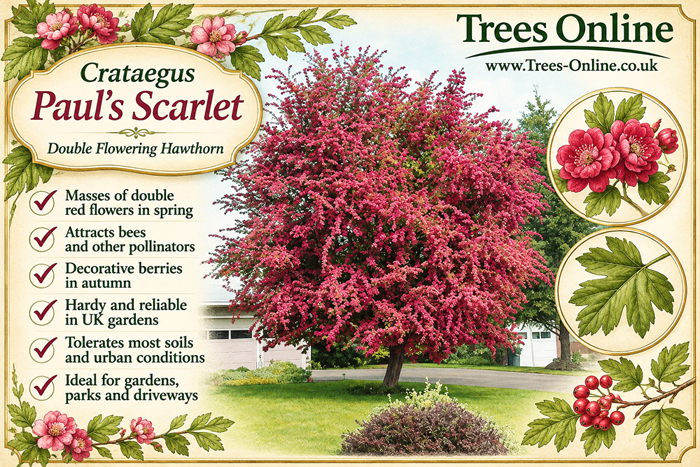
Also known as Midland Hawthorn or Double Red Flowered Hawthorn, Crataegus laevigata 'Paul's Scarlet' is a deciduous ornamental tree with an eventual height and spread of around 8 m. Unlike the familiar white-flowering hawthorn, Paul's Scarlet produces masses of double, magenta-red flowers, usually during May. Each flower has extra petals arranged in layers, giving it the fuller appearance of a miniature rose. The flowers appear in clusters, creating an impressive spring display across the crown.[3]
Its glossy green leaves have three to five shallow lobes and provide an attractive summer canopy. Small orange-red berries may follow the flowers in autumn, although this variety is grown primarily for its blossom rather than a reliable fruit crop.[1][3]
Suitable for exposed gardens and many urban locations, it is an attractive choice for smaller gardens with sufficient space for its crown, as well as larger ornamental planting schemes.[1]
The branches have sharp thorns, which can provide sheltered cover for birds but an issue when planting near narrow paths or children's play areas.
Its currently accepted botanical name is Crataegus × media 'Paul's Scarlet'[1], and it has received the Royal Horticultural Society's Award of Garden Merit, recognising its high value as an ornamental garden plant.[1]
Larger and Mature Paul's Scarlet Hawthorn Trees?
As a very loose guideline, nursery estimates suggest around 20–40 cm of growth a year, although this varies with growing conditions and the age of the tree.[6] A young 2–3-year-old tree can therefore take many years to develop a substantial crown and presence in your garden. Our larger and mature specimens are going to save you a lot of time. The trade-off is that they require more careful planting and aftercare while their roots establish in their new surroundings.[2]
Where to Plant Crataegus Paul's Scarlet Trees
Paul's Scarlet grows well in full sun or partial shade and tolerates exposed or sheltered positions. It accepts clay, chalk, loam and sandy soils, including acid, neutral and alkaline conditions, provided the ground drains reasonably well. Avoid persistently waterlogged areas.[1]
The RHS rates this tree as hardy below −20°C, making it suitable for most UK gardens, including colder inland locations.[1]
Allow sufficient space for its spreading crown, particularly near buildings, boundaries and neighbouring trees.
Planting and Caring for Mature Potted Hawthorn Trees
Before planting, water the rootball thoroughly. Dig a hole wide enough for the roots to spread, but no deeper than necessary. The point where the trunk widens into the main roots should remain at ground level.[2]
Remove the container, gently loosen any tightly circling roots, backfill with soil, firm carefully and water thoroughly.
Water regularly during dry weather for at least the first two growing seasons. Large and mature specimens may require particular attention, as the RHS advises that specimen trees and shrubs can take two or even three growing seasons to become fully established.[7]
Apply mulch around the base to retain moisture and reduce competition from grass and weeds, keeping it clear of the trunk. Larger specimens may also require suitable staking or support.[2]
Once established, Paul's Scarlet generally needs little pruning beyond removing dead, damaged or unwanted branches. Possible problems include aphids, leaf spot and fireblight, although these do not affect every tree.[1]
The tree is grown for ornament rather than food, so don't be looking to make a Paul's Scarlet sandwich. The RHS warns that its seeds contain toxins and that the ornamental fruits should not be eaten by pets.[1]
The Remarkable Victorian History of Paul's Scarlet Hawthorn
Paul's Scarlet has an interesting history dating back to Victorian Britain. Around 1858, an unusual branch bearing deep red double flowers appeared on a pink-flowering hawthorn growing in the garden of Christopher Boyd near Waltham Cross, Hertfordshire.[4]
This naturally occurring change is known as a 'sport', where part of a plant develops different characteristics from the rest. The new variety was propagated by William Paul, a well-known nurseryman, and exhibited at the International Horticultural Exhibition in 1866.[4]
Hawthorn also has a long history in British folklore. Traditionally called the May tree, its blossom was associated with the arrival of summer. There was even an old superstition that bringing hawthorn blossom indoors would bring bad luck. These beliefs concern hawthorns generally rather than the Victorian Paul's Scarlet cultivar specifically.[5]
See What Our Customers Are Saying About Our Paul's Scarlet Hawthorn Trees
"Dear Alan our *Crataegus Pauls Scarlet tree arrived today and it looks very handsome indeed. Thank you for your efforts kind regards Paul Mahoney 0820-26636"
"The trees came this morning - no problems. Thank you for continuing to work in these scary times. You are much appreciated. Tree Fairy xxx 0620-26281"
"I was very pleased with the trees when they arrived - healthy, strong and well cared for. Your trees were excellent and following this response I would come to you again. So thanks. Helen S 0919"
*Added for transparency and clarity.
Sending Paul's Scarlet as a gift? A message card can be included at no additional cost. Simply enter your message during checkout.
Show sources
[1] Royal Horticultural Society – Crataegus × media 'Paul's Scarlet' – Accepted botanical name, mature height and spread, flowers, berries, soil, exposure, hardiness, pruning, pests, Award of Garden Merit and safety information.
[2] Royal Horticultural Society – Planting Trees and Shrubs – Container-grown trees, planting depth, root preparation, watering, mulching, staking and establishment care.
[3] Oregon State University – Crataegus laevigata 'Paul's Scarlet' – Double red flowers, leaf characteristics, thorns and growth habit.
[4] International Dendrology Society – Crataegus laevigata – Origin of Paul's Scarlet, Christopher Boyd, William Paul and its exhibition in 1866.
[5] Woodland Trust – Hawthorn – Traditional May blossom folklore and historical beliefs.
[6] Landscaping Emporium – Crataegus laevigata 'Paul's Scarlet' – Nursery-reported annual growth estimate of approximately 20–40 cm.
[7] Royal Horticultural Society – Trees and Shrubs: Establishment Problems – Specimen trees and shrubs can take two or three growing seasons to become fully established.