Bare Root Crataegus laevigata Paul's Scarlet
Click the link for Containerised Paul's Scarlet Hawthorn.
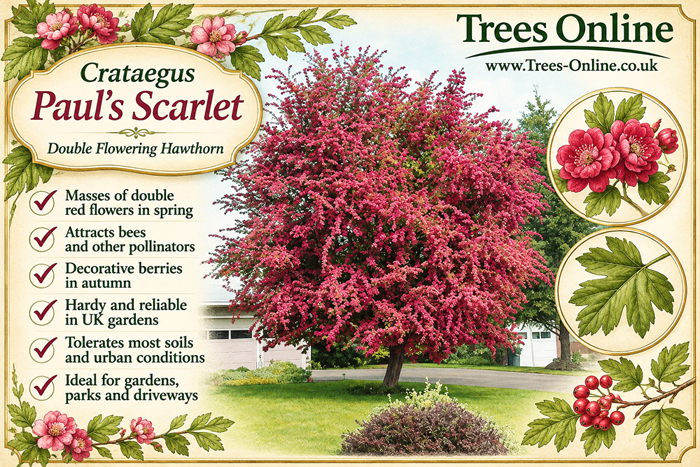
Our bare root Paul's Scarlet Hawthorn tree is a beautiful ornamental tree that produces masses of double, rosy-red blossoms in late spring. Also known as Crataegus laevigata 'Paul's Scarlet', this deciduous hawthorn develops a rounded, leafy crown, reaching up to 8 m tall and 8 m wide at maturity. Its spectacular May flowers make it an attractive choice for lawns, cottage gardens and ornamental planting.[1]
They are called May flowers to refer to the season they make an appearance. We are not hiding behind legal language to say we are not sure if they will flower or not.
Paul's Scarlet has received the Royal Horticultural Society's Award of Garden Merit, recognising its value as a garden plant.[4]
Why Buy Bare Root Paul's Scarlet Hawthorn Trees?
Bare root trees are usually cheaper than potted and rootball versions because they are grown in the ground and supplied without a pot or heavy rootball of soil. This reduces the cost of pots, compost, handling and transport. You get the same variety of tree for less money.
The disadvantage is that bare root trees are only available from November to March, while they are dormant. They also need a little extra care when planting. Keep the roots moist and protected from drying out, plant as soon as possible after delivery and water thoroughly after planting.[5]
Unlike the familiar white-flowering hawthorn, Paul's Scarlet produces clusters of richly coloured, fully double flowers that resemble miniature roses. For those not in the know, it is literally as described: two or more layers of petals making the flowers look fuller. These contrast beautifully with its glossy green leaves, which have three to five shallow lobes.[2]
As autumn approaches, the foliage can develop yellow tones before falling. Small orange-red berries may also appear (now we are hiding behind legal language!), although the main attraction of this variety is its outstanding spring blossom.[3]
The branches carry sharp thorns, giving birds some sheltered cover and making the tree suitable for an informal boundary. However, the thorns are worth considering if planting close to narrow paths or children's play areas.[2][3]
Where to Plant Crataegus Paul's Scarlet
This is an adaptable tree that grows well in full sun or partial shade. It tolerates exposed or sheltered positions and a wide variety of soils, including clay, chalk, loam and sand. Acid, neutral and alkaline soils are all suitable, provided drainage is reasonably good. Avoid persistently waterlogged ground.[1]
It is exceptionally cold hardy, with an RHS hardiness classification indicating tolerance of temperatures below −20°C.[1]
Give newly planted trees sufficient water during dry weather while their roots become established for at least two seasons. Mulching around the base helps retain soil moisture and reduces competition from surrounding grass and weeds.[5]
Once established, Paul's Scarlet usually needs little pruning beyond removing dead, damaged or unwanted branches. It can occasionally suffer from aphids, leaf spot or fireblight, so inspect the foliage and shoots if the tree begins to look unhealthy.[1][6]
The tree is grown for ornament rather than food, so don't be looking to make a Paul's Scarlet sandwich. Its fruits should not be eaten by pets, and the RHS warns that the seeds contain toxins.[1]
The Remarkable Victorian History of Paul's Scarlet Hawthorn
Paul's Scarlet has an interesting Victorian history. Around 1858, a branch bearing unusually deep red flowers appeared on a double-pink hawthorn growing in the garden of Christopher Boyd, near Waltham Cross in Hertfordshire. This naturally occurring change, known to gardeners as a 'sport', was propagated by the famous nurseryman William Paul, who exhibited it at the International Horticultural Exhibition in 1866.[7]
Hawthorn also has a long place in British folklore. Traditionally called the May tree, its blossom was associated with the arrival of summer. There was even an old superstition that bringing hawthorn blossom indoors would bring bad luck. These beliefs concern hawthorns generally, rather than the Victorian Paul's Scarlet cultivar specifically.[8]
Show sources
[1] Royal Horticultural Society – Crataegus × media 'Paul's Scarlet' – Botanical name, mature dimensions, soil, exposure, hardiness, pruning, pests and harmfulness.
[2] Oregon State University – Paul's Scarlet Hawthorn – Flower colour, double flowers, glossy lobed leaves, thorns and growth habit.
[3] Royal Horticultural Society – Award-winning Flowering Hedge Plants – Flowering, autumn interest and ornamental characteristics.
[4] Royal Horticultural Society – Award of Garden Merit List – Lists Crataegus laevigata 'Paul's Scarlet' as a recipient of the Award of Garden Merit.
[5] Royal Horticultural Society – Planting Trees and Shrubs – Establishment, watering, mulching and planting care.
[6] University of Connecticut – Crataegus laevigata – Susceptibility to hawthorn leaf spot and blight.
[7] International Dendrology Society – Crataegus laevigata – Origin of Paul's Scarlet, Christopher Boyd, William Paul and the 1866 exhibition.
[8] Woodland Trust – Hawthorn – Traditional May blossom folklore.