Mulberry Trees for Sale: UK Buying Guide
This Mulberry Trees for Sale UK guide helps buyers choose the right mulberry tree based on size, fruit, shape/form and look. It covers black mulberry (Morus nigra), white mulberry (Morus alba), Morus rubra (red mulberry), potted mulberry trees, pruning, fruiting time and the main problems to know before buying.
Mulberry Tree Buyer’s Guide Contents
I Just Want to Buy a Good Mulberry Tree
If you want the simplest answer, choose a black mulberry fruit tree, as we assume you are here for the fruit rather than the ornamental qualities other mulberry trees offer. It is the best default choice for most UK buyers who want fruit rather than just an ornamental tree. RHS says black mulberry produces the best-flavoured mulberries, and mulberries are self-fertile, so one tree is normally enough. [1]
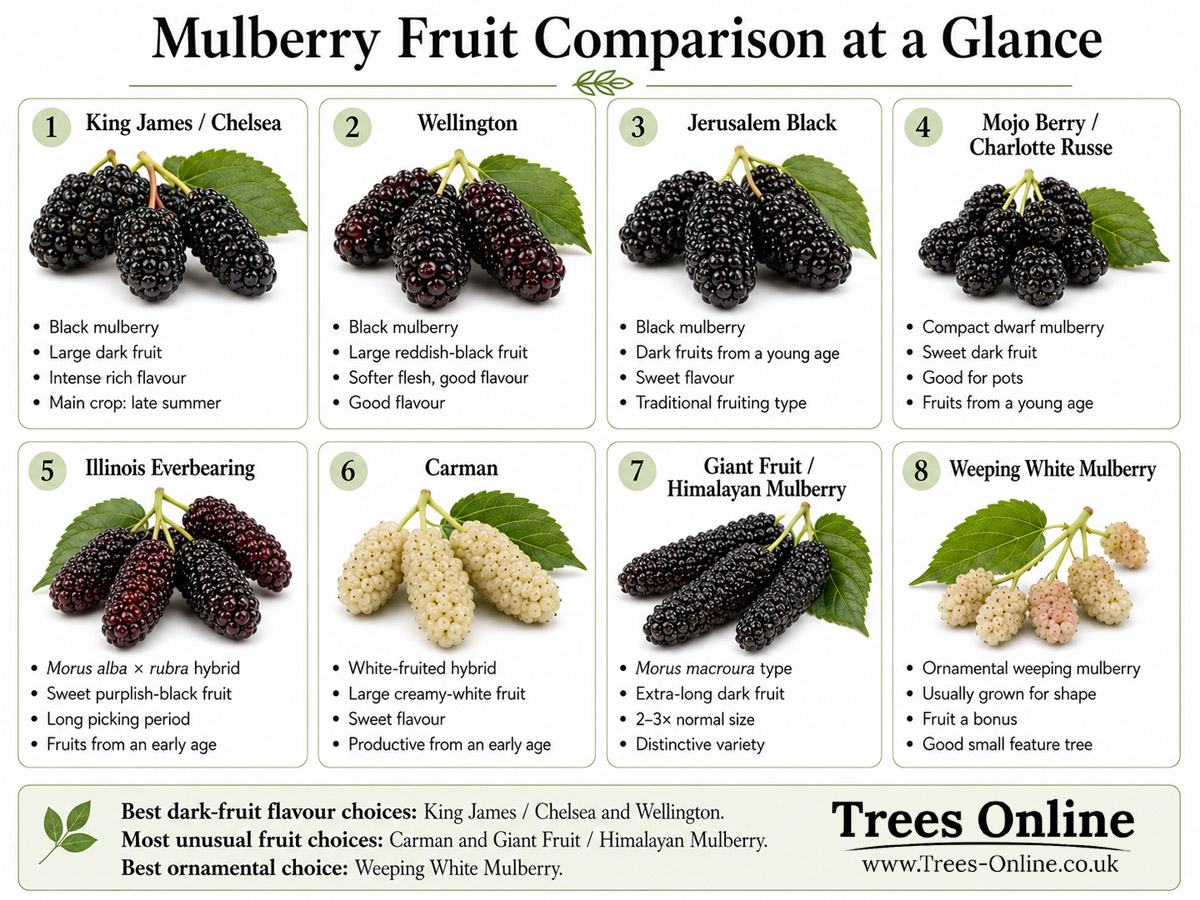
If that is enough information for you, then thanks for reading this far, get your card out and go and buy the King James/Chelsea or the Wellington Mulberry in that order.
Back to top
Black, White or Red Mulberry: Which Should You Buy?
If you want to pigeonhole them, then roughly speaking, black mulberry trees are the main choice for rich fruit flavour - the fruits, that is, so don't go licking the bark or leaves - while white, red and hybrid mulberries are edible too, but often have other standout features.
Outstanding black mulberries include Wellington and Morus nigra 'Chelsea', which is also sold or referred to as King James, King James I, or Chelsea / King James I.
White mulberry usually means Morus alba. It is a separate mulberry species from black mulberry, not just a mulberry with white fruit. White mulberries can produce edible fruit, and named forms such as King's White and White Large are grown for pale or white fruit. The name can be misleading because white mulberry fruit is not always pure white; depending on the tree, it can ripen through pale, pinkish, reddish or darker colours. White mulberry is also strongly associated with silkworms, as the leaves can be used to feed them. Weeping White Mulberry, usually Morus alba Pendula, is slightly different because it is often chosen for its weeping shape as well as any fruit. [3]
Red mulberry usually means Morus rubra, a North American species with sweet red to dark purple fruit. It is worth mentioning for buyers who want a less common edible mulberry, but true red mulberry varieties are not especially common in the UK. Some named mulberries have Morus rubra in their parentage without being pure red mulberries. Illinois Everbearing is a Morus alba × rubra hybrid that stands out for early fruiting and sweet purplish-black fruit over several weeks. Carman is also a Morus alba × Morus rubra hybrid, but it is better described as a white-fruited hybrid because it produces large creamy-white fruit.
Back to top
Mulberry Sizes
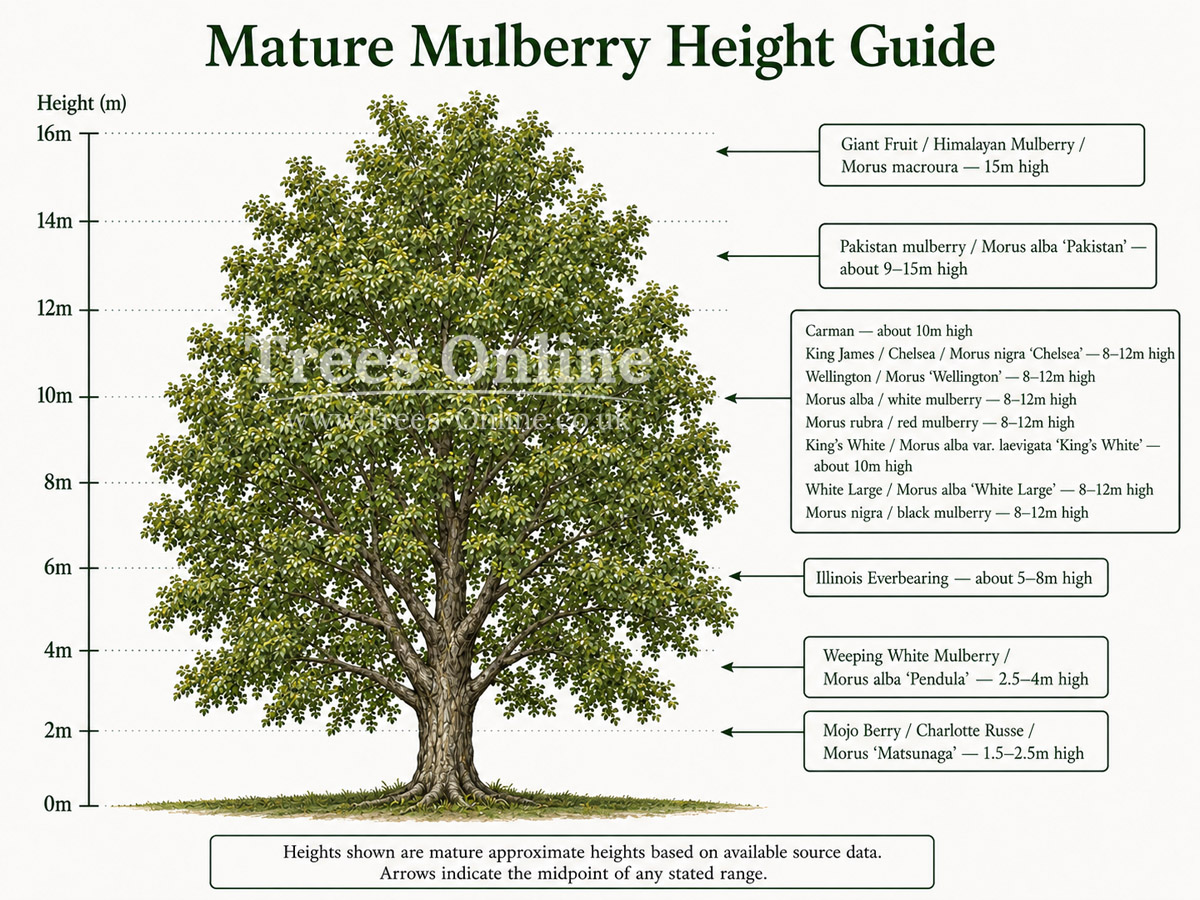
Where possible, we have given accurate and researched sizes. Those with less than 100% confirmed sizes give best guess.
-
Giant Fruit / Himalayan Mulberry / Morus macroura — 15m high
-
Carman — about 10m high
-
Pakistan mulberry / Morus alba ‘Pakistan’ — about 9–15m high
-
Illinois Everbearing — about 5–8m high
-
King James / Chelsea / Morus nigra ‘Chelsea’ — 8–12m high
-
Wellington / Morus ‘Wellington’ — 8–12m high
-
Morus alba / white mulberry — 8–12m high
-
Morus rubra / red mulberry — 8–12m high
-
King’s White / Morus alba var. laevigata ‘King’s White’ — about 10m high
-
White Large / Morus alba ‘White Large’ — about 8–12m high
-
Morus nigra / black mulberry — 8–12m high
-
Weeping White Mulberry / Morus alba ‘Pendula’ — 2.5–4m high
-
Mojo Berry / Charlotte Russe / Morus ‘Matsunaga’ — 1.5–2.5m high
Back to top
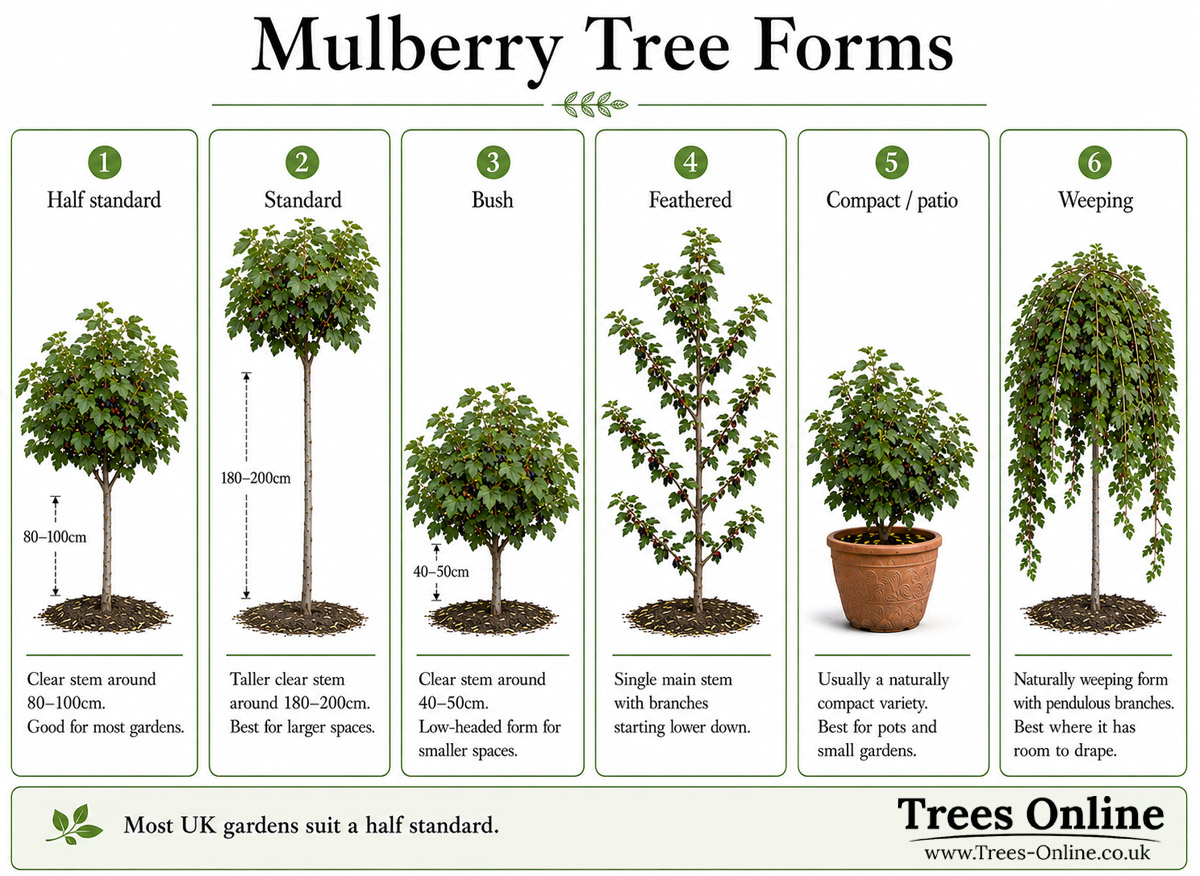
Half standard
A half standard mulberry has a clear stem of around 80-100cm before the branching starts, i.e. a lollipop shape with a short stick. It is a good choice for a lawn, border or feature position because the smaller clear stem doesn't dominate a smaller space.
Standard
A standard mulberry has a taller clear stem of 180-200cm. This is best for buyers who want a proper feature tree with space beneath the crown. It needs more room and is usually a better fit for larger gardens. You would find standards in arboretums, public parks and posh country estates etc.
Bush
Bush is not a common formal selling form for mulberries from many UK tree nurseries. They would be pruned to have less clear stem than a half standard. Bush form lets more light and air into the canopy, usually benefiting the foliage and fruit.
Feathered
A feathered mulberry has branches starting lower down the stem and usually has a single stem from which all branches grow. This can suit buyers who want a less formal fruit tree and do not need a clear stem underneath.
Compact / patio
Compact mulberries are different from normal trained forms. They rely on the variety staying smaller, not just on pruning. Mojo Berry / Charlotte Russe is the compact option worth knowing about if you want a mulberry for a large pot or smaller garden. [8]
Espalier
Espalier mulberries do exist, but they are specialist and uncommon. They suit a sunny wall or strong fence where you want the tree trained flat to save space. The catch is maintenance: they need regular tying-in and pruning, so most buyers are better with a normal tree form or a compact variety.
Summary
Most UK gardens would benefit from a half standard, but if your space is larger, go for a standard.
Back to top
Can You Grow a Mulberry Tree in a Pot or Small Garden?
Technically, most trees can be kept in pots if they are heavily managed, as bonsai proves. That does not make every tree suitable for a potted patio tree. A full-size mulberry in a pot is possible as a managed compromise, but is not the same as buying a proper compact patio tree. For the average enthusiastic green-fingered novice wanting a cute teeny tiny mulberry in a pot, get a variety that is naturally small, such as the Mojo Berry / Charlotte Russe, also marketed as Matsunaga or Morus rotundiloba. [8]
RHS says compact mulberries can be grown in large containers, ideally about 50cm wide and deep. [1] Keep in mind, the larger the container, the fewer the problems, i.e. watering, feeding and blowing over in the wind.
In summary, the smaller the mulberry tree is at maturity, the fewer problems you will have putting it in a pot.
Back to top
Where to Plant a Mulberry Tree
Put the tree somewhere sunny, sheltered and roomy. That matters more than almost anything else.
Mulberries like deep, moisture-retentive but well-drained soil. Avoid waterlogged ground, cold exposed corners, cramped patios and anywhere the crown will become a problem later. [1][2][3][4] USDA material also supports the practical point that open-grown mulberries fruit better than shaded trees. [13]
Also think about what happens when the fruit drops. Ripe mulberries are soft and can stain, so a lawn or open border is usually more forgiving than paving, a driveway or a seating area.
Back to top
Mulberry Tree Pruning: What Buyers Need to Know
Mulberry pruning is light whichever type you buy. That doesn’t mean you cannot prune at night time; it means the opposite of heavy, i.e. small cuts, not hacking large structural branches off to change the shape.
Black, white and red mulberries, compact Mojo Berry / Charlotte Russe and Weeping White Mulberry are all minimal-pruning trees. Remove dead, damaged, diseased and crossing branches. Timing matters because mulberries can bleed sap if pruned at the wrong time. Most are best pruned in late autumn or early winter when sap flow is low and leaf fall has occurred; red mulberry has a slightly wider RHS window of late summer to early winter. For weeping forms, prune to keep the shape clear rather than trying to turn them into ordinary trees. [2][3][4][5]
If a mulberry cut bleeds sap heavily, stop pruning and leave the wound alone. Do not recut it or paint it with sealant because it can trap moisture and increase fungal infection risk. The sap flow usually slows naturally, but the tree should be left to seal the wound itself. Heavy bleeding is a sign the pruning was done at the wrong time, so avoid further cutting until the proper dormant pruning window.
Back to top
How Long Before a Mulberry Tree Fruits?
Mulberries are long-term fruit trees, but not all varieties make you wait the same length of time. The RHS gives black mulberry generally at around eight years to start fruiting, although some varieties can be quicker. Chelsea / King James is one of the clearer traditional black mulberries for fruiting time, with RHS Plants giving around 4–5 years for first fruit and 7–10 years for full production. Mojo Berry / Charlotte Russe, Illinois Everbearing and Carman are all described by leading nurseries as fruiting from an early age, with Illinois Everbearing often suggested at around 3–4 years. [1][6][7][8]
This author has a King James in a large pot, and it took around 5 years to produce anything, but it was well worth the wait compared to the other mulberry purchased. It comes as no surprise that King James/Chelsea Mulberry is very well known for taste and is by far the biggest seller.
Back to top
Early, Main and Extended-Season Mulberry Choices
Mulberries are not as neatly split into early, mid and late seasons as apples or plums, but you can still choose varieties to stretch the picking window. For an earlier option, look at Mojo Berry / Charlotte Russe or Carman. For the main traditional black mulberry crop, choose King James / Chelsea or Wellington. For a longer picking period, Illinois Everbearing is the useful one to know, as it is described as fruiting over several weeks in summer. Treat the timing as guidance rather than a guarantee, because mulberry cropping depends on variety, tree age, site and weather.
Back to top
Mulberry Tree Problems Buyers Should Know About
- Mulberries can be slow to crop compared to other fruit trees you can buy online.
- Full-size trees need room.
- Ripe fruit can stain as the fruits release their juice easily. We can guarantee plum-red fingers after picking only a few of them.
- Birds may take berries.
- Wet weather can encourage mulberry leaf spot. [1][9]
The biggest avoidable mistake is planting one where fallen fruit becomes annoying. Avoid driveways, pale paving, patios, cars and washing lines.
Back to top
Mulberry Fruit Uses
You won’t find fresh mulberries for sale in mainstream shops as they do not travel or store very well at all. If you are prepared to wait a few years, then there are all sorts of unique-tasting treats you can use them for.
- Eating fresh from the tree has to be the best one.
- Use in pies and crumbles.
- Make jam or jelly.
- Make syrup or cordial.
- Use in summer puddings.
- Add to yoghurt, porridge or desserts.
- Freeze for later use.
- Dry them like raisins.
- Use in sauces for desserts or game.
- Make wine or liqueur.
- Use in smoothies.
- Cook into compote.
Back to top
Mulberry Tree Summary
Mulberries are useful as long-lived fruit trees, shade trees and character trees. Black mulberries in particular can live for a very long time, with some sources noting they may fruit for hundreds of years. [10] They also have wildlife value, and white mulberry has the added interest of its historical link with feeding silkworms from its leaves. The main reason to grow one, though, is the fruit: soft, rich, unusual and rarely sold fresh because it bruises so easily and doesn't keep well unless processed.
Back to top
Mulberry Tree FAQs
Do mulberry trees need a pollinator?
No. Mulberries are self-fertile, so one tree is enough. [1]
Can you grow mulberry trees in the UK?
Yes. Most popular choice is King James/Chelsea for flavour but you need to wait for the fruit as they are slow to arrive. Choose a sunny, sheltered position with fertile, moisture-retentive but well-drained soil. [1]
Can you grow a mulberry tree in a pot?
Yes, but choose a compact variety and use a large container. Do not treat a normal black mulberry as a patio/potted tree unless it is sold for that use. [1] If you point-blank refuse to listen to advice, then use the biggest pot you can get your hands on. If one person can easily move it once the tree and dirt are in, it probably is too small.
How big does a mulberry tree grow?
Traditional black mulberries can become broad, spreading trees. RHS gives black mulberry a possible size of up to about 9m tall and wide. [1]
When do mulberry trees fruit?
Established trees usually fruit in August and September. [1]
How long before a mulberry tree fruits?
Black mulberries can take around eight years, although some varieties fruit sooner. [1]
Are mulberry trees messy?
They can be. Ripe fruit is very soft and can stain, so avoid planting over driveways, pale paving or patios. You could always leave an artist blank canvas underneath and sell the splat marks as modern art.
Where can I buy a mulberry tree online?
Back to top