|
UK Plum Trees for Sale: Buying Guide
This plum tree buying guide helps novice gardeners choose the right plum tree to buy online. As plums, damsons and gages are very similar, this buying guide covers all three fruit trees.
Q? Which plum tree should I buy for a beginner?
A) Just tell me the best one to buy, I don't want to read your thesis on stone fruits.
Fair enough, it can be difficult to gage some customers’ attention span, and we don’t want to create any damsons in distress. That would be just plum wrong.
There are others to choose from for many different reasons, these seem easier for the novice gardener to us.
Plum Tree Buyer’s Guide Contents
Plum, Gage and Damson Trees: What’s the Difference?
They are close relatives and are grown in much the same way, but they suit slightly different buyers.
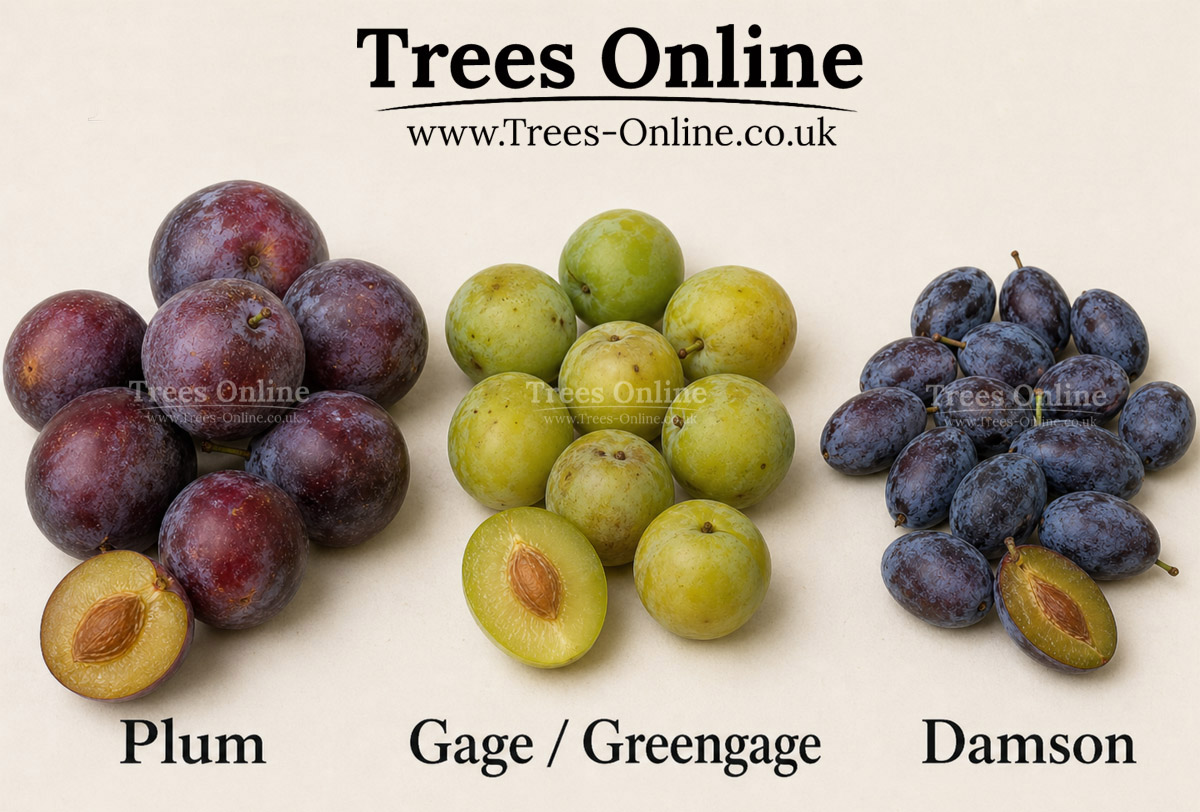
- Plum trees: the main all-round choice. Some are best for eating fresh, some are better for cooking, and some do both.
- Gage and greengage trees: types of plum often grown for sweet dessert fruit, although some are culinary or dual-purpose.
- Damson trees: usually sharper than dessert plums and normally used for cooking, jams and preserves.
In simple buying terms: choose a plum for the easiest all-round fruit tree, a gage if sweet flavour is your priority, and a damson if you want cooking fruit, jam or preserves.
Plums, gages, greengages and damsons are closely related, but fruit shape, colour and usual kitchen use can help you decide which tree to buy.
View larger fruit comparison imageYou can also browse our plum trees for sale, gage and greengage trees for sale, or damson trees for sale.
Back to top
The Next Best Plum, Gage and Damson Trees to Buy
Start with these Trees Online options if you want a quick shortlist rather than comparing every plum, gage and damson variety.
Best Plum Trees for Beginners
Best Gage and Greengage Trees for Sweet Fruit
Best Damson Trees for Cooking, Jam and Preserves
Best Choices for Small Gardens and Pots
- Patio plum trees - best if space is tight or you want a tree for a large container.
- Trained plum trees - cordons and fans can work well where space is narrow.
- Self-fertile varieties - usually the easiest option if you only want one tree.
- Smaller rootstocks - check the rootstock before buying, because it controls the eventual size.
Back to top
Stepping Into The Dark Side of Buying a Plum Tree Online
If you truly want to take charge of your fruit tree buying decision then you need to know a few things.
Do you want a plum, gage or damson?
A plum is the safest all-round choice. A gage is usually bought for sweeter dessert fruit. A damson is usually bought for sharper fruit for cooking, jams and preserves.
Is it self-fertile?
Many plum, gage and damson trees are self-fertile i.e. will produce fruit without the need of another tree nearby, so you can often grow just one tree. Even though a tree is self-fertile, harvest sizes can be improved by adding a pollination partner nearby (explained later). You need to know about pollination and fertility if your tree is not self-fertile, otherwise you might have no plums, damsons or gages.
How big will it get?
The rootstock tells you how big the tree is likely to become. This matters if you are planting in a small garden, near a fence, or in a large pot. See rootstocks below.
Bare root or Potted?
Bare root is available to buy, and plant from November to March called the dormant period, which is after leaf drop and before new foliage appears. They are the same tree as the potted versions but come with no soil around the roots. They are usually cheaper and can come with a few extra options e.g. maiden 1-year-old. This means you can train it to be any shape or form you wish.
Bare root options have a few other considerations which the novice gardener might not be aware of e.g.
- Leaving the roots exposed and drying out.
- Planting too deep and burying the graft union
- Not firming the soil around the roots properly
- Not watering after planting (helps fill voids)
- Letting mulch touch the trunk
These extra points can be a cause of poor performance or failure i.e. arguably bareroot can have a slightly higher failure rate.
Potted or containerised plants are available all year round and can be planted so long as the ground is not waterlogged, frozen or too dry.
Tree form
This is the shape or style it has been grown to e.g. half-standard, bush etc. There can be extreme differences between two different forms so worth while reading up on the differences. See Tree Form below.
Back to top
Plum, Gage and Damson Tree Rootstocks
A plum tree is usually made of two parts.
Rootstock: the roots and lower stem. This controls vigour (how much effort a tree puts into growing and bushing out) and size.
Scion: the plum, gage or damson variety grafted onto the rootstock, i.e the rest of the tree. This gives you the fruit variety.
It would be great if rootstocks had an easy-to-understand name like "small garden suitable" but you know what people who get to name things are like, they like to make things sound a certain way. Below is a height guide for each rootstock.
| Rootstock |
Vigour |
Approximate RHS size guidance |
Best use |
| VVA-1 |
Semi-dwarfing |
About 3m as a bush |
Smaller garden trees where available |
| Pixy |
Semi-dwarfing |
About 3-4m as a bush |
Bush trees, fans and some trained forms |
| St Julien A |
Semi-vigorous |
About 3.6-4.5m as a bush |
Good general garden rootstock for plums, gages and damsons |
| Brompton / Myrobalan B |
Vigorous |
About 6m |
Larger gardens, orchards and places with more room |
For most normal gardens, St Julien A is a useful middle-ground rootstock. It gives you a useful height fruit tree without going straight into full orchard size. For smaller gardens and pots, go with VVA-1 or Pixy. You can grow St Julien A in pots but you will need a larger pot. The bigger the pot, the fewer problems you are likely to have, such as blowing over, drying out if you forget to water, and roots spiralling around the pot.
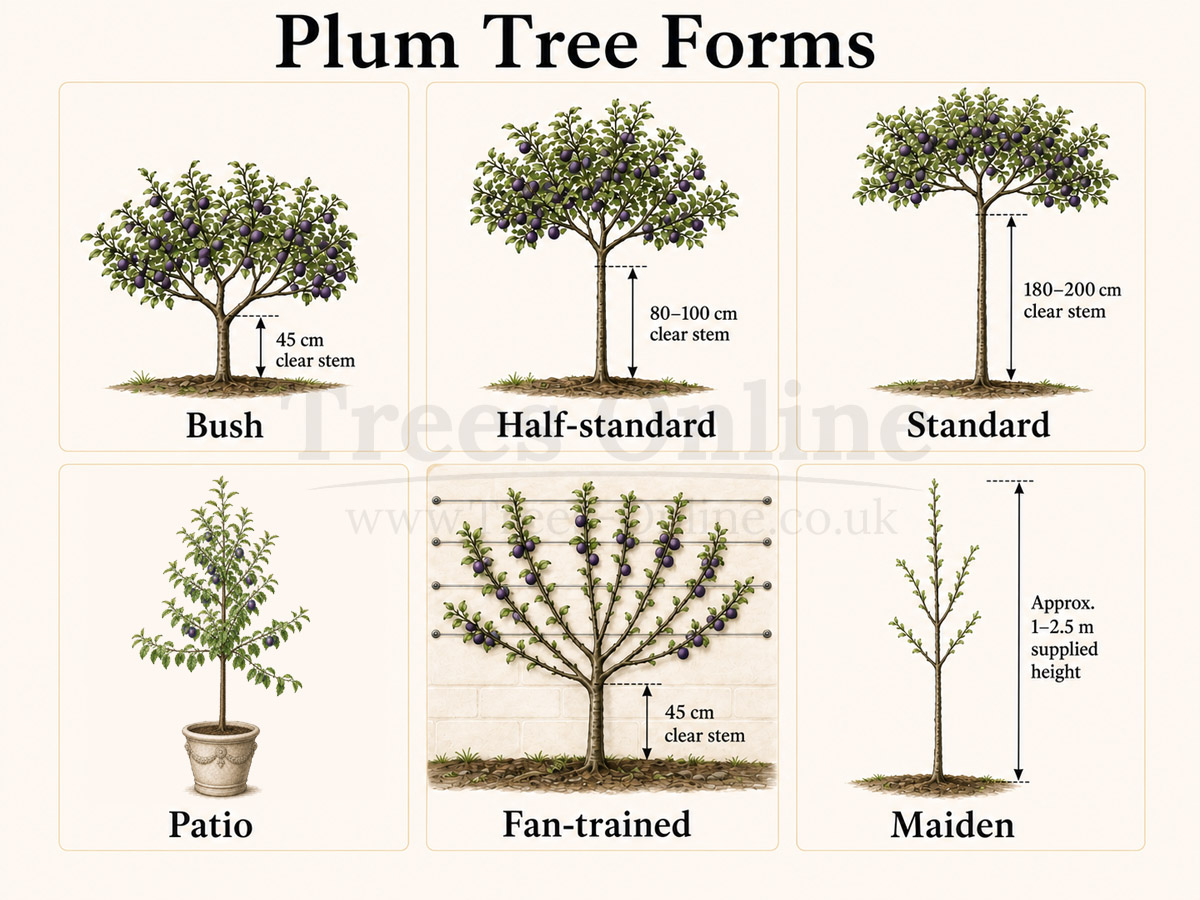
Tree form means the shape you are buying. It affects how the tree looks, how much space it needs, and how easy it is to pick and prune.
Bush: short clear stem of around 45 cm before branches start. Usually the easiest form for picking, pruning and general care of the tree. More growing real estate compared to a half standard, and it lets more air and light into the canopy which is better for fruiting and tree health. Good for beginners, but not as ornamental as a half standard.
Half standard: taller clear stem of around 80-100cm. Useful if you want space under the crown to mow or plant something else nearby. The downside is that picking and pruning can be slightly less convenient than with a bush form, but it looks more ornamental.
Standard: Clear trunk around 180-200cm and larger crown. Better for large gardens or orchard-style planting. The advantage is a proper tree shape with more presence and large fruit harvests; the downside is that it needs more space and is harder to pick and prune compared to smaller forms.
Patio: compact tree for a pot or small garden, usually on a smaller rootstock. The advantage is that it suits limited space and can be easier to protect from frost by moving to a warmer location, e.g. higher ground, south-facing wall, unheated conservatory/greenhouse. Move back as soon as frost risk has passed otherwise pollination could be reduced. The downside is that it needs more regular watering and feeding than a tree planted in the ground.
Fan-trained: branches trained flat against a wall or support in the shape of a fan. Useful where you want to use a warm wall e.g. south-facing and give blossom a little more protection from cold winds and frost. Sun-loving fruit trees do well in this form. The advantage is better use of warmth, shelter and space; the downside is that it needs training, pruning, suitable support and is more expensive to buy and ship. If you have the patience, buy a maiden and prune it yourself into a fan shape. We suggest investing a few hours on YouTube to learn how.
Maiden: a one to two-year-old tree that has had no pruning. It is this form that every other form comes from e.g. bush, half standard, fan etc. Where you cut determines it's future shape. The advantage is flexibility and low cost; the downside is that it needs more skill, patience and time before it looks like a finished tree, usually 1-2 seasons.
If you are new to fruit trees, choose a bush or half-standard. If you enjoy pruning, training and something a bit different, then cordons and fans become more interesting.
Back to top
Other Useful Things to Know Before Buying a Plum Tree
Once you have picked the type of fruit tree, there are a few practical details that decide whether the tree is a good buy for your garden.
Pollination
Many plum, gage and damson trees are self-fertile and are listed as such in the product description, so one tree will technically bear fruit. That being said, self-fertile trees can crop better with another suitable variety nearby. [2] Trees listed as semi-self-fertile will definitely crop better. For those that are not self-fertile, you will need a pollination partner, explained below.
Pollination Partner
You need a pollination partner if your fruit tree is NOT self-fertile.
Your plum, gage or damson tree will have some sort of letter and/or number displayed called a flowering group, e.g. C1, C2, C3, C4 and C5. Each one represents a period of time when the flowers will open. For pollination to happen and the fruit growing process to begin, a bee or other flying buzzy thing needs to have visited a different variety of plum, gage or damson before visiting yours and transfer pollen. To clarify, plums, gages and damsons will cross-pollinate each other as they are very similar.
For maximum pollination, your flowers need to be open for as long as the other pollinating tree flowers are open, and this is achieved by buying a second tree with the same letter/number combination e.g. a C3 and a C3. The variety needs to be different, e.g. two Avalon (C3) plum trees will not cross-pollinate each other.
You can also buy your second plum, gage or damson tree from a group one below or one above, as the flowering times will overlap. It will not be for as long as the same numbered group but enough to give a decent harvest.
As you can see, self-fertile in the best way to go if you only have room for one tree. If one is listed as partially self-fertile, it means you won't get a full crop of fruit unless you plant a pollination partner nearby.
Pollination Summary
An appropriate pollination partner is one that is in the same flowering group or one above or one below the first tree you buy.
Two non-self-fertile plum, gage or damson need to be in the same flowering group for best results. Next best results are the second tree being one flowering group above or below.
Two self-fertile trees will improve fruit yields so long as they are appropriate pollination partners.
Warmth and Shelter
For the best crops, plant plums, gages and damsons in a warm, sunny, sheltered spot although some growers say good results can come from partial shade also. The warmest and sunniest sheltered spot is usually a south-facing or south-west-facing position, ideally near a wall or fence that catches the sun and gives protection from cold wind. Avoid frost pockets and exposed windy sites Gages are especially worth giving your best warm position because they are usually grown for high-quality dessert fruit. [2]
Harvest Timing
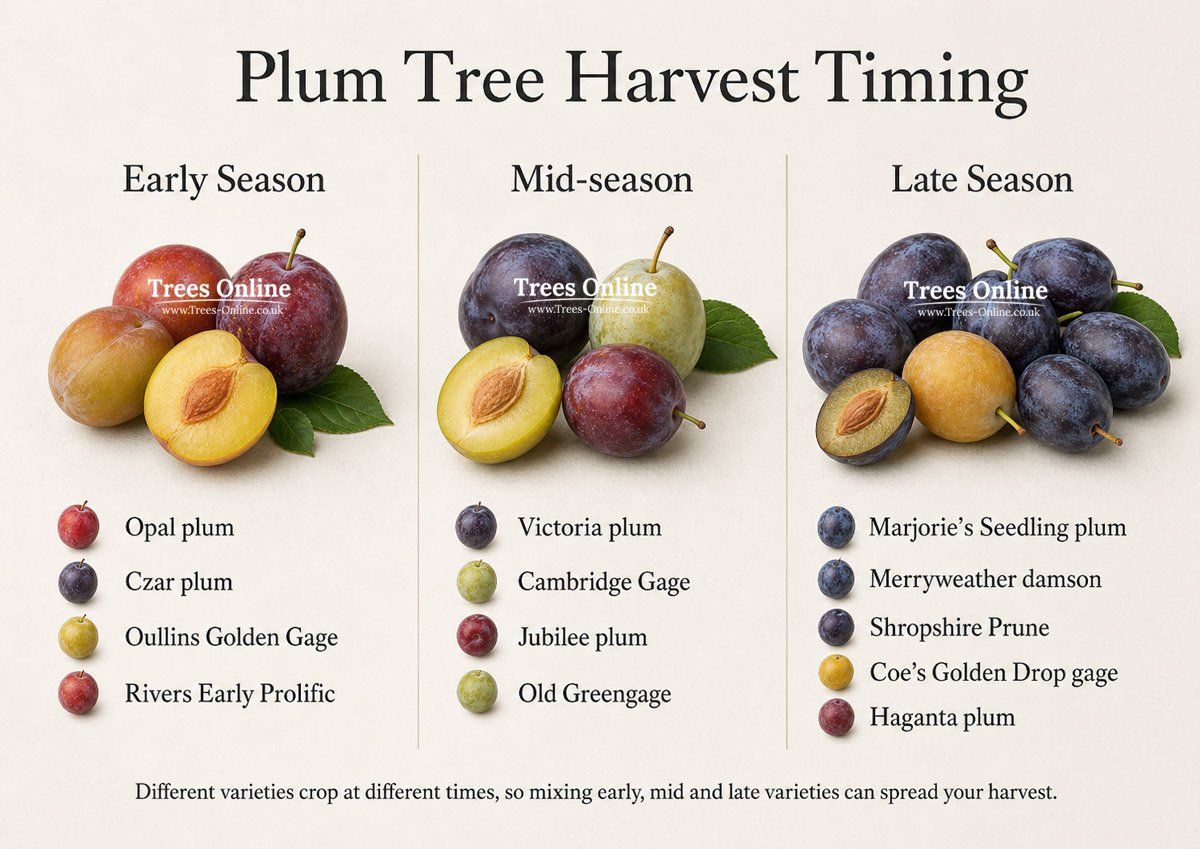
Different varieties crop at different times, and flowering group is not a reliable indicator of when to expect fruit. AN entire crop from two trees in one go is a lot of fruit so spacing out harvest times is helpful. Also, choosing fruit with a long storage time reduces rushed cooking, freezing and dehydrating sessions to prevent waste. We have highlighted those noted for having longer storage times in red.
RHS AGM stands for Royal Horticultural Society Award of Garden Merit, basically an all-round good performer compared to others in the group. Below is a list of plums, gages and damsons listed by harvest times of "early season", "mid-season" and "late in the season".
Early Season
Opal plum (C3), self-fertile, RHS AGM, reliable early dessert plum with orange-red / reddish-purple fruit.
Czar plum (C3), self-fertile, RHS AGM, reliable early blue plum, good for cooking and dual-purpose use.
Oullins Golden Gage (C4), self-fertile, RHS AGM, earlier gage option with greenish-yellow fruit.
Blue Tit plum (C2), self-fertile, RHS AGM, compact, reliable tree, useful mid-August plum.
Yellow Pershore / Pershore plum (C2), self-fertile, RHS AGM, canary-yellow culinary plum, compact tree.
Rivers Early Prolific plum (C2), early, heavy-cropping plum, good early-season option.
Herman plum (C2), self-fertile, early plum, useful eating plum.
Avalon plum (C2), partly self-fertile, large eating plum, better with a pollination partner.
Methley plum (C1), very early flowering group, useful only if matched carefully.
Edda plum (C2), early C2 plum option.
Mid-season
Victoria plum (C3), self-fertile, RHS AGM, very popular dual-purpose plum, reliable regular crops.
Cambridge Gage (C3), partly self-fertile, excellent sweet gage, reliable for a gage but needs warmth.
Denniston’s Superb / Imperial Gage (C2), self-fertile, RHS AGM, reliable greenish-yellow gage, good late-August option.
Jubilee plum (C3), self-fertile, Victoria-style eating plum with good quality fruit.
Belle de Louvain plum (C3), self-fertile, very large red culinary plum, compact tree.
Old Green Gage (C3), classic sweet greengage, flavour is the selling point.
Guinevere plum (C3), dessert plum, useful C3 pollination-group option.
Excalibur plum (C3), large-fruited plum, good where fruit size is the selling point.
Reeves plum (C3), C3 plum option.
Valor plum (C3), mid-to-late type often sold for larger blue fruit.
Late in The Season
Marjorie’s Seedling plum (C3), self-fertile, RHS AGM, heavy-cropping late blue plum, good for eating and cooking.
Farleigh damson (C3), self-fertile, compact damson, blue-black fruit.
Shropshire Prune / Prune Damson (C3), self-fertile, RHS AGM for Prune Damson, good for cooking, jam and preserves.
Merryweather damson (C3), self-fertile, RHS AGM, large, popular damson, good for jam and cooking.
Giant Prune (C3), prune-type fruit, useful if you want a later cooking/preserving type.
Warwickshire Drooper plum (C2), later yellow plum, useful dessert/cooking type.
Coe’s Golden Drop gage (C2), late gage valued for flavour.
Reine Claude de Bavay gage (C2), late gage/greengage type, flavour-led choice.
Haganta plum (C3), partly self-fertile, large plum, keeps well.
Verity plum (C3), later C3 plum option.
Back to top
Patio Plum Trees for Small Gardens and Pots
Patio plum, damson and gage trees are useful if you want fruit but do not have room for a full garden tree. The right rootstock will keep the tree smaller i.e. making it more suitable to grow in a pot or on a patio, but they need more attention. [7]
For a small garden or pot, look for:
- patio plum trees in pots or dwarf plum trees
- dwarf or semi-dwarfing rootstocks e.g. VVA-1, Pixy and St Julien A
- self-fertile varieties if you only want one tree
Container-grown plum trees need regular watering in dry spells and should not be allowed to dry out completely. They may also need feeding because nutrients wash out of pots more quickly than from garden soil. [1] [7]
Below are common symptoms associated with pot-grown plum trees and what they usually mean.
Wilting leaves and dry compost — water deeply until water drains from the bottom.
Water running straight through the pot — soak the pot slowly in stages; very dry compost can repel water at first.
Yellow leaves and soggy compost — reduce watering and check the drainage holes are clear.
Poor new growth — feed in spring and check whether the tree is rootbound.
Roots coming from drainage holes — move into a larger container or refresh the compost.
Tree blowing over — use a heavier pot, move it out of strong wind or stake it securely.
Few flowers — move to a sunnier sheltered position and avoid over-pruning.
Flowers but no fruit — check pollination, frost damage and whether bees were active during flowering.
Lots of small fruits — thin the fruit if the crop is overcrowded.
Fruit dropping early — water consistently and reduce stress on the tree.
Sticky leaves — check for aphids and treat early before they spread.
For most beginners with limited space, the easiest route is a small,garden plum tree that is potted, self-fertile, in the largest container you can handle, placed in the sunniest sheltered spot you have. The smaller the pot, the more maintenance and risk.
Back to top
Plum, Gage and Damson Tree Buying FAQs
Plum Tree FAQs
Do plum trees grow well in the UK?
Yes. Plums, gages and damsons can grow well in the UK, especially in a warm, sunny, sheltered position. A sheltered site helps blossom set and reduces the risk of weather spoiling the crop. [1] [2]
Plums, gages and damsons usually do best in warmer, sunnier and more sheltered parts of the UK. South-facing or west-facing gardens, walled gardens and sheltered urban plots often give the most reliable crops. Colder northern, upland, windy or frost-prone gardens can still grow plums, but site choice becomes more important. Use the warmest sheltered spot you have, avoid frost pockets, and consider a fan-trained tree against a sunny wall if your garden is particularly cold e.g. bottom of a valley, north side of a hill.
What is the best month to plant a plum tree?
For bare root plum trees, plant during the dormant season, usually November to March. Potted plum trees can usually be planted for much of the year if the ground is not frozen, waterlogged or extremely dry. [1]
Autumn to early spring is the easiest time. The tree is under less stress, the soil is usually moist, and you will not have to water as heavily as you would in warm dry weather.
Do I need two plum trees to produce fruit?
Not always. Many plum, gage and damson trees are self-fertile, so one tree can often grow fruit on its own. Some varieties still need a compatible pollination partner, and cross-pollination can improve cropping. [2]
Each tree sold online will be listed as sef-fertile or not self-fertile.
Can you prune a plum tree in October in the UK?
It is better not to. Plums, gages and damsons are normally pruned in spring or summer, not autumn or winter, because pruning in colder wetter months can increase disease risk. [1] [6]
Why is my plum tree not fruiting?
No blossom, the tree may be too young, too shaded, over-pruned, overfed with nitrogen, or pruned at the wrong time.
Fix: give it time, improve light where possible, avoid high-nitrogen feeding (a common novice gardener mistake, if some is good more must be better), and prune correctly in spring or summer.
Blossom appears but no fruit forms, late frost may have damaged the flowers, pollination may have failed, or bees/insects may not have been active during flowering which can happen if the weather is cold. Minimum temperature for pollinators to come out is 8 degrees centigrade.
Fix: improve shelter, avoid frost pockets, protect small trees during frost warnings, and plant a compatible pollination partner if needed.
Lots of blossom but very little fruit, poor pollination, cold wet windy weather during flowering, or lack of a suitable pollination partner.
Fix: check whether the variety is self-fertile if not, add a compatible pollination partner, and encourage pollinators with nearby flowering plants.
Small fruits form then drop which can be caused by drought stress, irregular watering, poor pollination, natural fruit drop in June/July, or the tree carrying more fruit than it can support.
Fix: water consistently in dry spells, mulch properly, and thin heavy crops if needed. A heavily fruited branch may snap, better to have less amazing fruit than none!
Plenty of leaves but no fruit, too much nitrogen feed, not enough sun, or the tree putting energy into growth rather than cropping.
Fix: stop high-nitrogen feeding, improve sunlight if possible e.g. pruning back a larger tree, and use a balanced fruit-tree feed only where needed.
Fruit starts but stays small, overcrowded crop, lack of water while fruit is swelling, poor soil, or the tree is still establishing.
Fix: thin overcrowded fruit, water during dry spells, mulch, and give young trees time to establish.
Tree fruits one year but not the next. The causes can be heavy cropping the previous year which takes a lot out of the tree, stress, frost damage, pruning mistakes, or poor weather during flowering.
Fix: thin very heavy crops, keep watering steady, prune correctly, and accept that some years are worse because of weather.
Fruit is damaged or maggoty, plum moth, wasps, birds, or other pest damage.
Fix: use plum moth traps where appropriate, remove damaged fruit, pick promptly, and use netting if birds are a problem. Over-watering can cause the fruits to split, and that attracts the wasps etc. Remove fallen or damaged plums so they do not attract more wasps. Wasps are usually less active early in the morning and late in the evening, so those are often better times to pick ripe plums and remove fallen and split ones.
Tree looks weak and does not crop well. Cause can be drought, waterlogging, poor soil, root damage, disease, or planting too deep.
Fix: check drainage, watering, mulch level, planting depth and soil condition; correct what you can and avoid burying the graft union.
What should you not plant next to plum trees?
It is not so much what not to plant next to, it is more a case of don't plant near to.
Keep plum trees away from large trees, dense hedges and vigorous shrubs where they would compete for light, water and nutrients. As a rough guide, give a garden plum tree several metres of clear space, with about 4–5m for a normal St Julien A tree and more for vigorous or standard trees.
How far from a house should you plant a plum tree?
That depends on the rootstock and final tree size. You need to allow enough space for a mature tree to grow to full width which is roughly the same or slightly less than the height. You can prune the tree back to prevent branches rubbing against the house.
Fruit trees are not usually the main trees people worry about for house foundation issues. The risk is on shrinkable clay soils, where trees can remove moisture from the ground and contribute to soil movement. Older buildings with shallow foundations can show the effects of this more readily.
How tall is a 2 year old plum tree?
It depends on the rootstock, form and how the tree has been grown. The more useful question is the expected mature size, because that tells you whether the tree suits your garden.
Most plum trees as a half-standard or bush on a St Julien A rootstock will be around 150-200cm tall minus the pot.
Gage and Greengage Tree FAQs
What is a gage tree?
A gage tree is a type of plum tree. Gages and greengages are often grown for sweet dessert fruit, although some are culinary or dual-purpose. [2]
What is the difference between a plum and a gage?
Gages are types of plum. In buyer terms, plums are the broad all-round group, while gages and greengages are often chosen for sweeter dessert fruit.
Do greengages grow in the UK?
Yes. Greengages can be grown in the UK, but they are worth giving a warm, sunny, sheltered position for the best crops and best fruit quality. [2]
What are greengages used for?
Greengages are often grown as dessert fruit for eating fresh, but some gage varieties can also be used for cooking or dual-purpose use.
Do greengages taste like plums?
Yes, because greengages are types of plum. They are usually bought for their sweet, rich dessert flavour rather than as a basic cooking plum.
Can I grow a greengage tree from a stone?
You can grow a seedling from a stone, but it will not reliably produce the same variety. If you want known fruit quality, predictable size and not some Frankendamson, buy a grafted tree on a known rootstock. [5]
When should you prune a gage tree in the UK?
Prune gage trees in spring or summer rather than winter. They are stone fruits, like plums and damsons, and should not be treated like apple or pear trees for pruning. [1] [6]
Damson Tree FAQs
Can you eat damsons from a tree?
Yes, ripe damsons are edible, but they are usually sharper (taste, not ability to cut anything!) than dessert plums and are normally used for cooking, jams and preserves. [4]
Do you need two damson trees?
Not always. Many damsons are self-fertile, but check the variety before buying. A compatible tree nearby can still improve cropping in some cases.(see above for pollination partners) [2]
In short, if your damson is self-fertile then no, it will produce fruit by itself. If it is not, it will need a pollination partner. Even if your tree is self-fertile, an appropriate pollination partner will improve fruit yields (see above)
Can you keep a damson tree small?
Yes, but start with the right rootstock and form e.g. VVA1/Pixy rootstock. Choose a smaller rootstock, prune at the right time, and avoid buying a vigorous tree if you only have limited space.
Where is the best place to plant a damson tree?
Where someone else will do the digging and looking after it for you. The worst place to plant it is in someone else's garden, they are sure to notice.
For best cropping, plant damsons in a sunny, sheltered position with fertile, well-drained soil. Some growers say damsons can still fruit in partial shade, but sun and shelter are still the safer choice.
Can you prune damson trees in October?
It is better not to. Damsons are stone fruits, so they are best pruned in spring or summer, not autumn or winter. RHS advises avoiding damson pruning during the dormant season or in mid- to late autumn to reduce the risk of silver leaf disease and bacterial canker.
The main issue is that silver leaf spores are released mainly in autumn and winter, especially in damp conditions, and pruning cuts give disease an entry point. Even when pruning in spring or summer, it is best to choose a dry spell, not wet weather. [4] [6]
Why is my damson tree not producing fruit?
Likely causes include young tree age, frost-damaged blossom, poor pollination, too much shade, dry soil, incorrect pruning or pest and disease issues.
Are damson trees native to the UK?
Damsons are an old cultivated form of plum, generally associated with Prunus insititia / Prunus domestica subsp. insititia. RHS gives the plant range as central and southern Europe and North Africa, while Kew lists Prunus insititia as native to parts of central Europe and introduced to Great Britain and Ireland.
Are damson trees good for wildlife?
Yes, damson blossom can support pollinating insects and the fruit may be used by wildlife. If you also want fruit for yourself, netting or picking promptly may be needed.
Back to top
Plum Tree Summary
For most UK gardens, check three things before buying: whether the tree is self-fertile, what rootstock it is on, and whether you have a warm, sunny, sheltered place to plant it. That solves the biggest issues.
Please feel free to contact us if you have any plum, gage or damson tree questions.
Back to top
Sources
- Royal Horticultural Society, How to grow plums. Used for plum growing advice, planting, pruning, care, harvesting and problem guidance. https://www.rhs.org.uk/fruit/plums/grow-your-own
- Royal Horticultural Society, Plums, gages and damsons: choosing cultivars. Used for plum, gage and damson differences, pollination guidance, fruit type and warm sheltered site advice. https://www.rhs.org.uk/fruit/plums/choosing-cultivars
- Royal Horticultural Society, Rootstocks for fruit. Used for plum, gage and damson rootstock guidance including Pixy, St Julien A and vigorous rootstocks. https://www.rhs.org.uk/fruit/fruit-trees/rootstocks
- Royal Horticultural Society, How to grow damsons. Used for damson growing, pruning and care guidance. https://www.rhs.org.uk/fruit/damsons/grow-your-own
- Royal Horticultural Society, How to grow gages. Used for gage growing, pruning, care and seed/grafting guidance. https://www.rhs.org.uk/fruit/gages/grow-your-own
- Royal Horticultural Society, How to prune plum trees safely. Used for pruning timing and disease-risk guidance. https://www.rhs.org.uk/fruit/plums/pruning
- Royal Horticultural Society, Fruit in containers. Used for container-growing guidance for fruit trees including plums. https://www.rhs.org.uk/fruit/fruit-trees/containers
- Royal Horticultural Society, Silver leaf. Used for silver leaf disease timing, damp-condition risk and pruning-wound infection guidance. https://www.rhs.org.uk/disease/silver-leaf
- Royal Horticultural Society, Fruit pollination. Used for fruit-tree pollination and pollination-partner guidance. https://www.rhs.org.uk/advice/beginners-guide/fruit-basics/fruit-pollination
- Royal Horticultural Society, Positioning fruit. Used for advice on light, temperature, shelter and exposure when siting fruit trees. https://www.rhs.org.uk/advice/beginners-guide/fruit-basics/positioning-fruit
- Royal Horticultural Society, Plum moth. Used for plum moth damage guidance affecting plums, damsons and gages. https://www.rhs.org.uk/biodiversity/plum-moth
- Royal Horticultural Society, Plum aphids. Used for aphid issues affecting plum trees. https://www.rhs.org.uk/biodiversity/plum-aphids
|
|