Fig Trees for Sale UK: Buying Guide
Fig trees are a good choice if you want something a bit different from the usual apple, pear, plum or cherry tree, but still want fruit you can realistically grow in a UK garden.
This guide explains the basics and fundamentals of buying a fig tree for a UK garden or pot.
Fig Tree Buying Guide Contents
I Just Want to Buy a Good Fig Tree — What Should I Choose?
If you want the easy answer, buy a reliable fig tree such as a Brown Turkey Fig Tree, grow it in the sunniest sheltered spot you have, and keep the roots restricted in a pot or suitable planting area. If that is enough for you, thanks for putting in all that effort to read this far and good luck with your fig tree purchase from Trees Online.
For most novice buyers, a potted fig tree is the least confusing route. It keeps the tree easier to manage, suits patios and small gardens, and avoids the common mistake of planting a vigorous fig straight into unrestricted open ground.
Back to top
Best Fig Trees for UK Gardens
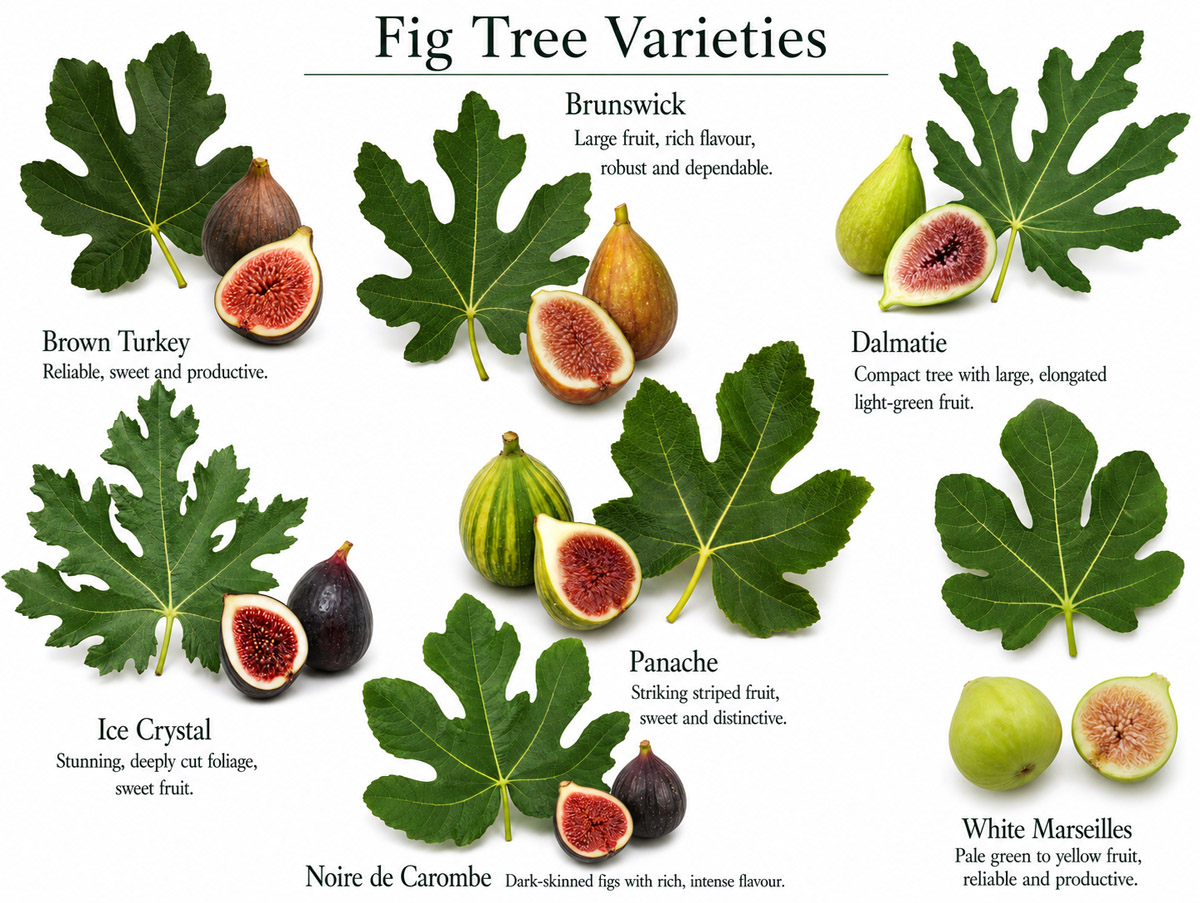
Trees-Online currently lists several fig varieties, including Brown Turkey, Brunswick, Dalmatie, Figues De Marseille / White Marseilles, Ice Crystal, Noire De Carombe and Panache. Our first choice for most buyers is Brown Turkey. Brunswick is a good alternative, especially where you want another reliable outdoor fig option.
Back to top
Fig Tree Varieties UK: Quick Comparison
| Fig variety |
Best for |
Buyer note |
| Brown Turkey |
First-time fig buyers |
The obvious reliable choice for many UK gardens. Good place to start if you only want one fig tree. |
| Brunswick |
Another outdoor fig option |
Worth considering if you want an alternative to Brown Turkey. |
| Dalmatie |
Smaller gardens and containers |
RHS describes Dalmatie as a compact fig to around 2.5m tall and suitable for small gardens and containers. [7] |
| Figues De Marseille / White Marseilles |
Pale-fruited fig |
RHS describes White Marseilles as hardy and reliable, with large, sweet, pale green fruit. [4] |
| Ice Crystal |
Ornamental leaf interest |
Useful if the look of the plant matters as well as the fruit. |
| Noire De Carombe |
Dark-skinned fruit |
A good option if you want something different from the usual Brown Turkey route. |
| Panache |
Unusual striped fruit |
A striking choice if fruit appearance matters to you. Best treated as an interesting alternative, not the default first fig tree. |
Back to top
Which Form of Fig Tree Should I Get?
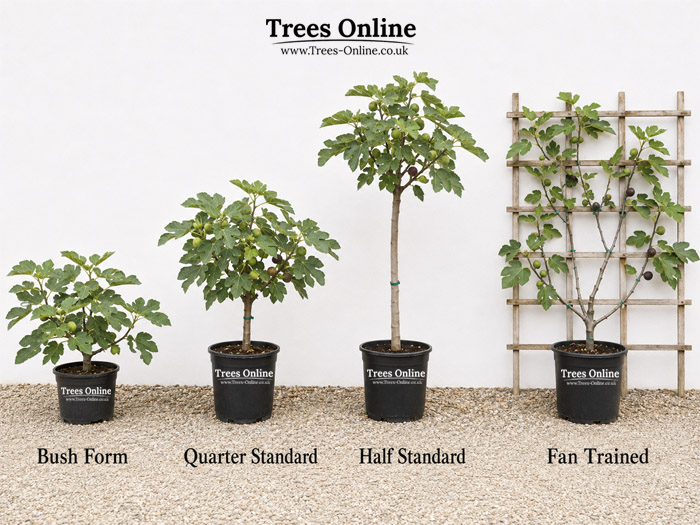
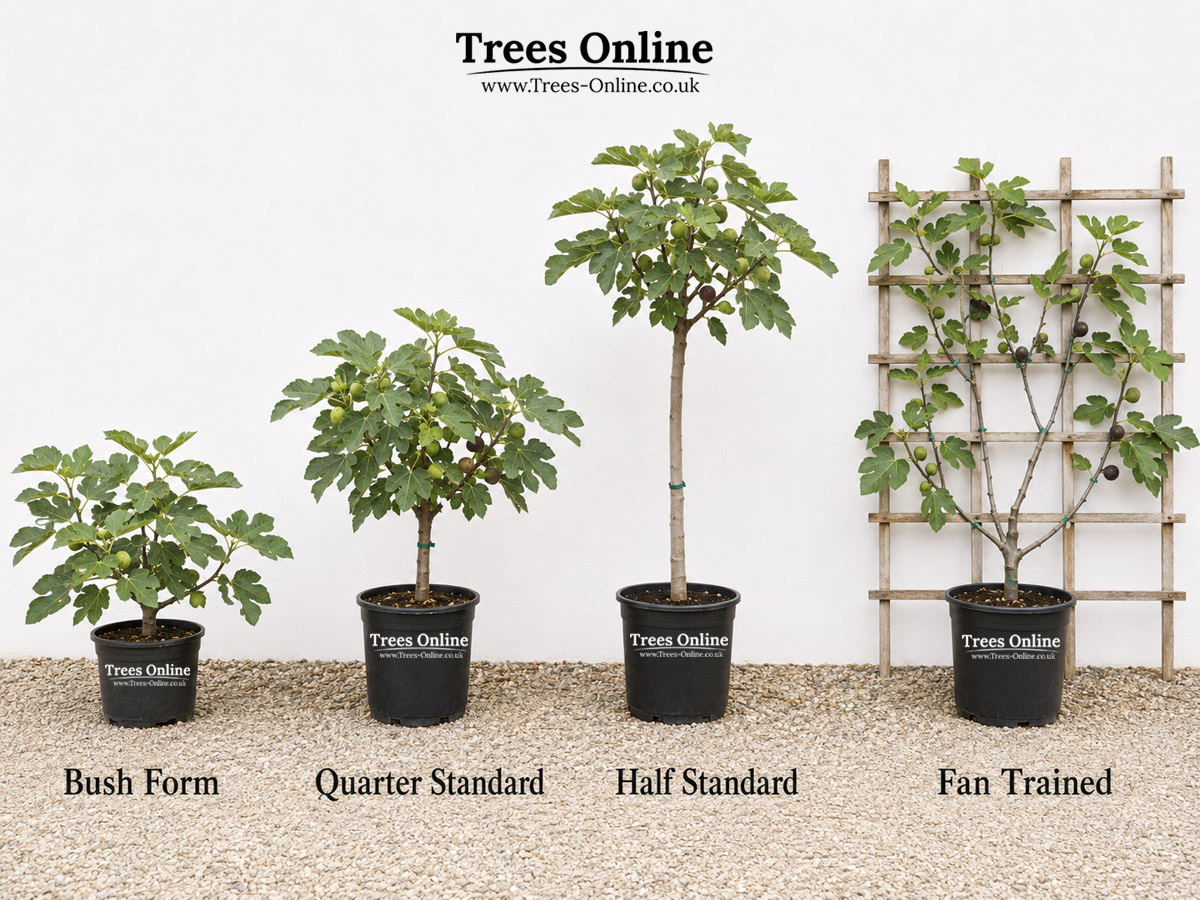
Fig tree forms guide showing the main shapes buyers may see when choosing a fig tree, including bush, quarter standard and half-standard forms.
View larger fig tree forms image
With UK figs, your options are usually bush, quarter standard or half-standard (see below for fan). These are usually sold by pot size or height until they get to over around 240cm, and then the half-standards go by girth size. The bush or multi-stem option is still sold by height.
Girth is the circumference of the trunk measured around 100cm above ground level and is presented in ranges e.g. 6-8cm girth. Larger girth sizes usually indicate an older, more established tree.
Bush/Multi-stem: A short clear stem before the branches start growing. Arguably more growing real estate and easier to let light and air into the canopy, which helps light and air move through the canopy.
Half-Standard: A more ornamental shape that is easier to plant and mow underneath. Around 80-100cm of clear stem and looks lollipop shaped.
Quarter Standard: Less clear stem than a half standard e.g. 40-50cm i.e. branches start lower down the trunk.
Fan trained: Although some retailers sell them, the cost of sending them is more than the plant and so are usually offered as local delivery only or collection. Some may sell them as very young plants so they fit in a standard box but not many.
Back to top
Brown Turkey Fig Tree: RHS AGM (Royal Horticultural Society Award of Garden Merit)
Among edible cropping figs, Brown Turkey is one of the safest RHS Award of Garden Merit choices for most novice UK buyers. Ice Crystal is also associated with RHS AGM status, but it is usually valued more for its unusual ornamental foliage than as the main reliable cropping fig for a novice buyer.
RHS says the Award of Garden Merit is for plants that are reliable and perform well in gardens. To qualify, a plant must be:
- excellent for ordinary garden use
- available to gardeners
- of good constitution
- not need specialist growing conditions or specialist care
- not be especially prone to pests or disease
- stable in form and colour
Receiving the award in 1993, growers have had plenty of time to try and develop a superior variant but as yet, we are still waiting.
Back to top
Do Fig Trees Need Pollination?
No. For normal garden buying purposes, you do not need a second fig tree for pollination.
RHS explains that cultivated figs produce seedless fruit without fertilisation, so no pollination is needed. [4]
Back to top
Potted Fig Trees, Patio Fig Trees and Container Growing
Fig trees are especially useful for pots and patios. In fact, growing a fig in a pot is often one of the best choices, not a second-best compromise. Why? Because fig foliage can grow strongly if their roots are left to run freely. A pot helps keep the roots contained, which helps control the tree and can encourage fruiting rather than just leafy growth.
A potted fig tree is a good choice if:
- you have a patio rather than a large garden
- you want to keep the tree smaller
- you want to move the tree
- you want fruit without planting a full-sized tree in open ground
The trade-off is watering. Pots dry out faster than open ground, especially in warm weather. RHS says newly planted figs and those with restricted roots are especially vulnerable to drying out, and container figs should not be left standing in trays of water. [4]
Back to top
Why Root Restriction Matters for Fig Trees
Root restriction sounds technical. It is not. It simply means stopping the fig tree’s roots from spreading too freely.
That matters because figs can become vigorous leafy plants if the roots are not managed. RHS says limiting fig roots reduces vigorous leafy growth and helps the plant focus on fruit production. [4]
For most buyers, the easy root-restriction options are:
- Grow the fig tree in a large pot — simplest for patios and small gardens.
- Use a root-control bag — useful if planting in the ground.
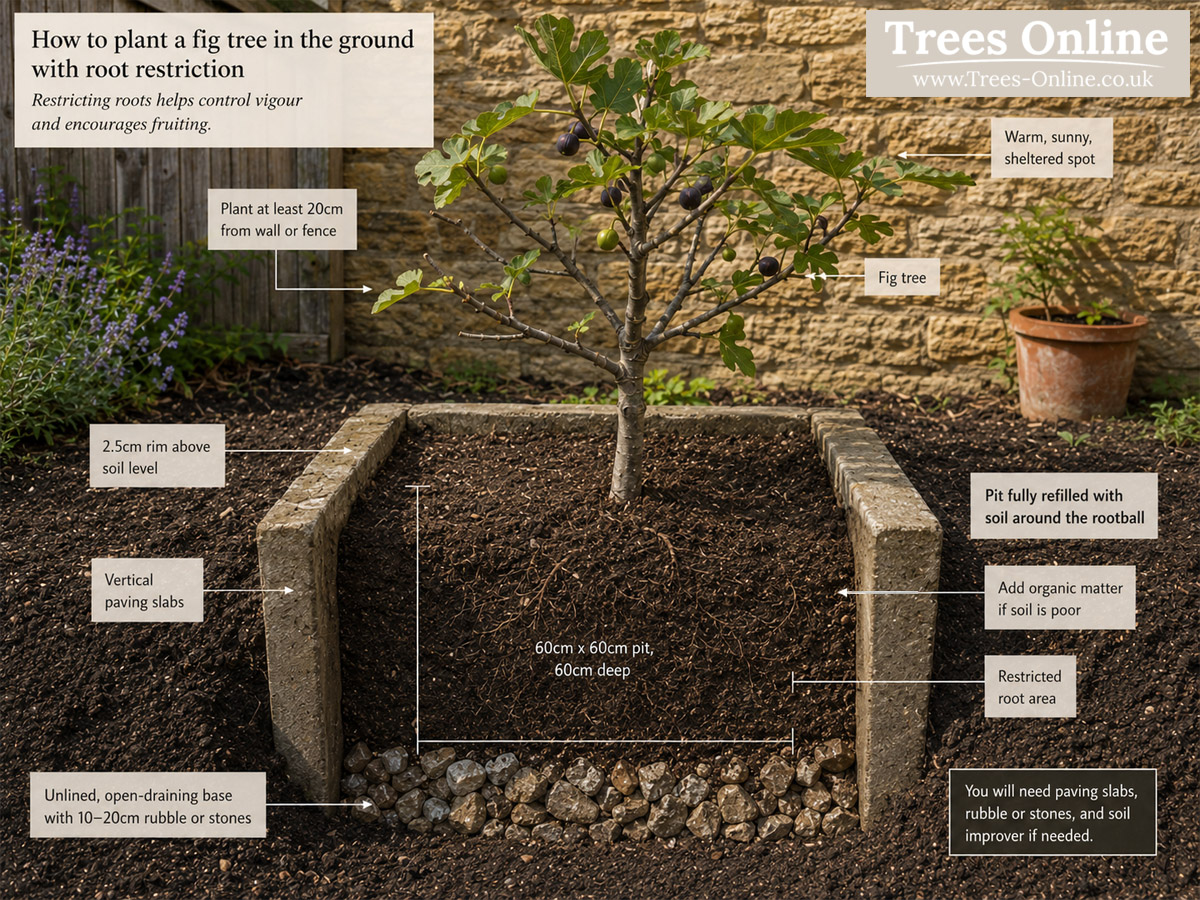
- Plant in a lined pit — more work, but useful where a permanent in-ground fig is wanted. Dig a hole and make a "topless box" from paving slabs and plant inside that.
- Use a naturally restricted space — for example, near hard landscaping, provided the site is suitable.
For a beginner, a large pot is normally the easiest to understand and manage. It keeps the tree under control, suits small spaces, and helps avoid the classic fig mistake: planting it in open ground, giving it everything it wants, then wondering why it produces loads of leaves and not much fruit.
Back to top
Where to Plant a Fig Tree in the UK
Fig trees need the warmest, sunniest, most sheltered position you can give them. That is the first thing to check before buying one.
The ideal spot is usually against a sunny wall or fence, especially one that holds warmth. RHS recommends a warm, sunny, sheltered spot and says a south- or south-west-facing wall or fence is a good position for figs planted in the ground. [4] If you have a sunny conservatory or greenhouse, they do particularly well.
A fig tree is a poor choice if the only available spot is cold, shaded, exposed or wet. It may still grow leaves there, but fruiting is likely to be disappointing. In other words, you might end up owning a leafy green sulk.
Fig trees are not especially fussy about soil, but they do need good drainage. They can grow in chalk, loam or sandy soil and prefer soil that is moist but not wet, ideally neutral to alkaline. Avoid cold, waterlogged ground. If your soil is heavy and stays wet in winter, grow your fig tree in a large pot or a raised, well-drained position instead.
Back to top
How Big Do Fig Trees Grow?
A fig tree can stay manageable, but it is not naturally tiny. If planted in open ground with unrestricted roots, a fig can become a large shrub or small spreading tree.
RHS describes Ficus carica as a large deciduous shrub or small spreading tree to around 3m tall and 4m wide. [6]
That does not mean every fig tree in every garden will reach that size. Variety, pruning, container size, root restriction and growing conditions all make a difference. But it does mean you should not plant a fig in unrestricted open ground and assume it will behave like a neat patio plant.
If space is limited, the easiest ways to keep a fig tree smaller are:
- grow it in a large pot
- restrict the roots
- train it as a fan against a sunny wall
- prune it to control size and shape
RHS describes Dalmatie as a compact fig to around 2.5m tall and suitable for small gardens and containers. [7] That makes it worth considering if you want a fig tree but do not have space for a larger, more vigorous plant.
Back to top
Fig Tree Pruning: What Buyers Need to Know
Fig trees can grow strongly, so pruning matters if you want to keep the tree manageable. The aim is not to chop it hard every year. It is to control size, keep the shape open, and stop the tree becoming too large and leafy for the space.
RHS advises pruning figs twice a year: once in early to mid-spring after the last hard frost, and again in early to mid-summer. Spring pruning is for removing dead, damaged, crossing or badly placed branches. Summer pruning is lighter and helps control new growth. [5]
Be careful with the sap. Fig sap can irritate skin, so wear gloves and long sleeves when pruning. Start lower down and work upwards so sap is less likely to drip onto your skin. [5]
Do not keep cutting back new growth after mid-summer. RHS says the tiny fruit embryos that can produce the following year’s crop start forming at the shoot tips around then, so late pruning can remove next year’s useful crop before it has had a chance to develop. [5]
There is also a difference between tiny fruit embryos and larger unripened figs. The small pea-sized fruitlets that survive winter can swell and ripen the following year. Larger figs that are still unripe by autumn are unlikely to become useful fruit and should be removed.
Hard pruning can also trigger strong new leafy growth. That may be useful if you are renovating an overgrown fig, but it is not what most buyers want. For a normal garden fig, light, regular pruning is usually better than ignoring it for years and then cutting it back hard.
Back to top
When Do Fig Trees Fruit in the UK?
Fig trees can produce fruit in the UK, but outdoor crops depend heavily on warmth, variety, site and the season.
The main outdoor crop in the UK usually comes from pea-sized fruitlets that formed at the shoot tips in late summer of the previous year, survived winter, and then swelled and ripened the following summer. RHS says figs generally produce two crops a year, but in the UK’s cooler climate only one usually ripens outdoors. Figs grown under glass all year round may successfully ripen both crops. [4]
A fig is usually ready to pick when it softens and starts to hang down. RHS says ripe figs may split slightly when gently squeezed or produce a droplet of sugary liquid from the eye at the base. [4]
Back to top
Fig Tree Buying FAQs
Are fig trees self-fertile?
For normal UK garden buying purposes, yes. Cultivated figs do not need a pollination partner, so one tree is usually enough.
Do I need two fig trees?
No. You do not need two fig trees for pollination. This makes figs simpler to buy than many apple, pear, plum and cherry trees.
Can fig trees grow outside in the UK?
Yes, but they need the right position. A warm, sunny, sheltered spot gives the best chance of good outdoor fruit.
What is the best fig tree for the UK?
Brown Turkey is usually the safest beginner choice because it is widely grown and reliable in suitable UK garden conditions.
Can fig trees grow in pots?
Yes. Fig trees are very well suited to pots, patios and containers. A pot also helps restrict the roots, which can keep excessive leaf growth down and promote more fruiting.
Are fig trees good for patios?
Slabs and stone are probably best to make patios out of but if you mean to grow on a patio then yes, if the patio is sunny and sheltered. A warm patio can be one of the best places for a potted fig tree.
How big do fig trees grow?
Fig trees are not naturally tiny. In open ground with unrestricted roots, a typical fig may reach around 3m tall and 4m wide, while vigorous varieties such as Brown Turkey can be listed at around 2.5–4m tall over time. More compact varieties such as Dalmatie are closer to 1.5–2.5m. If space is limited, grow figs in a large pot, restrict the roots, prune regularly or train them as a fan against a wall, where they can be kept to about 1.8m tall and 3.5m wide.
Where should I plant a fig tree?
Choose the warmest, sunniest, most sheltered position available. A sunny wall or fence is ideal where possible.
When should I plant a fig tree?
Spring is usually the easiest time. Potted fig trees can be planted for much of the year if the ground is not frozen, waterlogged or extremely dry.
When do figs ripen in the UK?
Outdoor figs usually ripen in late summer or early autumn, depending on variety, site and weather. Warm sheltered positions give the best chance of ripe fruit.
Why is my fig tree not fruiting?
Common reasons include lack of sun, too much unrestricted root growth, cold exposure, poor ripening weather or drought in pots.
Should I restrict fig tree roots?
Usually, yes. Root restriction is one of the most useful ways to keep fig trees manageable and encourage fruiting rather than excessive leafy growth.
Is Brown Turkey the best fig tree for beginners?
For many UK buyers, Brown Turkey is the best starting point. It is well known, widely grown and a sensible first fig tree for a sunny sheltered garden or patio.
Back to top
Sources
- RHS — Ficus carica Brown Turkey: https://www.rhs.org.uk/plants/56327/ficus-carica-brown-turkey-%28f%29/details
- RHS — Ficus carica Panachée: https://www.rhs.org.uk/plants/57837/ficus-carica-panach-e-%28f%29/details
- RHS — Ficus carica White Marseilles: https://www.rhs.org.uk/plants/49419/ficus-carica-white-marseilles-%28f%29/details
- RHS — How to grow figs: https://www.rhs.org.uk/fruit/figs/grow-your-own
- RHS — Figs: pruning and training: https://www.rhs.org.uk/fruit/figs/fig-pruning-and-training
- RHS — Ficus carica: https://www.rhs.org.uk/plants/7199/ficus-carica-%28f%29/details
- RHS — Ficus carica Dalmatie: https://www.rhs.org.uk/plants/227521/ficus-carica-dalmatie-%28f%29/details