Pear Trees for Sale UK: Buying Guide
This pear tree buyer’s guide helps novice gardeners choose the right pear tree to buy online.
Pear Tree Buyer’s Guide Contents
How to Choose a Pear Tree the Easy Way
If you know nothing about them and just want to buy a pear tree online, choose a potted, self-fertile variety such as Conference, Concorde or Invincible. Quince A rootstock will give you a larger tree in the 3.4-5m height range, and Quince C will grow to around 2.5-3m. [1] [4] If that is all you need from us to make your pear tree purchase, thanks for visiting, good luck, have a good one or a reasonable two and adios amigo. If not, keep reading.
The second easiest option is to look at our slightly more in-depth suggestions below. You need to know that self-fertile means it will grow pears without needing another tree nearby to pollinate i.e. a pollination partner. If it is non self -fertile then you need another pear tree of a different variety nearby to be a pollination partner.
Most Popular Pear Trees to Buy
If you want the quick route, choose from the top five lists below. They give you the strongest options by pear type without turning the page into a fruit catalogue.
Top Pear Trees for Beginners
- Conference - self-fertile, sweet, juicy, reliable and one of the easiest pear trees to choose for a UK garden.
- Concorde - self-fertile, compact, sweet, juicy and useful where space is limited.
- Invincible / Delwinor - self-fertile, disease resistant, heavy cropping and suitable for northern UK gardens.
- Family Pear Tree - three varieties on one tree that pollinate each other, useful where space is tight.
Top Pear Trees for Flavour
- Doyenné du Comice - popular dessert pear with rich flavour and juicy flesh.
- Beurré Hardy - juicy, tasty, large-fruited pear with heavy cropping potential.
- Williams Bon Chrétien - classic sweet, juicy pear, useful for eating and cooking.
- Beth - sweet, juicy, early and especially useful if you want dessert pears sooner in the season.
- Concorde - sweet, juicy, compact and a good all-round garden pear.
Top Pear Trees for Small Gardens and Pots
- Concorde - compact, self-fertile and suitable for smaller gardens.
- Conference - self-fertile, reliable and suitable for many garden situations.
- Beth - small, sweet, juicy and useful for a smaller pear selection.
- Family Pear Tree - multiple varieties on one tree, useful where you do not have room for several trees.
- cordon pear trees - good for narrow spaces, walls, fences and productive rows.
Top Pear Trees for Different Uses
- Williams Bon Chrétien - sweet, juicy and useful for eating or cooking.
- Invincible / Delwinor - cooking and eating pear with strong cropping and northern UK suitability.
- Sensation - red-skinned pear with juicy fruit and attractive red foliage.
- Onward - rich, juicy pear with good harvest potential and frost resistance noted on the product listing.
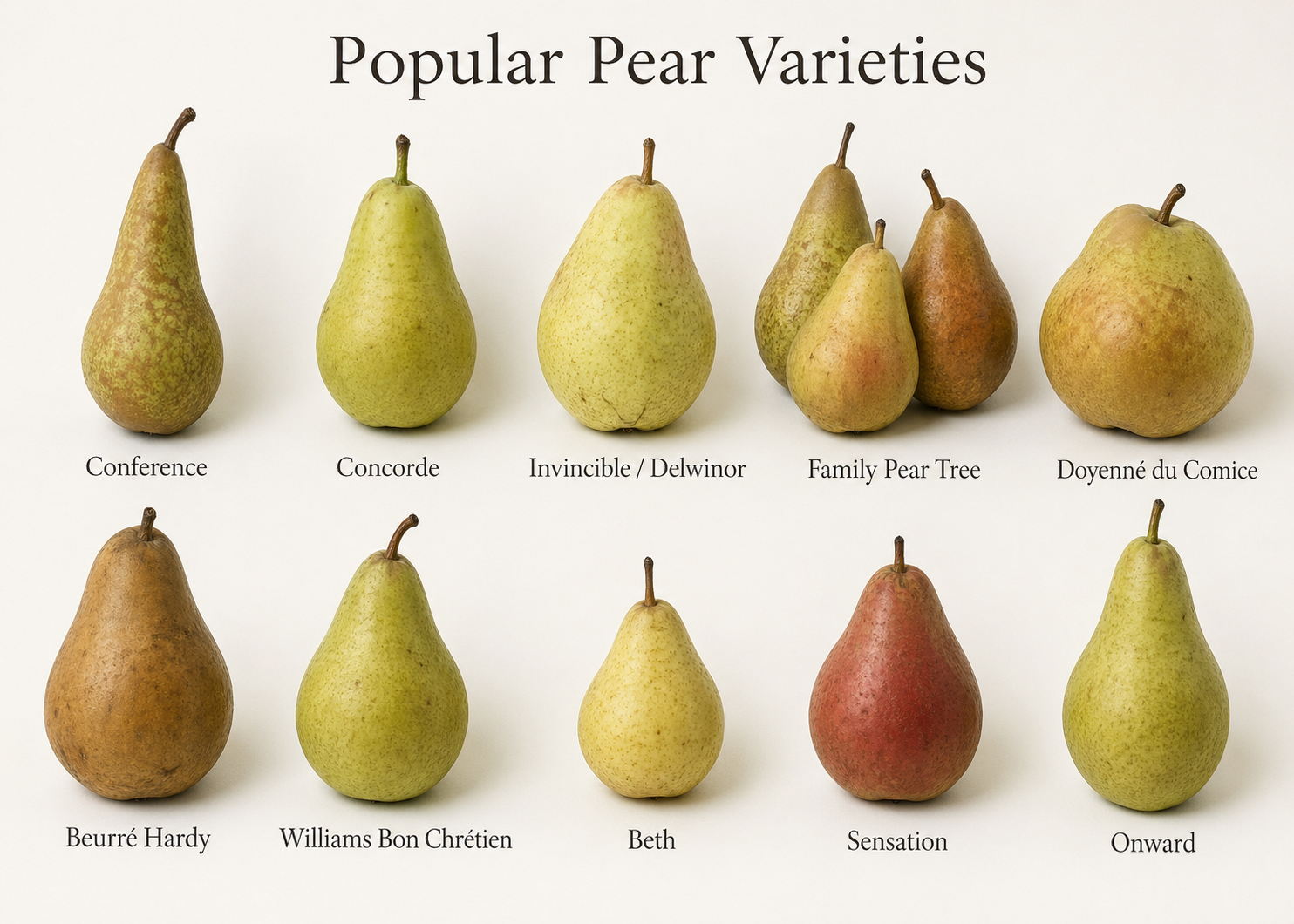
Popular pear varieties for UK gardens.
Back to top
Stepping Into The Dark Side of Buying a Pear Tree Online
Pears are usually a little less forgiving than apples. They flower earlier, prefer more warmth and shelter, and late spring frost can damage blossom. If your garden is cold, exposed or shaded, choose the warmest, sunniest, most sheltered spot you have. [1] [2]
If you really want to take charge of what pear tree you are buying then learn the different options to ensure you get the best pear tree for you. Below are the options explained and things you need to know before making a very informed decision.
Pear Pollination: When pollen from one pear tree flower is transferred to another compatible pear tree flower so the tree can start producing pears.
Bare-root Pear Trees vs Potted Pear Trees: Bare-root pear trees are usually cheaper and are planted during the dormant season, normally from autumn to spring. Potted pear trees can usually be planted for much of the year, if the ground is not frozen, waterlogged or extremely dry, and suit beginners better. [1]
Pear Types:
- Dessert pears are for fresh eating.
- Cooking pears are firmer pears used for cooking, poaching, bottling and preserves.
- Dual-purpose pears can be used for eating and cooking.
- Ornamental pears are grown mainly for blossom, shape and autumn colour rather than edible fruit. If a pear tree is listed in the ornamental tree section, then do not buy it for the fruits.
Pollination:
Self-fertile: Self-fertile pear trees can produce fruit without another pear tree nearby but a compatible pear tree close by will improve fruit yield. Read the non-self-fertile section below to choose the right pear tree. This is the easiest of all the pear tree options to choose. [3]
Non-self-fertile: These pear trees require pollen from another pear tree that is a different variety [2] [3]. The flowers of both trees need to open at the same time so bees and other pollinating buzzies can transfer pollen between them. [2] [3]
Pear blossom times are usually grouped by flowering or pollination group e.g. C1, C2, C3, C4 and C5. Each represents a period of time when the flowers are open e.g. if you have two different pear trees in your garden and both are C3 then they will open their flowers at roughly the same time. This is the optimal way of choosing pear trees i.e. both opening at the same time, however a pear tree in the group above or below can also work. To summarise, if your pear tree is non-self-fertile and is a C3, you need to buy another C3 or a C2 or C4.
Triploid: Some pear cultivars are triploid, which means they need pollination to start making pears but are poor pollinators for other trees. Think of them as selfish lovers, they will take all they can and give nothing of value in return.
Let the complicated explanation begin. If you REALLY want a triploid pear, then buy a self-fertile pear tree as well, to pollinate it. If your triploid pear is in pollination group C3, then ideally you want a self-fertile pear also in group C3. Failing that, a C2 or C4 will work.
If the pear tree you buy to pollinate your Triploid is NOT self-fertile then the triploid will not pollinate your second tree and you get no pears on the second tree. If you don't want that, then you need a third pear tree, again, ideally in the same pollination group but one above or below will work. [3]
Back to top
Pear Tree Rootstocks
A pear tree is made up of two parts.
Rootstock: the roots and lower stem. This controls the tree’s vigour, mature size and how strongly it grows.
Scion: the pear variety grafted onto the rootstock. This produces the branches, leaves, blossom and fruit.
Rootstock is one of the most important things to understand before you buy a pear tree. It largely determines how big the tree will get and how manageable it is in your garden. Final size is still affected by soil, site and pruning, so heights are a guide rather than a fixed promise. [4]
| Rootstock |
Vigour |
RHS size guidance |
Best use |
| Quince C |
Dwarfing |
2.5-3m as a bush |
Cordon, bush, central leader, smaller gardens and compact trees |
| Quince A |
Semi-vigorous |
3-4.5m as a bush |
Bush, cordon, fan, espalier, half standard and general garden use |
For most UK gardeners, Quince A is the useful middle ground. It gives you a manageable pear tree with good cropping potential. Quince C is better where space is tighter or where you want a smaller tree. [4]
Tree Form
This describes the shape and form of the tree. The average pear tree is sold as a bush or half-standard.
Bush: short clear stem with a low head of branches. Usually the easiest form for picking, pruning and general use.
Half standard: taller clear stem with the branch head higher up. Gives more space underneath but can make picking slightly harder.
Standard: full-height clear stem and larger crown. Best for larger gardens and orchards.
Patio: compact pear tree for pots and small gardens, usually on a dwarfing rootstock.
Cordon: single main stem trained upright or at an angle. Ideal for narrow spaces or growing along fences and walls.
Espalier: horizontal tiers trained flat against a wall or support. Decorative and space-saving, but needs pruning.
Fan-trained: branches spread in a fan shape against a wall. Useful for warm, sheltered positions.
Maiden: young one-year tree with little or no branching, used for training your own shape.
For tight spaces, cordons are usually the most practical trained form. For walls and fences, espaliers and fans can make good use of warm, sheltered space. As a general guide, plant trained pear trees about 30cm from the wall or fence. If planting more than one, RHS gives spacing of at least 3.6m apart for espaliers and fans, and around 75cm apart for cordons. [1]
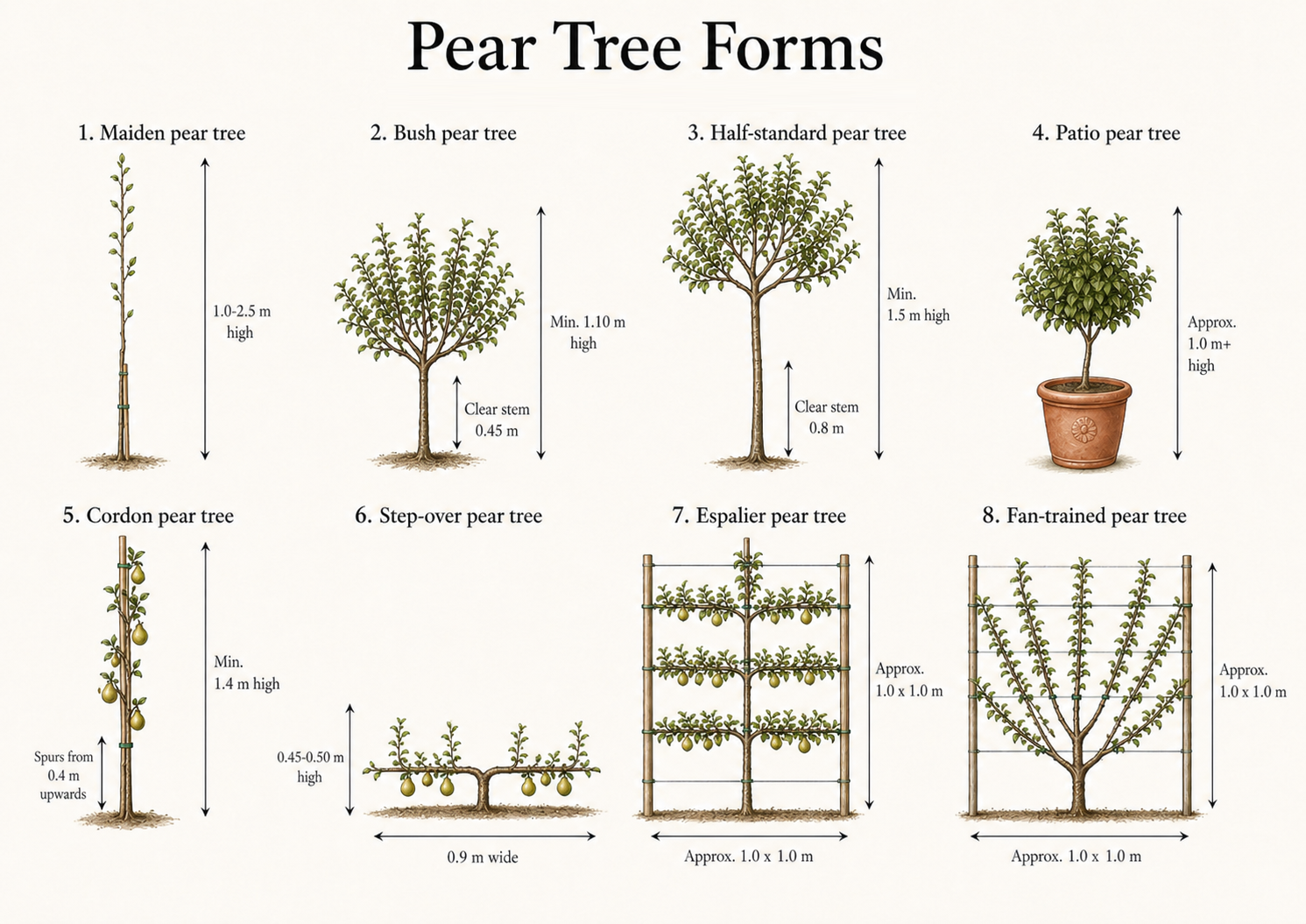
Common pear tree forms, including bush, half standard, cordon, espalier and patio pear trees.
Back to top
Other Useful Things to Know Before Buying a Pear Tree
Once you understand the fundamentals, there are a few extra details that can make a difference.
Harvest Time and Storage
Pears behave differently to apples. Many pears are picked before they are fully ripe and then allowed to ripen indoors. If you leave some varieties on the tree until they feel soft, they can turn mushy rather than improving. [1] [2]
If you want pears over a longer period, choose varieties with different picking times rather than one tree producing everything at once.
Do Not Choose Only by Supermarket Pears
Do not choose a pear tree purely because you recognise the name from a supermarket. Supermarket pears are often selected for storage, transport and shelf life, not just garden performance or flavour. RHS notes that imported supermarket cultivars from warmer countries can have a different flavour when grown in Britain, even if they grow well. [2]
Pollination Matters More Than You Think
Pears are less forgiving than apples when it comes to pollination. Even self-fertile pear trees can crop better with another compatible pear tree nearby. [3]
If you have space, planting two different pear varieties that flower at a similar time is usually the safer option.
Warmth and Position
Pear trees generally benefit from a warmer, sunnier and more sheltered position than apples. In cooler or more exposed parts of the UK, a south-facing or west-facing wall or a protected garden spot can make a noticeable difference to cropping. [2]
Disease and Problems
Pear trees can suffer from issues such as pear scab, rust and pests like pear leaf blister mite. Choosing a healthy, well-grown tree and planting it in the right position reduces the risk.
Good airflow, sunlight and avoiding waterlogged soil are simple steps that help prevent problems.
Family Pear Trees
A family pear tree has more than one pear variety grafted onto the same tree. This can be useful in a small garden because you get multiple varieties and improved pollination from a single tree.
The downside is that different varieties may grow at different speeds, so pruning is needed to keep the tree balanced.
Back to top
Patio Pear Trees for Small Gardens and Pots
A patio pear tree is usually grown on a dwarfing rootstock e.g. Quince C and kept compact enough for a large pot, patio or small garden. Compact varieties and trees grafted on dwarfing rootstocks can be grown in large containers. [1] [5]
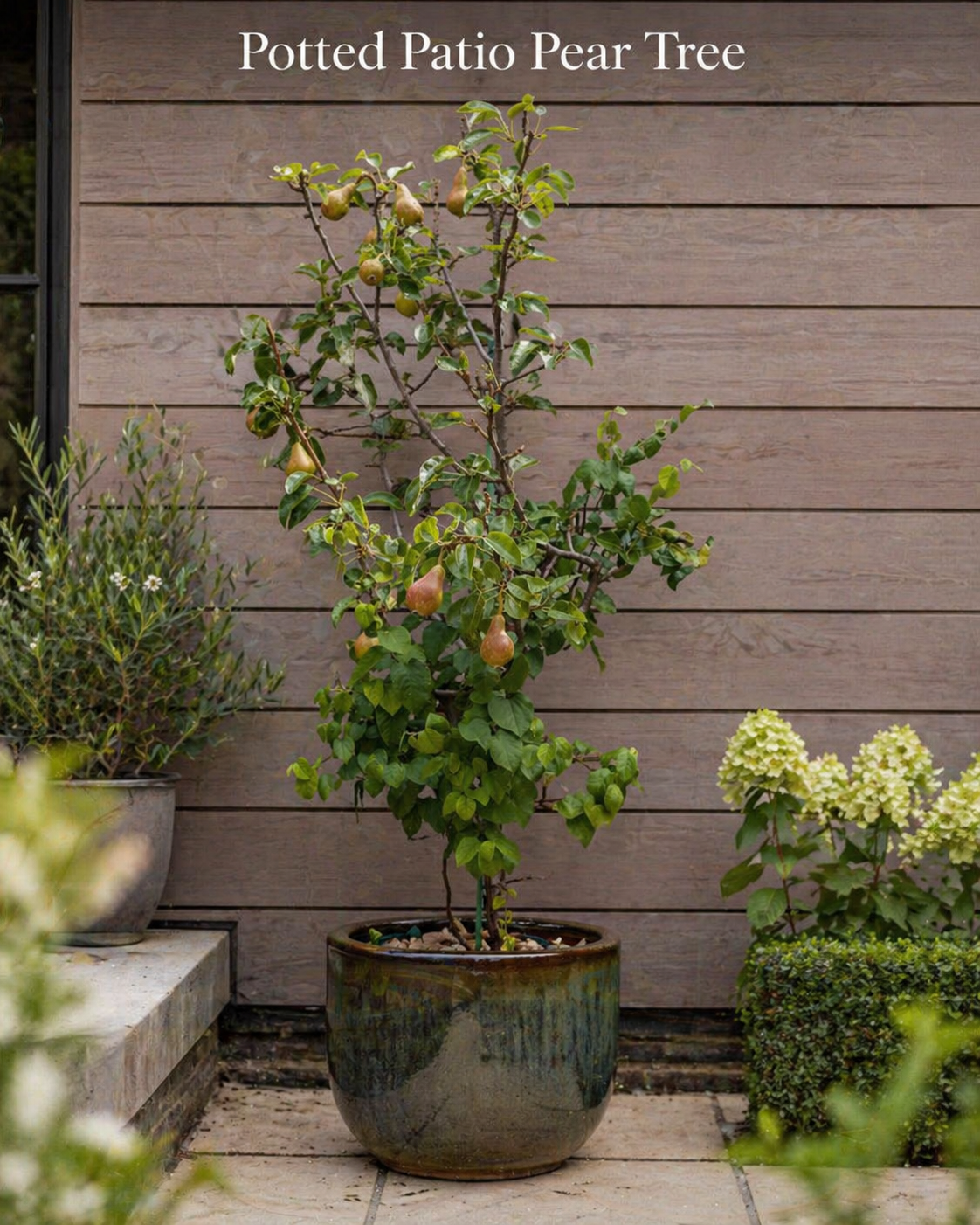
Potted patio pear tree for small gardens and container growing.
For smaller spaces, look for:
- Patio pear trees
- Dwarf pear trees
- Quince C or Quince A rootstocks
- Cordons where space is narrow
- Self-fertile or partly self-fertile varieties if you only want one tree. Partially self-fertile means you get a partial fruit harvest.
Pear trees are naturally stronger-growing than many small patio fruit trees, so do not assume a patio pear will stay tiny with no effort. The right rootstock, a large pot, regular watering and sensible pruning all matter.
If the tree is growing in a pot, use a large, stable container, the bigger the better, and do not let it dry out. Pear trees in pots need more watering and feeding than pear trees planted in the ground. [5]
For most beginners with limited space, a potted, self-fertile pear tree on Quince C or Quince A is the easiest route.
Below are common symptoms associated with pot grown pear trees and how to remedy them.
Wilting leaves and dry compost — water deeply until water drains from the bottom. Repeat several times.
Compost pulling away from pot edge — water slowly in stages; top up with fresh compost if the level has sunk.
Water running straight through — soak the pot; if it keeps happening, repot with fresh soil-based compost.
Yellow leaves and soggy compost — stop watering, clear drainage holes and raise the pot on feet.
Sour-smelling compost — repot into fresh free-draining soil-based compost.
Brown leaf edges in hot weather — water deeply and consistently; mulch the pot surface and keep the container from baking against hot paving or walls.
Poor new growth — feed in spring and check the pot is not rootbound.
Roots coming from drainage holes — repot into a larger container.
Tree blowing over — use a heavier/larger pot, move out of strong winds and/or stake it.
Few flowers — move to the sunniest sheltered position and avoid hard winter pruning of fruiting wood.
Blossom turning brown after frost — cover with fleece during frost nights; move the pot under temporary shelter, not into a warm house.
Flowers but no pears — check pollination and add a compatible pear nearby.
Lots of tiny pears — thin the fruit in early summer leaving 1-2 pears per cluster.
Fruit dropping early — water consistently and thin overcrowded fruit.
Orange spots on leaves (pear rust) — remove fallen leaves and improve airflow. Check for juniper nearby.
Black scabby marks on fruit/leaves — remove affected material and avoid wetting foliage when watering. Water roots only.
Aphids on shoots — squash small colonies by hand, spray larger colonies off with water, encourage ladybirds/hoverflies by growing flowers nearby such as calendula, yarrow, fennel, dill, alyssum or daisies, avoid broad-spectrum insecticides, and use a fruit-safe aphid spray only if needed.
Sticky leaves — check for aphids and treat as above.
Raised blisters on leaves — likely pear leaf blister mite; remove badly affected leaves, clear fallen leaves, and if it keeps coming back, spray the bare tree in winter with a fruit-tree winter wash from a garden centre. Search for "winter wash"
Powdery white growth — Likely powdery mildew; cut off infected shoot tips and bin them, keep watering steady in dry spells, avoid high-nitrogen feed, and use a fruit-safe mildew spray only if it keeps spreading.
Back to top
Best Conditions for Pear Trees
Pear trees can be slightly more demanding than apples, but if you get the basics right they are still very rewarding to grow in the UK.
A south-facing or west-facing spot is often better than a cold, shaded or exposed position. [1] [2]
Choose:
- A sunny position
- A warm, sheltered spot
- Fertile, well-drained soil
- Slightly acidic to neutral soil, ideally around pH 6.0 to 7.0 [8]
- Good airflow around the tree
- Enough space. Quince A 3.5 to 5.5m wide. Quince C 2.5-3.5m wide. [1]
Avoid:
- Deep shade
- Waterlogged or poorly drained soil
- Very acidic or very alkaline soil
- Heavy clay that stays wet in winter
- Frost pockets where cold air settles
- Very exposed, windy sites
- Planting too close to large trees, walls or fences
Pear blossom is more vulnerable to late spring frost than many apple varieties, so a sheltered position can make a noticeable difference to fruit set. [2]
If your soil is heavy, improve the planting area before planting rather than burying the tree in a hole full of rich compost. The aim is free-draining soil that holds moisture without sitting wet.
If you are in a cooler or exposed part of the UK, growing a pear tree against a south-facing or west-facing wall as a cordon, espalier or fan can improve cropping and reliability.
Back to top
When to Plant Pear Trees
Bare-root pear trees are planted during the dormant season of November to March, aka autumn to spring. Potted pear trees can usually be planted nearly all year, as long as the ground is not frozen, waterlogged or extremely dry. [1]
Autumn to early spring is still the easiest time to plant because the tree is under less stress and needs less watering.
Basic planting steps:
- Dig a hole wider than the roots or pot
- Keep the graft union above soil level
- Backfill with soil and firm gently
- Water well after planting
- Stake the tree if the rootstock or site needs it
- Mulch around the base, but keep mulch away from the trunk
Back to top
Watering, Feeding, Mulching and Pruning Pear Trees
Young pear trees need watering while they establish, especially during dry weather. Potted pear trees need more attention because they cannot reach moisture deeper in the soil. [1] [5]
Mulch helps retain moisture and reduce weed competition. Apply it around the base of the tree, but keep it away from the trunk to avoid damp-related issues. A 1m diameter is a good size.
Feed in spring if growth is weak or soil is poor. Pear trees are not heavy feeders, so avoid overdoing it i.e. follow the instructions. If some feed is good then more feed is not better. It can actually damage the roots.
Pruning depends on the tree form. A bush pear tree is not pruned in the same way as a cordon or espalier so it pays to spend the research time. The topic is too large to cover it in this document.
For most garden pear trees, prune out dead, damaged, crossing or inward-growing branches so the centre of the tree stays open and light can reach the fruit. The idea is to make space in the middle of the canopy so air and light can get in. No fruit should be growing in the middle of the canopy anyway, it should all be on the outer edges of the tree for optimal results.
In the UK, most pear tree pruning is done in winter while the tree is dormant. Trained forms such as cordons and espaliers are often pruned in summer to control growth. [6] [7]
Back to top
How Long Before a Pear Tree Fruits?
It depends on the variety, rootstock, age of the tree and growing conditions.
Pear trees are often slightly slower to start fruiting than apples. RHS lists Quince C and Quince A pears as starting to fruit after about four years, although an older potted tree will likely crop sooner after planting than a very young bare-root tree. [4]
Even though 4 years is listed, some of that time has already passed when you receive the tree. A bare-root maiden will be 1-2 years old, and a half-standard or bush in bare-root or potted form will be 2-3 years old.
If you want pears soonest:
- Choose a potted pear tree rather than a very young bare-root one
- Choose a dwarf or semi-vigorous rootstock such as Quince C.
- Plant in a warm, sunny, sheltered position
- Make sure pollination requirements are covered (not applicable if self-fertile)
If you want the lowest cost, buy a younger or bare-root tree and allow more time for it to establish.
If you want the least effort, choose a potted, self-fertile pear tree and give it the right conditions from the start.
Pear Tree Buying FAQs
Do pear trees grow well in the UK?
Yes, but they usually need a warmer, sunnier and more sheltered position than apples to crop well. In colder or exposed gardens, choosing the right spot makes a big difference. [1] [2]
Where is the best place to plant a pear tree?
A sunny, sheltered position is best. South- or west-facing spots are usually more reliable, especially for fruiting. Avoid frost pockets if possible. [1] [2]
Do pear trees grow quickly?
Growth depends on the rootstock and conditions. Quince C keeps pear trees smaller and fruits sooner, while Quince A makes a larger garden tree but a full harvest takes a bit longer. Rootstock is the main thing to check before buying. [4]
How hardy is a pear tree?
Pear trees are generally hardy in the UK, but their blossom can be damaged by late spring frost, which affects fruiting. A warm, sheltered site helps reduce that risk. [1] [2]
How long does it take a pear tree to bear fruit?
It depends on rootstock, tree age and growing conditions. RHS lists Quince C and Quince A pears as starting to fruit after about four years. [4]
How do you encourage a pear tree to fruit?
Give it full sun, shelter, enough water while establishing, suitable pruning and compatible pollination. Poor pollination, frost damage and a cold shaded site are common causes of poor fruiting. [1] [2] [3]
Do pear trees need to be planted in pairs?
Not always. Some pear trees are self-fertile or partly self-fertile, but many need another compatible pear nearby. Even self-fertile trees often crop better with another compatible cultivar nearby. [3]
Which pear tree is best for a small garden?
Choose a compact pear tree on Quince C, or choose a trained form such as a cordon. Concorde and Conference are useful starting points if you want a self-fertile pear from the Trees Online range.
Can you keep a pear tree small?
Yes, but start with the right rootstock and form. Quince C produces a smaller tree than Quince A. Patio trees, cordons and trained forms are usually better for small spaces than trying to fight a vigorous tree with pruning. [4]
What is the easiest pear tree to grow in the UK?
For most beginners, Conference and Concorde are sensible choices because they are self-fertile and widely used garden pears. The easiest option is usually a potted, self-fertile pear tree planted in a warm, sunny, sheltered position.
What is the best time to plant pear trees?
When someone else is willing to do the work for you. Failing that, bare-root pear trees are planted while dormant, from autumn to spring. Potted trees can usually be planted at other times, but avoid hot, dry weather and frozen or waterlogged ground, in summary almost all year. [1]
Can you grow pear trees in pots?
Yes. Choose a compact pear tree on Quince C rootstock, use a large stable container and keep it watered and fed. Trees in pots dry out faster than trees in the ground. [1] [5]
Do you need two pear trees to produce fruit in pots?
Not always. A self-fertile pear tree can produce fruit on its own, but a second compatible pear nearby can improve cropping. This second tree does not have to be in the same pot. [3]
What should you not plant next to pear trees?
Avoid large trees or vigorous plants that heavily compete for water, light and nutrients. Keep grass and weeds away from the base while the tree establishes. [1]
Also avoid:
Large trees that steal light, water and nutrients.
Dense shrubs that crowd the base.
Vigorous climbers that climb into the canopy.
Grass right up to the trunk while the tree is young.
Plants needing constant wet soil.
Junipers, where pear rust is a known problem nearby.
Anything that blocks sun or airflow.
Can you train a pear tree against a wall or fence?
Yes. Pear trees can be trained as cordons, espaliers or fans. This is useful for small gardens and can help pears crop better by using a warmer, sheltered wall or fence position. [1] [7]
What is the best soil for pear trees?
Pear trees prefer fertile, well-drained soil in a sunny position. Avoid waterlogged or very poorly drained ground. [1]
Pear trees grow best in slightly acidic to neutral soil, ideally around pH 6.0 to 7.0. Avoid very acidic and very alkaline soils as poor conditions can reduce growth, cropping and overall tree health. [8]
Why is my pear tree not fruiting?
Common reasons include poor pollination, frost damage to blossom, lack of sun, incorrect pruning, young tree age, drought, waterlogging or pest and disease issues. [1] [2] [3]
Back to top
Pear Tree Summary
If you have an average UK garden and want the easy route, buy a potted, self-fertile pear tree on Quince A or Quince C, in bush, half standard or patio form. Choose the warmest, sunniest and most sheltered spot you have, and make sure pollination is covered if your tree is not self-fertile.
Please feel free to contact us if you have any pear tree questions.
Back to top
Sources
- Royal Horticultural Society, How to grow pears. Used for pear growing advice, site choice, planting, containers, trained-tree spacing, harvesting and general care. https://www.rhs.org.uk/fruit/pears/grow-your-own
- Royal Horticultural Society, Choosing pear cultivars. Used for pear cultivar choice, warmth and shelter requirements, fruit type, pollination, supermarket-flavour warning and spring frost risk. https://www.rhs.org.uk/fruit/pears/choosing-cultivars
- Royal Horticultural Society, Fruit pollination. Used for pollination advice, self-fertile tree guidance, pollination distance and triploid explanation. https://www.rhs.org.uk/advice/beginners-guide/fruit-basics/fruit-pollination
- Royal Horticultural Society, Rootstocks for fruit. Used for Quince C and Quince A pear rootstock size, vigour, fruiting and spacing guidance. https://www.rhs.org.uk/fruit/fruit-trees/rootstocks
- Royal Horticultural Society, Fruit in containers. Used for advice on growing fruit trees in containers, including watering and feeding requirements. https://www.rhs.org.uk/fruit/fruit-trees/containers
- Royal Horticultural Society, Apples and pears: pruning made easy. Used for winter pruning guidance. https://www.rhs.org.uk/fruit/apples/pruning-made-easy
- Royal Horticultural Society, Apples and pears: training espaliers. Used for trained forms such as espalier and cordon systems. https://www.rhs.org.uk/fruit/apples/training-espalier
- University of Minnesota Extension, Growing pears in the home garden. Used for soil pH guidance that pear trees prefer slightly acidic soil, pH 6.0 to 7.0. https://extension.umn.edu/fruit/growing-pears