Cherry Trees for Sale UK: Fruiting Cherry Buying Guide
Looking for cherry trees for sale in the UK?
Your options are self-fertile or not, patio or full-size, potted or bare root, dessert or cooking. This guide will help you choose a fruiting cherry tree that gives you the best chance of a good crop.
I Just Want to Buy a Good Cherry Tree: Best Cherry Trees to Buy
If you do not want to read the whole guide and just want an easy dessert cherry that can fruit on its own, start with Lapins Cherokee, Stella, Sunburst, Sweetheart or Celeste. For an easy cooking cherry tree, choose Morello. If you want a dark dessert cherry with good splitting resistance and you are happy to provide a pollination partner, look at Kordia. [6][9] If that is you sorted and you are off to buy a cherry tree from www.trees-online.co.uk then thanks for reading and we appreciate your business.
Self-Fertile and Non-Self-Fertile Cherry Trees
You need to know the difference between them because if you don’t, you likely will get no cherries from the non-self-fertile group.
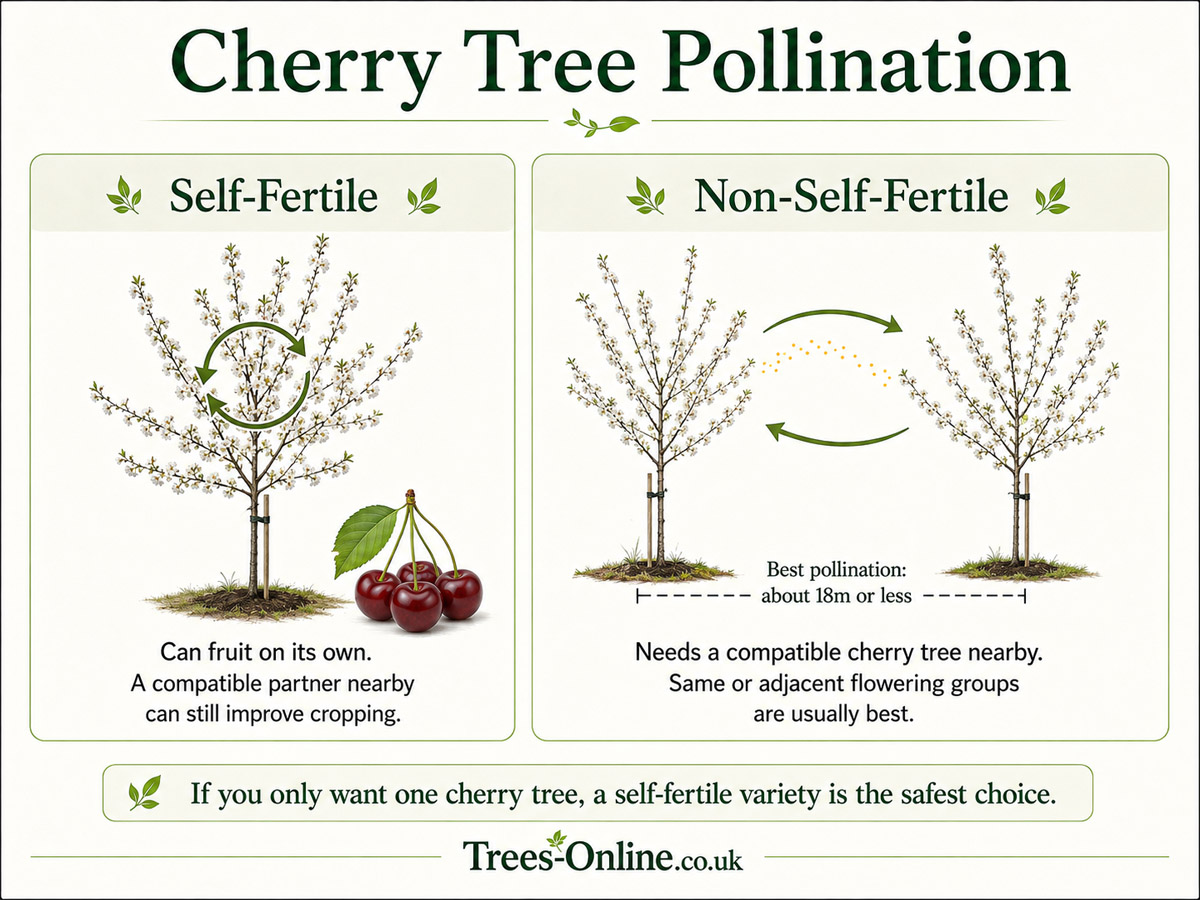
Self-fertile means you can plant this on its own and it will still grow cherries. In short, the flowers pollinate themselves to get the cherry fruit-growing process going. Crop yields can be improved by having a suitable pollination partner nearby, explained below. [5]
Non-self-fertile means it requires the pollen from another cherry tree nearby (optimally, around 18m or less) to get the cherry fruit growing process started. [5] You will need a suitable pollination partner, explained below.
Partially self-fertile sits in the middle. It may set some fruit on its own, but it is not the safest one-tree choice. Treat it as a variety that should have a compatible pollination partner if you want the best chance of a decent crop.
If you only want one cherry tree, choose a self-fertile variety.
Cherry Tree Pollination Partners
Every cherry tree belongs to a flowering group listed as 1, 2, 3, 4, and 5. This represents a 1–2 week period when the flowers are open. When the flowers are open at the same time, bees and other flying buzzies can visit both trees and transfer pollen between the two of them. This is called cross-pollination and starts the fruit-growing process.
If you have two different varieties of cherry tree in the same flowering group then their flowers open at roughly the same time and would make ideal pollination partners. Pollination can still happen if the groups are adjacent to each other e.g. a 3 and a 2 or a 4 and a 5. If you were to plant e.g. a 2 and 4, by the time the flowers opened on the 4, the flowers on the 2 would have been long gone.
Self-fertile trees pollinate themselves and will produce fruit without cross-pollination BUT fruit yields can be improved if a suitable pollination partner is planted close by. [5]
Pollination also depends on weather and insect activity. A warm, sheltered position helps because pollinating insects can reach the flowers more easily. Exposed, windy or frost-prone spots can reduce the chance of a good crop even when the varieties should match on paper. [1]
Sweet and sour cherry pollination note: sour cherries are self-fertile and can pollinate sweet cherries, but sweet cherries will not pollinate sour cherries. For most buyers, this means Morello does not need a sweet cherry partner to crop, but it may help pollinate a compatible sweet cherry nearby if the flowering times overlap. [8]
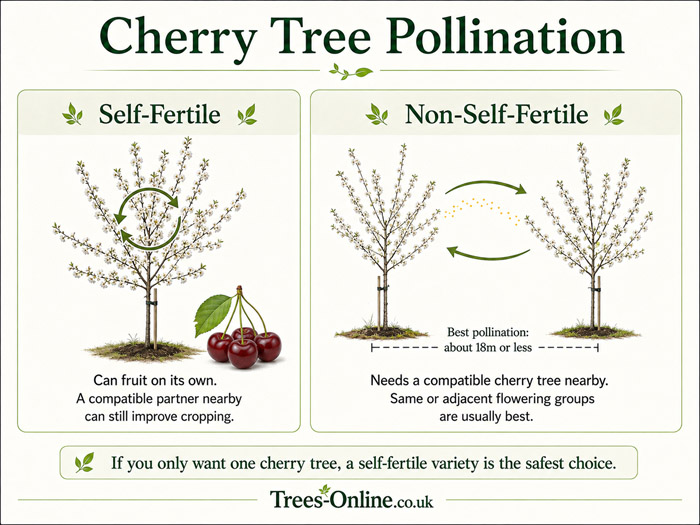
Cherry tree pollination: self-fertile cherries are the easiest one-tree choice, while non-self-fertile cherries need a compatible cherry nearby.
View larger imageHead about to explode with all this jibber jabber? Buy any self-fertile dessert cherry on a bush or half-standard form. If you want more than one tree, we advise picking different varieties so you are not overwhelmed with one massive crop.
Sweet Cherry Trees, Sour Cherry Trees and Cooking Cherry Trees
Sweet cherry trees are those you can eat directly without cooking and not get a suck face, in short, dessert cherries.
Sour and cooking cherry trees basically mean the same thing. They have a tart taste, but some cooking cherries can be eaten without turning your head inside out when they are VERY ripe. Usually only really suitable for cooking and preserves.
Cherry Harvest Times: When Do You Want to Pick Cherries?
Harvest time is worth checking before you buy. Cherries can crop from late June through to late summer or early autumn, depending on variety, weather and site. They do not continue ripening after picking, so timing matters if you want fresh eating cherries for a particular part of summer. [1]
The table below shows cherry tree options available for a wider harvest season.
| Variety |
Typical harvest note |
Buyer use |
| Merton Glory |
Early season; often late June to early July. |
Early sweet cherry. Not self-fertile, so needs a pollination partner. |
| Celeste |
Early season. |
Early self-fertile dessert cherry. |
| Merchant |
Early season. |
Popular early dessert cherry used here as a season comparison variety. |
| Stella |
Mid season; often mid to late July. |
Self-fertile dessert cherry and easy one-tree choice. |
| Sunburst |
Mid season; often late July. |
Self-fertile dessert cherry with large sweet fruit. |
| Summer Sun |
Mid to late July. |
Semi-self-fertile dessert cherry that benefits from a partner. |
| Kordia |
Late July / early August. |
Dark dessert cherry with splitting resistance, but needs a pollination partner. |
| Lapins Cherokee / Lapins |
Late July / early August. |
Self-fertile dessert cherry with heavy crops. |
| Felicita |
Late season. |
Self-fertile dessert cherry with large fruit. |
| Stardust Coveu |
Late season. |
Self-fertile white-fleshed dessert cherry. |
| Sweetheart |
Very late; late summer into early autumn. |
Self-fertile late dessert cherry that extends the picking season. |
| Penny |
Late summer. |
Late dark dessert cherry. Not self-fertile, so needs a pollination partner. |
| Morello |
Late summer. |
Self-fertile acid/cooking cherry. |
Use harvest dates as a guide, not a guarantee. Weather, site, rootstock and the age of the tree can all move picking time slightly. If you want the longest cherry season, choose more than one compatible variety with different picking times.
RHS AGM Cherry Varieties
The RHS Award of Garden Merit is given to plants and trees that perform very well. The RHS AGM cherry list includes Kordia, Lapins, Merchant, Morello, Penny, Stella, Summer Sun and Sweetheart. [10]
| Variety |
Type |
Self-fertile? |
Useful buyer point |
| Kordia |
Sweet cherry |
No |
Dark dessert cherry with good splitting resistance. |
| Lapins Cherokee / Lapins |
Sweet cherry |
Yes |
Heavy crops of dark red dessert cherries. |
| Merchant |
Sweet cherry |
No |
Early dessert cherry, useful as a harvest-season comparison variety. |
| Morello |
Acid/cooking cherry |
Yes |
Reliable cooking cherry and more tolerant of shade than sweet cherries. |
| Penny |
Sweet cherry |
No |
Late dark dessert cherry that needs a pollination partner. |
| Stella |
Sweet cherry |
Yes |
Popular self-fertile dessert cherry and easy one-tree choice. |
| Summer Sun |
Sweet cherry |
No / semi-self-fertile in Trees-Online listing |
Large dark red dessert cherry that benefits from a partner. |
| Sweetheart |
Sweet cherry |
Yes |
Late self-fertile dessert cherry that extends the picking season. |
Cherry Tree Size, Rootstocks and Small Gardens
Cherry trees are usually made from two joined plant parts: the rootstock and the scion. The rootstock is the lower part of the tree, including the roots and lower stem, and it helps control size and vigour. The scion is the fruiting variety grafted onto it, such as Stella, Sunburst or Lapins Cherokee. Each different rootstock will control characteristics such as height.
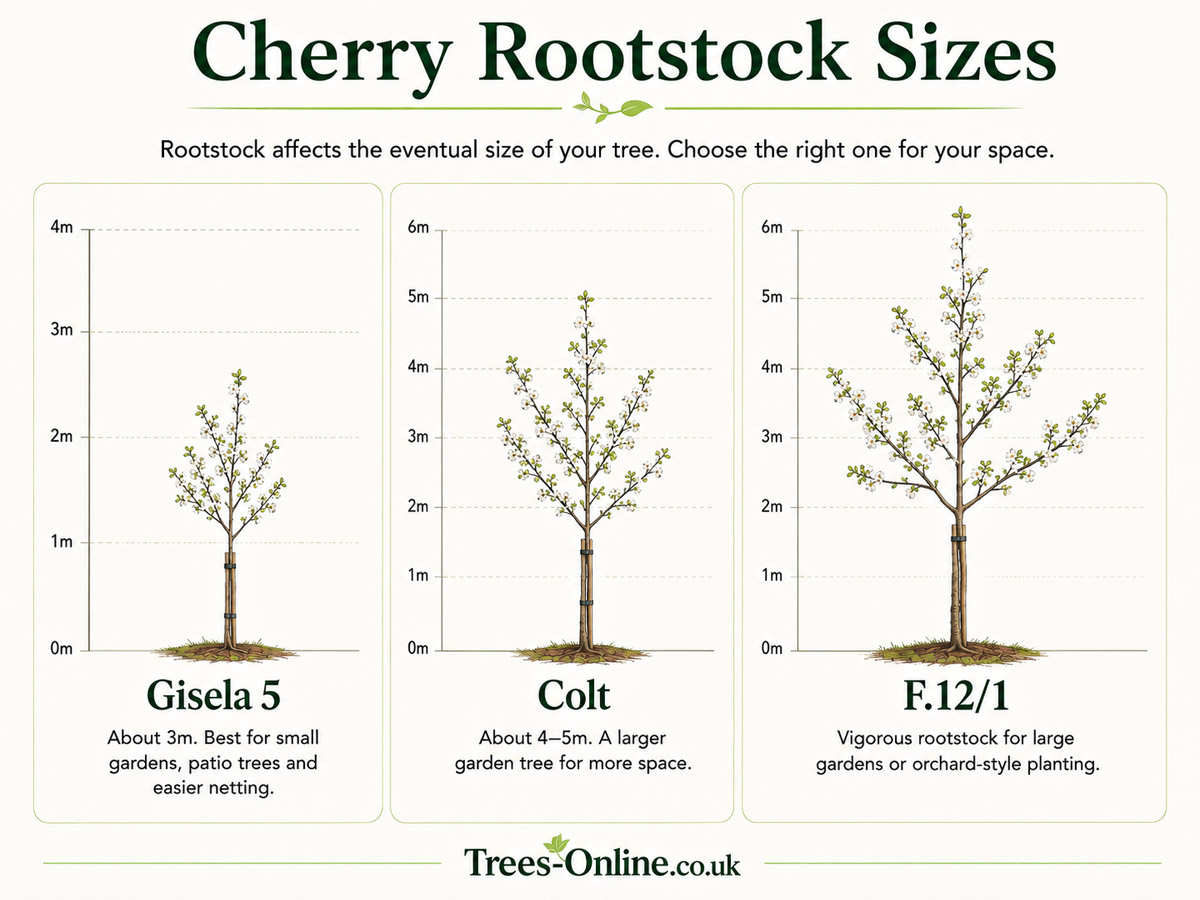
The two most popular are Gisela 5 and Colt. They will give you mature heights of around 3m for Gisela 5 and 4–5m for Colt. [3][7]
F.12/1 / F.12.1 is a vigorous rootstock and more used for orchards or large gardens.
For small gardens, pots and patios, choose Gisela 5. Colt is larger and suits bigger bush, half-standard and fan-trained trees. [7]
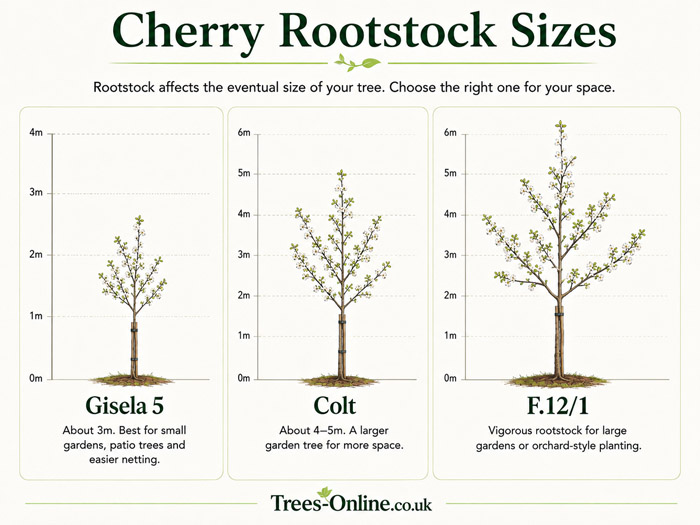
Cherry rootstock size comparison: Gisela 5 is the smaller choice, Colt suits larger garden trees, and F.12/1 is for larger gardens or orchard-style planting.
View larger imageBare Root vs Potted
Potted cherry trees are supplied growing in a pot. Container-grown cherry trees are available all year round and can potentially be planted at any time, although they settle in best from late autumn to spring. [1] These suit the novice gardener more because less can go wrong.
Bare root cherry trees are supplied without soil around the roots and are only available while dormant, from late autumn to early spring. [1] These are cheaper and can come with a few more options but need a little more care and maintenance. A novice can plant them but we suggest reading up on planting bare root cherry trees.
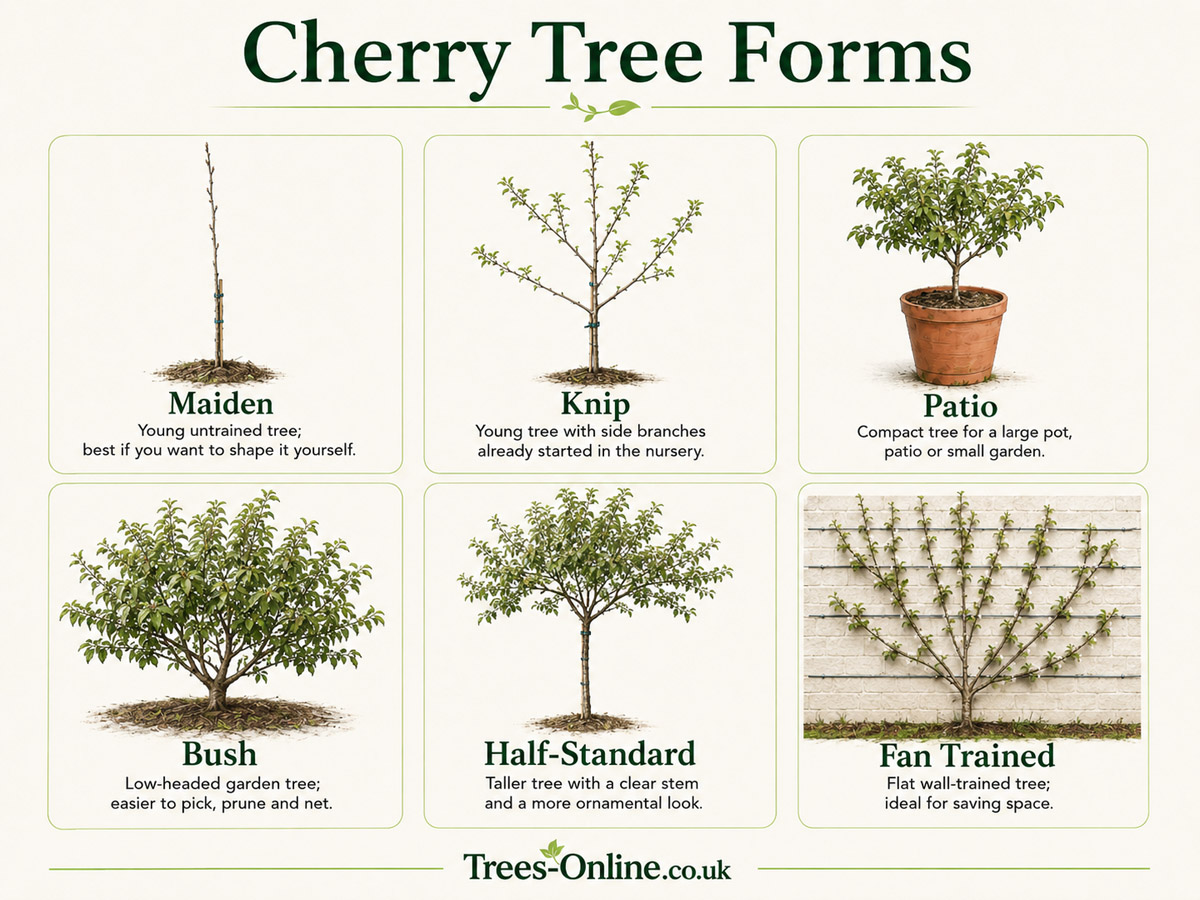
A form is how the tree has been grown, pruned or trained so it gives a different shape that can be useful in different situations.
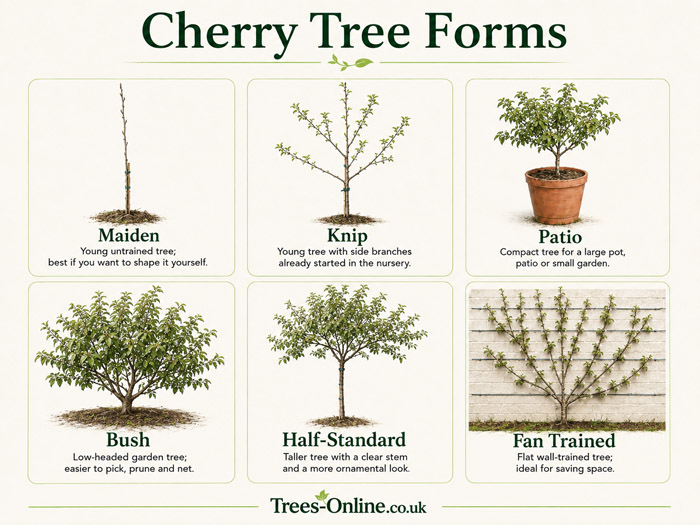
Cherry tree forms: the shape you buy affects how easy the tree is to train, pick, prune and net.
View larger imageMaiden
A young, untrained cherry tree, usually around 1 year old. It is normally a single main stem, sometimes with side shoots and sometimes without. Choose a maiden if you want a cheaper young tree and are happy to train it yourself. Usually 1m–2.5m tall, depending on variety, type and rootstock. This is the “blank slate” most other forms come from.
Knip
A young cherry tree with its basic shape already started in the nursery. It has a strong central leader and side branches already formed, so if left alone it should still grow on as a central-leader bush-style tree. It may need light pruning or tidying as it grows, but it does not need the same major formative pruning as a maiden.
Patio
Usually grafted onto Gisela 5 rootstock but has been pruned and trained to be more suitable or pleasing for patio and pot use.
Bush
A normal garden fruit-tree shape with a short clear stem and a low head of branches. Easier to pick, prune and net than taller forms. Usually a clear stem of 0.45m before branching starts. Arguably more growing real estate than half-standard cherry tree. Bush and half-standard are the most popular forms we sell.
Half-Standard
A taller tree form with a clear stem before the branches start. Easier to mow and plant underneath with a more ornamental shape than a bush. A clear stem of around 80cm and around 150–180cm tall. Bush and half-standard are the most popular forms we sell.
Fan Trained
A cherry tree trained flat against a wall, fence or wire support and in a fan shape. Useful where space is limited and for keeping fruit, pruning and netting within reach. Being against a wall offers a little more protection from frost because of the microclimate it creates.
Fan-trained is the practical trained form for cherries. RHS says cherries are too vigorous to be trained as espaliers or cordons, so if you want a cherry tree flat against a wall or fence, choose fan-trained rather than expecting a cherry espalier or cordon. [1]
Best Conditions and Ideal Planting Position for Cherry Trees
Check the planting spot before you choose the tree. The right cherry in the wrong place can still crop badly.
- Best position: warm, sheltered and not prone to late frosts, because frost can damage flowers and shelter helps pollinating insects reach the blossom. [1]
- Sweet cherries: choose full sun, ideally a sunny open spot or a south- or south-west-facing wall. [1]
- Acid cherries: tolerate some shade and can suit a less sunny wall better than sweet cherries. [1]
- Best soil: deep, fertile, moisture-retentive and well-drained. RHS gives an ideal cherry soil pH of 6.5–6.7. [1]
- Avoid: shallow soil, sandy soil, very wet ground, poor drainage, cramped spaces and sites that are impossible to net against birds. [1]
If your garden is exposed or windy, a self-fertile variety is usually the safer choice, but shelter still matters because bees and other pollinating insects work better where they can actually reach the flowers.
Are Cherry Trees Easy to Grow?
Cherry trees are not difficult if you buy the right type for the right place. The main buyer mistakes are choosing a tree that gets too big, planting a sweet cherry in too much shade, ignoring pollination, forgetting bird protection, or pruning it like an apple tree. If you choose a self-fertile variety on the right rootstock and plant it in a sunny, well-drained spot, you have avoided most of the common problems. [1][2][3][5]
How Soon Will a Cherry Tree Produce Fruit?
Gisela 5 cherry trees start fruiting after about 2 or 3 years, and Colt cherry trees after about 3 or 4 years. [4] But don’t forget when you buy a tree from Trees Online, some of that time has already gone. For a maiden, take off 1 year; for all the other forms, take off a minimum of 2 years.
Common Cherry Tree Issues Buyers Should Know
Cherry trees are worth buying, but there are a few problems buyers should know before ordering.
Birds eating the crop
Birds love cherries. If you want the fruit for yourself, plan how you will net the tree or protect the crop before it ripens. This is easier with smaller trees, patio trees and fan-trained trees.
Fruit splitting after rain
Sweet cherries can split if they take up too much water around ripening time, especially after rain. Make your watering regime consistent and keep a close eye on the weather. Splitting can be inevitable, but harvesting before heavy rain reduces losses. If splitting resistance is important, Kordia is worth considering because RHS describes Kordia fruit as resistant to splitting. [1][9]
Poor cropping
A cherry tree may crop poorly if it is too young, planted in the wrong place, short of sun, badly pollinated, damaged by frost, pruned at the wrong time, or stripped by birds before you notice.
Wrong pruning time
Cherries are not pruned like apples and pears. Established cherry trees are normally pruned in summer, after cropping, when the risk of silver leaf and bacterial canker is lower. A subject too large for a short buyer’s guide so just be aware it is worth knowing about.
Bacterial canker and silver leaf
Cherries can be affected by bacterial canker and silver leaf. Good pruning timing (when the weather is predicted dry for a few days), clean cuts, avoiding unnecessary heavy pruning and choosing a healthy tree all help reduce risk.
Wrong site
Sweet cherries need a sunny, sheltered, well-drained position. If the site is cold, wet, exposed or heavily shaded, a cherry tree is more likely to struggle.
Cherry Tree Buying FAQs
Do I need two cherry trees to get fruit?
Not if you choose a self-fertile variety. RHS says acid cherries are self-fertile and many modern sweet cherries are self-fertile. RHS also gives Stella cherries as an example of a self-fertile fruit tree. [1][5][6] Two compatible self-fertile varieties should also improve cropping.
What is the best cherry tree for a one-tree garden?
A self-fertile variety is the safest choice. In the Trees-Online range, simple options include Stella, Lapins Cherokee, Sunburst, Sweetheart, Celeste and Morello. [6]
Can you keep a cherry tree small?
Yes, mainly by choosing the right rootstock and form. Gisela 5 is the main small-space rootstock to look for. [1][3]
Can cherry trees grow in pots?
Yes, but choose a compact option such as a tree on Gisela 5 and use a large container. The larger the container, the fewer problems you will have such as drying out and blowing over.
When should I prune a cherry tree?
Prune cherries in summer rather than treating them like winter-pruned apples and pears. [2]
How much space do cherry trees need?
It depends on rootstock and form. Gisela 5 cherry spacing at 2.4–3m and half-standard Colt spacing at 3.6–4.5m. [4][7]
How far should a cherry tree be planted from a house?
There is no single safe answer to that because the issue is more about the soil in your garden. If you have heavy clay then the water the tree removes makes the clay shrink and can cause subsidence. If you don’t have clay, you likely won’t have any issues from trees. The roots can cause issues with old drains and paths that are easily cracked but that is usually the main remaining risk.
Can an apple, pear or plum tree pollinate a cherry tree?
No. Cherry trees need compatible cherry pollen. Apples, pears, plums and other fruit trees do not pollinate cherry trees. If your cherry tree is not self-fertile, choose a compatible cherry variety that flowers at the same time.
Cherry Tree Summary
If you want the easiest route, buy a self-fertile fruiting cherry tree that suits your space. Choose Stella, Sunburst, Lapins Cherokee, Sweetheart or Celeste for a simple dessert cherry, and Morello for cooking. For small gardens or patios, look for Gisela 5 or patio options; for larger bush, half-standard or fan-trained trees, Colt may be suitable. Check fruit type, self-fertility, rootstock, mature size, planting position and bird protection before ordering. Browse the Trees-Online fruiting cherry trees for sale and choose the tree that best fits your garden. [1][3][5][6][7]
Sources