Apple Trees for Sale UK: Buying Guide
This apple tree buyer’s guide helps novice gardeners choose the right apple tree to buy online.
Apple Tree Buyer’s Guide Contents
How to Choose an Apple Tree the Easy Way
If you know nothing about apple trees and just want to buy an apple tree online, choose a potted, self-fertile variety on a rootstock that suits your needs. For many average UK gardens, that usually means M26 for a tree around 3m at maturity, or MM106 for a tree around 3.5m Once established, they are relatively low-maintenance. Every apple tree listed on Trees Online has its rootstock displayed in the options panel.
If you just want to go straight ahead and buy an easy-to-grow apple tree online, then here are our suggestions.
Most Popular Apple Trees to Buy
If you want the quick route, choose from the top five lists below. They give you the strongest options by apple type without turning the page into a fruit catalogue.
Top 5 Self-Fertile Eating Apple Trees
- Red Falstaff - self-fertile, disease resistant, juicy, stores well and gives heavy crops.
- Red Windsor - self-fertile, compact, disease resistant, patio-friendly and a good pollinator.
- Scrumptious - self-fertile, disease resistant, popular, high yielding and suitable for containers.
- Red Devil - self-fertile, red-fleshed, strawberry-flavoured, disease resistant and useful for juicing.
- Saturn - self-fertile, crisp, juicy, disease resistant and a good pollinator.
Top 5 Non-Self-Fertile Eating Apple Trees
- Discovery - early dessert apple, crisp, juicy, strawberry-flavoured and disease resistant.
- Katy - large cropping, firm, disease resistant, useful for juicing and a good pollinator.
- Laxton’s Superb - traditional sweet apple with hardy growth and Cox-like flavour.
- Fiesta / Red Pippin - sweet, crisp, Cox-style apple with large crops and good northern UK suitability.
- Lord Lambourne - reliable cropper with sweet, aromatic flavour and a hint of strawberry.
Top 5 Russet Apple Trees
- Egremont Russet - classic russet apple with sweet, firm, nutty flavour.
- Herefordshire Russet - russet dessert apple with rich Cox-style flavour, large crops and good keeping.
- Ashmead’s Kernel - intense sweet-sharp flavour, firm flesh, good keeping and disease resistance.
- Ribston Pippin - traditional rich-flavoured russet-style dessert apple.
- Rosemary Russet - russet dessert apple with strong sweet-sharp flavour.
Top 5 Cooking Apple Trees
- Bramley 20 - compact Bramley type, triploid, heavy cropping and useful for juicing.
- Bramley’s Seedling - famous triploid cooking apple with strong acidic flavour and juicing use.
- Grenadier - early cooking apple, compact, easy to grow and cooks to a sharp purée.
- Reverend W. Wilks - early cooker with very large fruit, compact growth and light lemon purée.
- Newton Wonder - cooking and eating apple, late keeping, good for juicing and recognised with an RHS award.
Top 5 Dual-Purpose Apple Trees
- James Grieve - self-fertile, reliable, popular, crisp and useful for eating or cooking.
- Charles Ross - self-fertile, easy to grow, good for eating and cooking, and suitable for northern areas.
- Bountiful - disease resistant, large cropping and useful for eating or cooking.
- Blenheim Orange - triploid, good for eating, storing and cooking, with large nutty apples.
- Howgate Wonder - large, sweet, juicy apple useful for cooking and eating.
Back to top
Stepping Into The Dark Side of Buying an Apple Tree Online
If you are still confuddled, keep reading. Below are the options explained and things you need to know before making a very informed decision.
Apple Pollination: When the pollen of one apple tree flower is put inside another apple tree flower of a different variety to start the process of growing apples.
Bare Root Apple Trees vs Potted Apple Trees: Bare root is cheaper and the one-year option means you can train the tree to any shape or form you wish. Only available November to March when the tree is dormant, i.e. when the tree has dropped its leaves. Small risk of increased failure rate in the hands of the new gardener. Potted apple trees can usually be planted for much of the year, if the ground is not frozen, waterlogged or extremely dry, and suit the beginner more.
Apple Type:
eating/dessert apples are for fresh eating,
cooking apples are for pies and crumbles. They are usually sour, i.e. more acidic, and give you quite the suck face if you bite into one. They cook well for pies, crumbles, sauces and baking.
dual-purpose apples can do both,
crab apples are mainly grown for blossom, fruit colour, wildlife and pollination support but can be used for jellies.
Pollination:
Self-fertile: Self-fertile apple trees can produce fruit without another apple tree nearby. They can still crop better with a compatible apple or crab apple close by. The easiest option to choose.
Non-self-fertile: These apple trees require the pollen of another apple or crab apple tree nearby, 18m or less is the best distance. The flowers of both trees need to be open at the same time for pollination to occur to let the bee's and other buzzies do their thing and take pollen from one apple tree blossom to the other.
Apple blossom times are indicated by a number e.g. C1, C2, C3, C4 and C5 and each represents around a two week flowering period. All apple trees have this number. Optimal results come from having two apple trees in the same flowering period because they open and close at the same time i.e. maximum pollination time. You can also buy an apple tree one group up or one group down to the apple tree you want to ensure pollination. The apple trees need to be of different varieties e.g. two C3 Discovery apple trees will not cross pollinate but a C3 Katy apple tree and a C3 Discovery will.
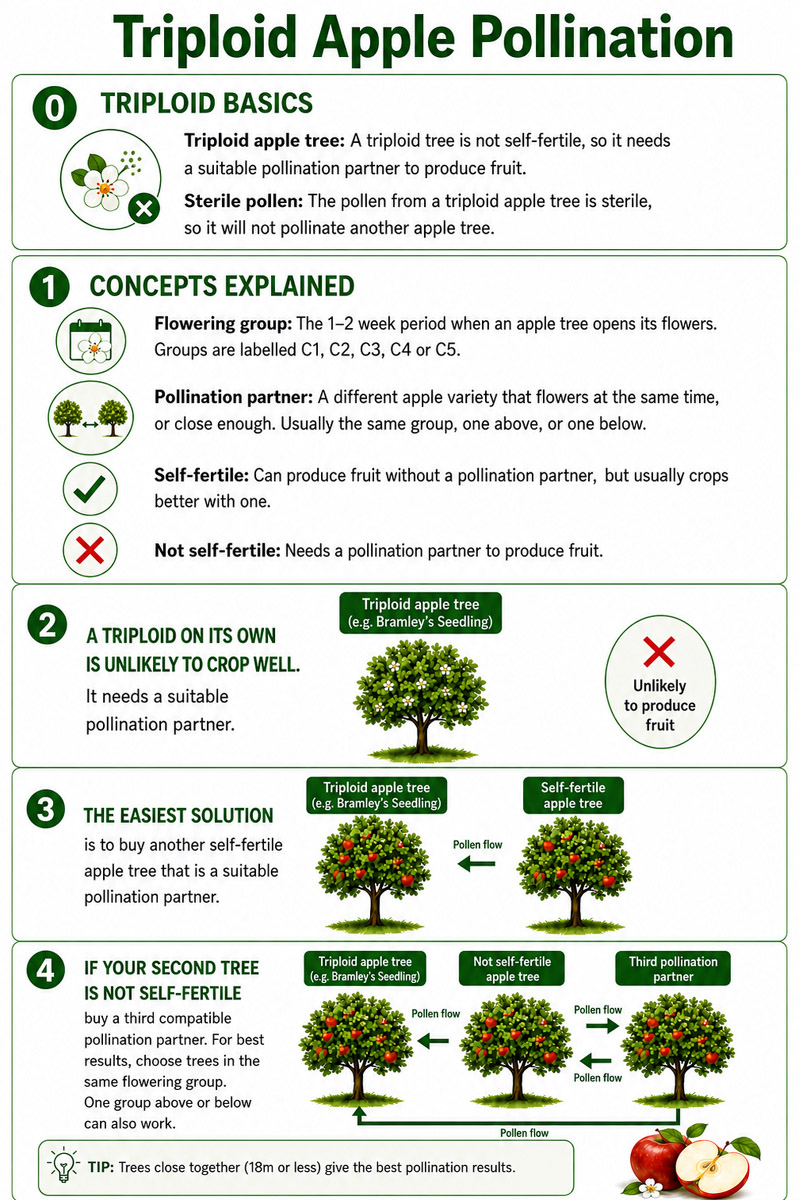
Triploid: Some apple trees are listed as triploid e.g. Bramley’s Seedling (C3), Jonagold (C4) and Blenheim Orange (C3). This means they need pollinating to produce apples but they will not pollinate other apple trees. So, if a Bramley’s Seedling (C3) is planted close to a Blenheim Orange (C3), neither tree is a useful pollination partner for the other. The best solution is to buy a C3 self-fertile apple tree but any C2 or C4 will do. If the apple tree you buy to pollinate your triploid is not self-fertile, then it will not produce apples. If you insist on having this setup then you would need a suitable pollination partner for your non-self-fertile tree, i.e. you may need three apple trees in total.
Back to top
Apple Tree Rootstocks
An apple tree is made up of two parts.
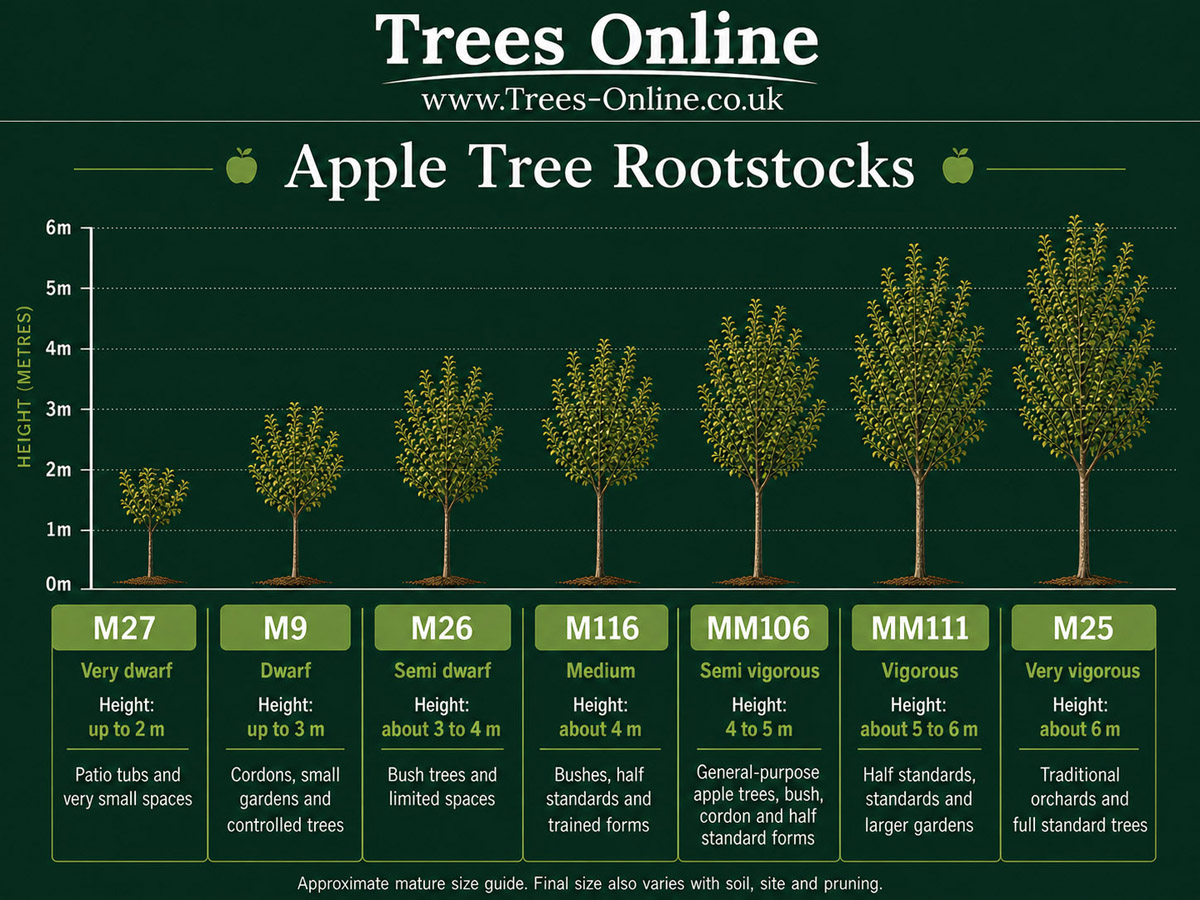
Rootstock: the roots and lower stem. This controls the tree’s vigour, mature size and how strongly it grows.
Scion: the apple variety grafted onto the rootstock. This produces the branches, leaves, blossom and fruit.
Rootstock controls the growth rate and helps decide how large the apple tree will become. Final size is still affected by soil, site and pruning, so heights are a guide rather than a fixed promise. [5]
| Rootstock |
Vigour |
Frank P Matthews size guidance |
Best use |
| M27 |
Very dwarf |
No more than 2m |
Patio tubs and very small spaces |
| M9 |
Dwarf |
No more than 3m |
Cordons, small gardens and controlled trees |
| M26 |
Semi dwarf |
Compact, free-standing tree |
Bush trees and limited spaces |
| M116 |
Medium |
About 4m |
Bushes, half standards and trained forms |
| MM106 |
Semi vigorous |
4-5m |
General-purpose apple trees, bush, cordon and half standard forms |
| MM111 |
Vigorous |
About 5-6m |
Half standards, standards and larger gardens |
| M25 |
Very vigorous |
About 6m |
Traditional orchards and full standard trees |
For most gardeners, M26 and MM106 are the useful middle ground to give you a good sized tree with a decent apple harvest. You will see what rootstock the apple tree has in the list of options for you to choose before buying an apple tree online.
Tree Form
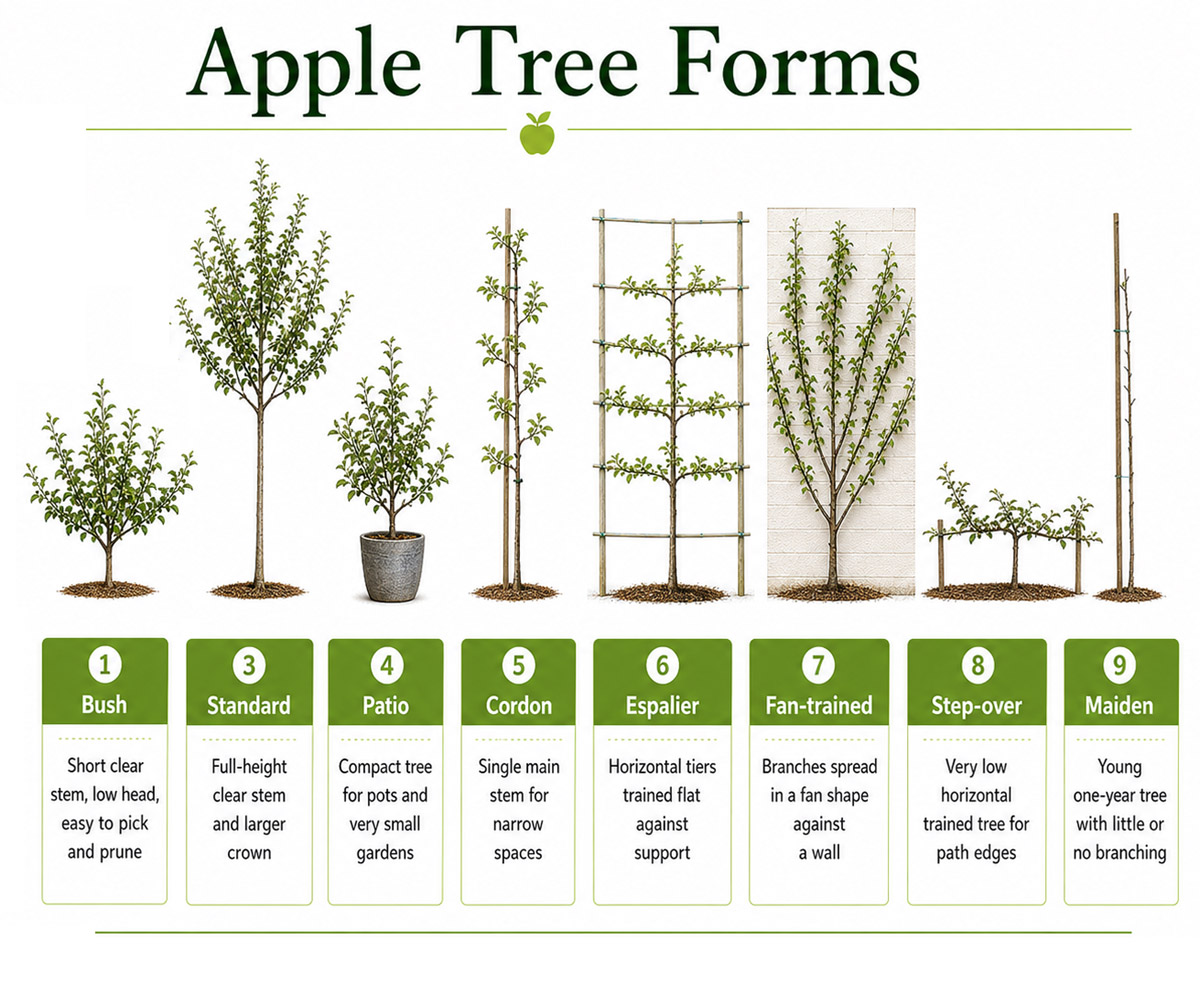
This describes the shape and form of the tree. The average apple tree is sold as a bush or half-standard.
Bush: short clear stem with a low head of branches. Usually the easiest form for picking, pruning and general use. More difficult to mow under and less formal looking.
Half standard: taller clear stem with the branch head higher up. Good if you want space underneath the tree, possibly more effort required to pick the apples as more are higher up.
Standard: full-height clear stem and larger crown. Best for larger gardens, orchards and grassed areas. Not a common form to buy online.
Patio: compact apple tree for pots, patios and very small gardens. Usually grown on a dwarfing rootstock.
Cordon: single main stem trained at an angle or upright. Good for narrow spaces, rows, walls and fences.
Espalier: horizontal tiers of branches trained flat against a wall, fence or support. Decorative and space-saving, but needs pruning.
Fan-trained: branches trained in a fan shape against a wall or fence. More common for stone fruit, but sometimes used where wall space is available.
Step-over: very low horizontal trained tree, usually edging a path or bed. Needs regular pruning and is more specialist.
Maiden: young one-year tree with little or no branching. Useful if you want to train the shape yourself.
Back to top
Crab Apple Trees
A crab apple is a small-fruited apple tree, usually grown as much for blossom, autumn colour and wildlife value as for the fruit itself. The apples are normally much smaller and taste much sharper than dessert apples, so they are more often used for jelly, jam, cider blending or left for birds. They are still part of the apple family, so a crab apple can help pollinate dessert apple trees if it flowers at the right time. Many suppliers use crab apples as orchard pollinators because they produce plenty of blossom and can cover several apple flowering groups, but flowering overlap still matters. Good pollinating crab apples often mentioned by UK suppliers include John Downie, Golden Hornet and Evereste.
Back to top
Other Useful Things to Know Before Buying an Apple Tree
Once you understand the fundamentals, there are a few extra details that can make a difference.
Harvest Time and Storage
General rule: later-ripening apples usually store better than early apples. Early apples usually need eating within a few days, while later-maturing varieties are usually better for storage and can keep for several months in the right conditions. [15]
If you want apples for more than a few weeks, choose varieties with different picking times. One early apple and one later-storing apple can be more useful than two trees that dump all their fruit on you at once.
These trees are noted for long shelf life fruit.
Self-fertile eating apples: Braeburn, Red Falstaff, Saturn, Scrumptious, Sunset
Non-self-fertile eating apples: Fiesta / Red Pippin, Herefordshire Russet, Laxton’s Superb, Lord Lambourne, Kidd’s Orange Red
Cooking apples: Newton Wonder, Bramley 20, Bramley’s Seedling
Dual-purpose apples: Blenheim Orange, Charles Ross, James Grieve, Newton Wonder, Bountiful
Russet apples: Ashmead’s Kernel, Egremont Russet, Herefordshire Russet, Ribston Pippin
Disease Resistance
Some apple varieties are more disease-resistant than others. That matters if you want an easier tree and do not want to spend your life inspecting leaves like a worried Victorian plant doctor. This is listed in the product description. [6]
For beginners, disease resistance is worth taking seriously. Here are a few suggestions for you.
Self-fertile eating apples: Red Falstaff, Red Windsor, Scrumptious, Red Devil, Saturn
Non-self-fertile eating apples: Discovery, Katy, Laxton’s Superb, Fiesta / Red Pippin, Lord Lambourne
Cooking apples: Grenadier, Newton Wonder, Bountiful, Bramley 20, Bramley’s Seedling
Dual-purpose apples: James Grieve, Charles Ross, Bountiful, Blenheim Orange, Newton Wonder
Russet apples: Egremont Russet, Herefordshire Russet, Ashmead’s Kernel, Ribston Pippin, Rosemary Russet
Family Apple Trees
A family apple tree has more than one apple variety grafted onto the same tree. This can be useful in a small garden because you get different apples from one tree, and the varieties can help with pollination.
The downside is that the grafted varieties may grow at different speeds, so pruning matters. If one variety grows much more strongly than the others, it can start to dominate the tree.
Step-Over and Spindlebush Apple Trees
Most people buy bush, half standard, standard, patio, cordon or espalier apple trees, but there are a few more specialist forms.
A step-over apple tree is trained very low, often along the edge of a path or bed. It is useful where space is tight, but it needs regular pruning to keep the shape.
A spindlebush apple tree is a compact upright form with a central leader and shorter side branches. It is more specialist than a normal bush tree, but useful where you want productive fruit in less space.
Two Apple Trees Can Be Better Than One
If you have the space, two different apple trees can be better than one. You improve your pollination chances, spread the picking season and reduce the risk of one poor year leaving you with nothing.
They do not need to be complicated. Two compatible varieties in the same or neighbouring flowering group is usually the sensible route. If one or both are self-fertile, even better.
Back to top
Patio Apple Trees for Small Gardens and Pots
A patio apple tree is usually grown on a dwarfing or very dwarfing rootstock and will normally reach around 1.5-2.5m at maturity.
For smaller spaces, look for:
- patio apple trees
- dwarf apple trees
- M27, M9 or M26 rootstocks
- cordons where space is narrow
- self-fertile varieties if you only want one tree
If the tree is growing in a pot, use a large, stable container, the bigger the better, and do not let it dry out.
Back to top
Best Conditions for Apple Trees
Apple trees are one of the easier fruit trees to grow in the UK, but they still need the basics.
Choose:
- a sunny position
- reasonably sheltered conditions
- fertile, well-drained soil
- enough space for the chosen rootstock and form
- good airflow around the tree
Avoid:
- deep shade
- waterlogged ground
- frost pockets if possible
- very exposed windy sites
- planting too close to large trees, walls or fences
Do not choose purely by supermarket familiarity. Supermarkets stock apples that store for the longest and then by taste. There are many apples that are far superior in taste to those stored in supermarkets.
Back to top
When to Plant Apple Trees
Bare root apple trees are planted in the dormant season. Potted apple trees can usually be planted for much of the year, as long as the ground is not frozen, waterlogged or extremely dry. Autumn to early spring is still the easiest planting period because the tree is under less stress and needs less watering. [1] [2]
Basic planting steps:
- Dig a hole wider than the roots or pot.
- Keep the graft union above soil level.
- Backfill with soil and firm gently.
- Water well after planting.
- Stake the tree if the rootstock or site needs it.
- Mulch around the base, but keep mulch away from the trunk.
Back to top
Watering, Feeding, Mulching and Pruning Apple Trees
Young apple trees need watering while they establish, especially during dry weather. Potted apple trees need more attention because they cannot reach moisture deep in the ground.
Mulch helps hold moisture and reduce weed competition. Keep it away from the trunk so the bark is not sitting damp.
Pruning depends on the form. A bush apple tree is not pruned in the same way as a cordon or espalier. For a normal garden tree, the basic aim is to keep the tree balanced i.e. branches of a similar length all round and open i.e. to let light and air into the main canopy.
Remove dead, damaged, crossing or badly placed growth.
Back to top
How Long Before an Apple Tree Fruits?
It depends on variety, rootstock, age, pollination and growing conditions. Dwarfing rootstocks often fruit earlier than vigorous rootstocks.
If you want fruit sooner, buy a larger potted or established apple tree. If you want the lowest cost, buy younger or bare root. If you want the least fuss, buy potted and self-fertile.
Apple Tree Buying FAQs
How fast do apple trees grow in the UK?
Apple tree growth depends mainly on the rootstock, variety, soil, water and pruning. Dwarf trees stay small, while vigorous rootstocks grow into much larger trees. Rootstock is the main thing to check before buying. [4] [5]
Most young apple trees grow roughly 30–60cm per year in good conditions, but dwarf and patio trees grow less because their rootstock is designed to keep them compact.
Can you keep apple trees small?
Yes, but start with the right rootstock. Pruning helps control size, but it is much easier to buy a dwarf, patio or semi-dwarf apple tree than to fight a tree that wants to grow too large. [4] [5]
Can you grow apple trees in pots?
Yes. Choose a patio or dwarf apple tree, use a large stable pot, and keep it watered and fed. Trees in pots dry out faster than trees planted in the ground. Apple rootstocks suitable for pot growing include M27, M9 and M26. [7] [8] [11]
What is the easiest apple tree to grow?
For most beginners, the easiest choice is a potted, self-fertile apple tree on a manageable rootstock such as M26 or MM106. Red Falstaff, Red Windsor and Scrumptious are good places to start. [3] [4] [5]
Do apple trees crop every year?
Many apple trees can crop every year, but fruiting depends on pollination, weather, pruning, tree age and aftercare. Some varieties can also crop heavily one year and more lightly the next. [9] [10]
If yours has cropped before and then stops, typical reasons include poor weather during flowering, late frost damaging blossom, poor pollination, biennial bearing after a heavy crop the previous year, wrong pruning, over-pruning, too much nitrogen fertiliser, too little sun, lack of water in dry weather, pot-grown trees drying out, waterlogged soil, disease, pests, June drop, birds or insects removing young fruit, poor soil fertility or damaged roots. [9] [10]
Can you grow an apple tree from a seed?
Yes, but it will not grow true to the apple it came from. You will get a new seedling apple of unknown quality. To get a named variety, such as James Grieve, the tree has to be grafted. [4] [11]
When should I pick apples in the UK?
It depends on the variety. Early apples may be ready in late summer, while later apples are picked in autumn. The best sign is usually fruit colour, flavour and whether the apple comes away easily when lifted and gently twisted. [7]
What is the best month to plant apple trees?
For bare root apple trees, plant during the dormant season, usually November to March. Potted apple trees can usually be planted for much of the year if the ground is not frozen, waterlogged or extremely dry. [1] [2]
Which apples grow best in the UK?
Many apples grow well in the UK. For garden buyers, it is usually better to choose a variety suited to your space, pollination setup and local conditions rather than picking by supermarket name alone. [6] [7]
How long do apple trees live in the UK?
Apple trees can live for decades in the UK. Smaller dwarf and patio trees are usually shorter-lived, often around 15–25 years. Semi-dwarf garden apple trees may live around 25–50 years, while larger orchard-style trees on vigorous rootstocks can live for 50 years or more if healthy and well cared for. [14]
Can you get British apples all year round?
Fresh British apples are seasonal, mainly harvested from late summer into autumn. Some varieties store well, so British apples can be available for longer after harvest. [7]
Where are most UK apples grown?
On an apple tree? Commercial apple growing is especially associated with Kent and the South East, Herefordshire, Worcestershire and East Anglia. [12]
Should apple trees be grown in pots or ground?
Planting in the ground is usually easier long-term because the tree has more access to water and nutrients. Pots are useful for patios and small spaces, but they need more watering and feeding. [7] [8]
Is it OK to plant an apple tree near the house?
Yes, if you choose a suitable rootstock and leave enough space for the mature tree. Avoid planting too close to walls, drains, paving or foundations. [1] [4]
What should you not plant next to an apple tree?
Avoid planting apple trees where they will be crowded by large trees, shaded by buildings, or forced to compete heavily for water and nutrients. Keep vigorous plants and grass away from the base while the tree establishes. [7] [9]
Can I plant lavender under an apple tree?
Yes, if the apple tree is established and the lavender gets enough sun and drainage. Do not crowd the trunk or disturb young apple tree roots. [1] [7]
What compost is best for apple trees?
For apple trees in pots, John Innes No. 3 or a good soil-based compost is usually the sensible choice. For trees in the ground, improve poor soil with organic matter rather than filling the planting hole with rich compost. [7] [8]
What is the best soil for apple trees?
Apple trees prefer fertile, well-drained soil in a sunny position. Avoid waterlogged ground and very poor drainage. [7]
How do you feed an apple tree?
Feed in spring if growth is weak or the soil is poor. Mulching also helps retain moisture and reduce competition, but keep mulch away from the trunk. [7] [9]
Are apple trees native to the UK?
The native wild apple of Britain is the crab apple, Malus sylvestris. Most garden apple trees are cultivated varieties, usually grafted onto rootstocks. [4] [13]
How did apples get to Britain?
Britain already had native crab apples, but the larger eating and cooking apples came from cultivated apples that originated in Central Asia and spread west through trade and farming. The Romans helped bring cultivated apples to Britain, and many more varieties were later developed through monastery, estate and orchard growing. [12] [13]
Back to top
Apple Tree Summary
If you have an average UK garden and want the easy route, buy a potted, self-fertile apple tree on M26 or MM106, in bush or half standard form. If you are venturing out into the complicated world of other apple tree options, we hope this article has helped.
Please feel free to contact us if you have any other apple tree questions.
Back to top
Sources
- Royal Horticultural Society, Trees and shrubs: planting. Used for advice that container-grown plants can be planted any time of year, with frozen or waterlogged ground avoided. https://www.rhs.org.uk/plants/types/trees/planting-trees-shrubs
- Royal Horticultural Society, How to plant a tree. Used for advice that autumn to spring is usually the best planting period, while containerised trees can be planted at other times with extra care. https://www.rhs.org.uk/plants/types/trees/how-to-plant-a-tree
- Royal Horticultural Society, Fruit pollination. Used for self-fertile fruit-tree advice and the note that even self-fertile trees can crop better with another suitable cultivar nearby. https://www.rhs.org.uk/advice/beginners-guide/fruit-basics/fruit-pollination
- Royal Horticultural Society, Rootstocks for fruit. Used for the explanation that rootstocks restrict vigour and help determine eventual tree size. https://www.rhs.org.uk/fruit/fruit-trees/rootstocks
- Frank P. Matthews, Rootstocks for Fruit Trees. Used for apple rootstock vigour, height and use guidance. https://www.frankpmatthews.com/advice/fruit_rootstocks/
- Royal Horticultural Society, Apples: choosing cultivars. Used for apple cultivar choice, garden size, fruit use and general selection guidance. https://www.rhs.org.uk/fruit/apples/choosing-cultivars
- Royal Horticultural Society, How to grow apples. Used for FAQ advice on apple growing, container compost, watering, picking and growing conditions. https://www.rhs.org.uk/fruit/apples/grow-your-own
- Royal Horticultural Society, Fruit in containers. Used for FAQ advice on growing apples and other fruit trees in containers and the extra watering/feeding needed in pots. https://www.rhs.org.uk/fruit/fruit-trees/containers
- Royal Horticultural Society, Apple tree problems: frequently asked questions. Used for FAQ advice on poor cropping, fruit drop, pests, diseases, drought and pollination problems. https://www.rhs.org.uk/fruit/apples/tree-problems-faqs
- Royal Horticultural Society, Fruit biennial bearing. Used for FAQ advice on apple trees cropping heavily one year and lightly the next. https://www.rhs.org.uk/problems/fruit-biennial-bearing
- Royal Horticultural Society, Growing fruit in containers. Used for FAQ advice that apples in containers should be specially grown for container use and that M26 is a container rootstock option. https://www.rhs.org.uk/education-learning/school-gardening/resources/food-growing/growing-fruit-in-containers
- Royal Horticultural Society, Fascinating facts and figures: apples. Used for FAQ background on the history of cultivated apple orchards in Britain. https://www.rhs.org.uk/advice/grow-your-own/features/fascinating-facts-and-figures-apples
- Royal Horticultural Society, Malus sylvestris. Used for FAQ confirmation that crab apple is native to Great Britain and Ireland. https://www.rhs.org.uk/plants/42329/malus-sylvestris/details
- Ask Extension, Apple tree disease resistance; also lifespan of dwarf trees. Used for FAQ lifespan ranges by dwarf, semi-dwarf and full-size apple tree. https://ask.extension.org/kb/faq.php?id=274886
- Royal Horticultural Society, Fruit: storing. Used for harvest and storage guidance, including the general rule that later-ripening fruit usually stores better than early fruit. https://www.rhs.org.uk/fruit/fruit-trees/storing