Damson Trees for Sale UK: Buying Guide
This damson tree buying guide is for UK gardeners who want to compare varieties before ordering. It explains the differences between traditional damsons, prune plums and bullaces, including fruit size, flavour, cooking uses, picking times, self-fertility, rootstocks and mature tree sizes.
Why Buy a Damson Tree?
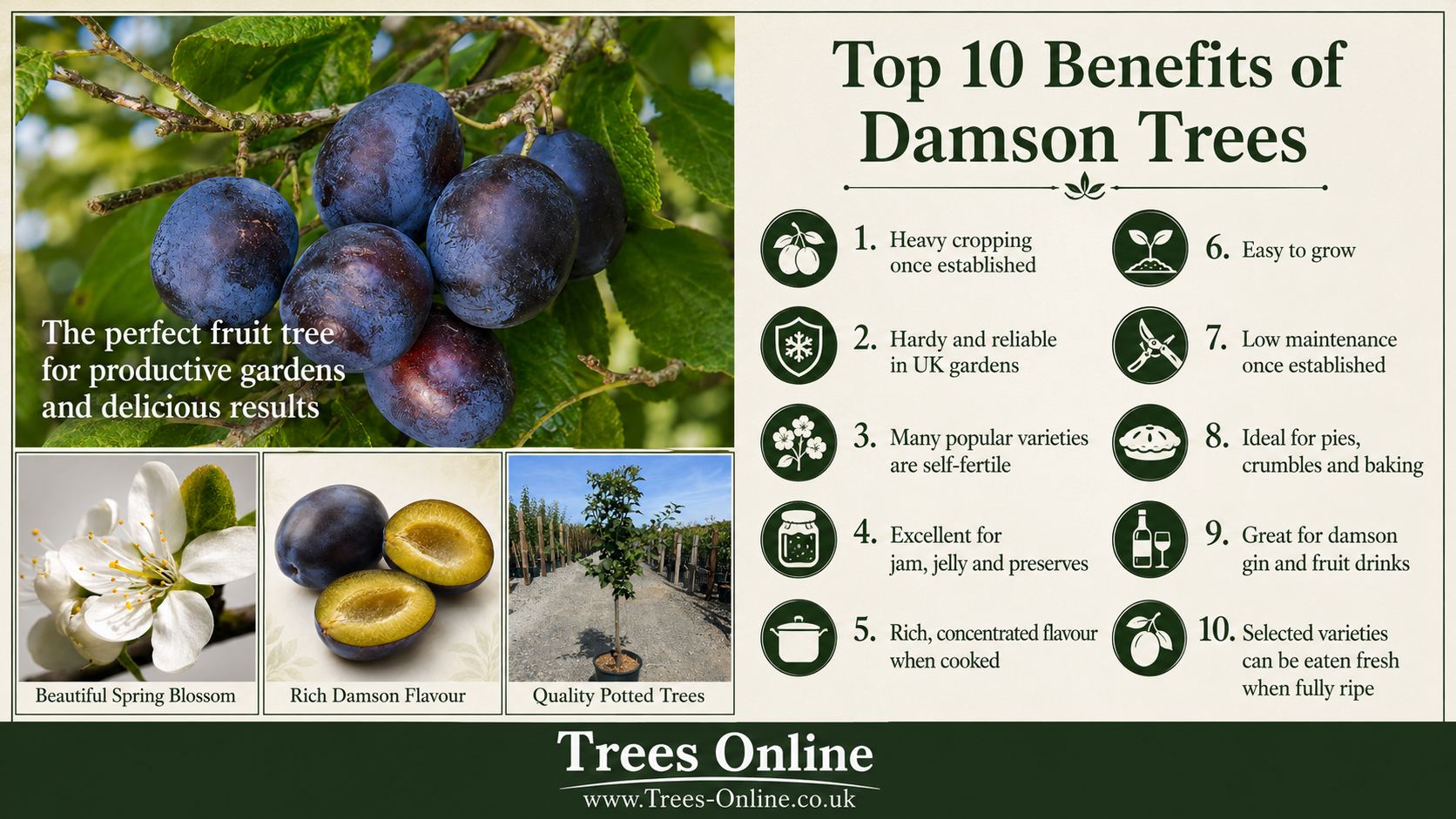
Damson trees suit UK gardens because they are relatively more hardy than plums, generally easy to grow, capable of producing heavy crops once established and their spring blossom supplies nectar for pollinating insects. [1] Most are self-fertile i.e. will produce fruit without the need of another tree. They are especially useful for jam, jelly, pies, crumbles, puddings, bottling, preserving and damson gin. [1]
Which Damson Tree Should I Buy?
This table compares damsons, bullaces and prune plums that UK buyers are likely to encounter. The most popular, based on general opinion and search engine traffic, is Merryweather. It is a dessert and cooking damson a clingstone, but it has the RHS Award of Garden Merit. Shropshire Prune is considered the best for cooking, and it is also not a freestone with the RHS Award of Garden Merit. For a particularly sweet damson, go for the Sweet Prune.
| Variety |
Fruit |
Stone |
Use |
AGM |
Description |
| Aylesbury Prune |
Small–medium; oval-oblong; dark blue-black; sweet-sharp |
Semi-freestone |
Dessert & cooking |
– |
Sweet, very late prune plum for fresh eating or cooking. [16] [19] |
| Blue Violet |
Small–medium; oval; violet-blue to blue-black |
Freestone / semi-freestone |
Dessert & cooking |
– |
An early option where easy stone removal matters. [9] [17] |
Bradley’s King
King of the Damsons |
Large; dark blue; sweet, less astringent, slightly dry |
Clingstone |
Cooking |
– |
Large-fruited and sweeter, especially good for jam and puddings. [14] [15] |
| Early Rivers |
Small; oval-oblong; purple-red to violet-blue |
Clingstone |
Cooking |
– |
Very early, but with less true damson flavour than stronger culinary varieties. [10] |
| Farleigh Damson |
Very small; oval-oblong; dark blue |
Clingstone |
Cooking |
Yes |
Hardy and reliable, producing small damsons well in cooler districts. [4] [13] |
| Langley Bullace |
Small; round-oblong; blue-black |
Semi-freestone |
Cooking |
Yes |
Late, heavy-cropping dark bullace with strong cooking flavour. [11] [18] [19] |
| Merryweather Damson |
Large; oval; dark blue to blue-black |
Clingstone |
Dessert when ripe; cooking |
Yes |
One of the largest damsons and the best stocked choice for eating fresh. [2] [3] |
| Shepherd’s Bullace |
Large; round-oblong; yellow to greenish-yellow |
Semi-freestone |
Cooking |
– |
Heavy crops of distinctive yellow, sweet-sharp cooking fruit. [5] [19] |
| Shropshire Prune |
Small; elongated; dark blue |
Clingstone |
Cooking |
Yes |
Best stocked choice for concentrated traditional cooking flavour and reliable crops. [6] |
Sweet Prune
Hauszwetsche |
Oval; dark blue-purple; yellow, high-sugar flesh |
Freestone |
Dessert, baking & preserving |
– |
Sweetest stocked option; excellent fresh, baked, frozen or dried. [7] [8] |
Stone terminology: freestone means the flesh separates comparatively easily from the stone; clingstone means it adheres firmly. Semi-freestone means the flesh partly adheres but separates more readily than a true clingstone. [3] [9] [10] [13] [14] [19]
Damson/Bullace vs Plum: What Is the Difference?
Damsons and bullaces are closely related types of plum. Compared with typical dessert plums, their fruit is usually smaller, sharper in flavour and less sweet when eaten raw. Their concentrated flavour develops when cooked, which makes them particularly suitable for jam, jelly, pies, crumbles, preserves and fruit drinks. [1]
Put simply, choose a damson or bullace for strong cooking and preserving flavour. Choose a dessert plum if you mainly want larger, sweeter fruit to eat straight from the tree.
Where Does Sweet Prune Fit?
Sweet Prune, also known as ‘Hauszwetsche’, is a European prune plum rather than a traditional English damson. However, suppliers often group it with damsons because it has similar dark-blue fruit, culinary uses and growing characteristics.
It has elongated fruit, yellow flesh and a higher sugar content than most traditional damsons. It can be eaten fresh and is also particularly suitable for baking, preserving, freezing and drying. [7]
In short, technically a plum but looks and behaves like a damson or bullace so is sold as such.
Are Damson Trees Self-Fertile?
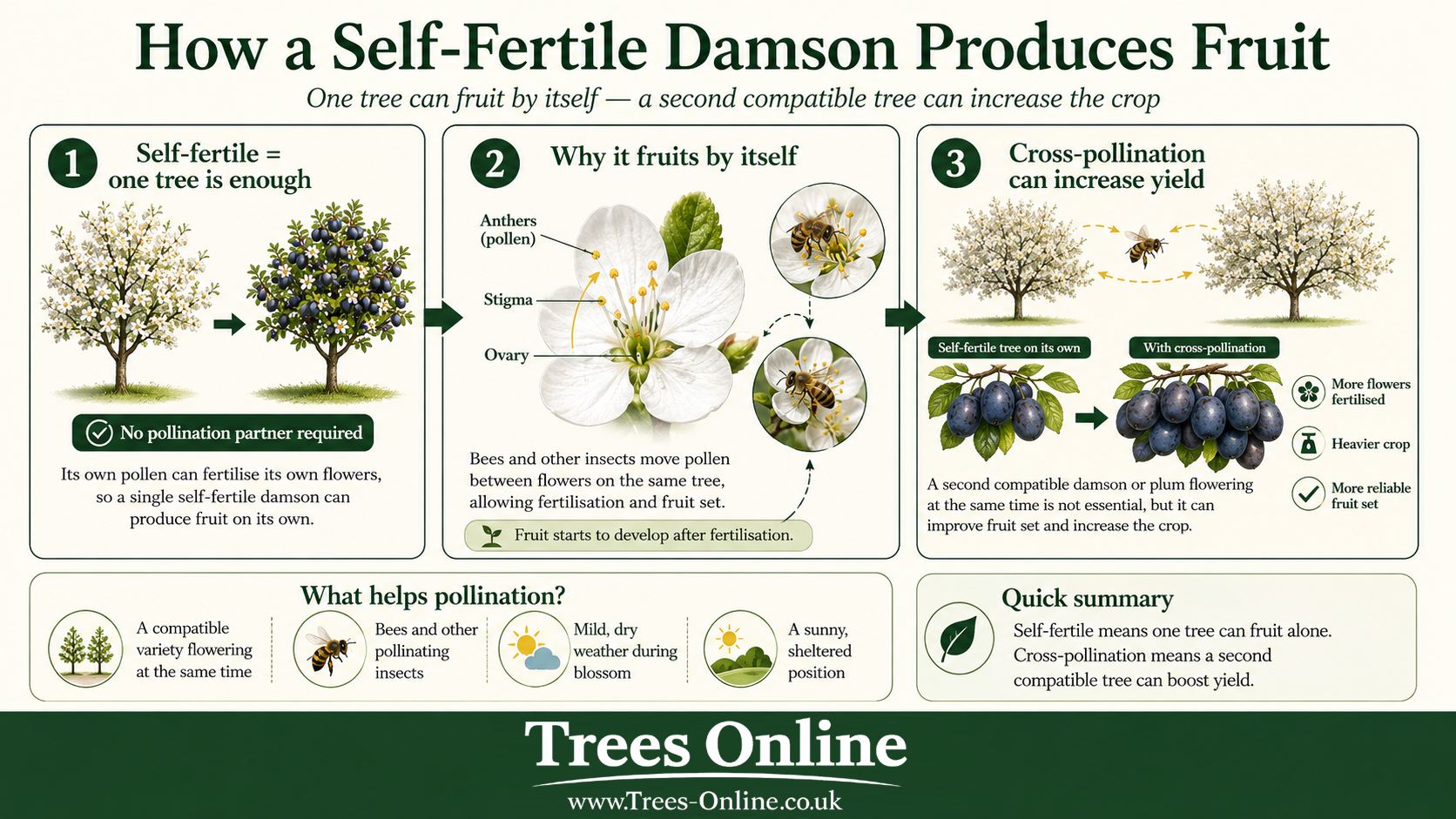
Yes. This means one tree can produce fruit without another damson or plum tree nearby. [2] [4] [5] [6] [7] [8]
Self-fertile does not mean pollination is unnecessary. Pollen still has to reach the flower’s receptive parts, usually with the help of insects. Cold, wet or windy weather during flowering can reduce insect activity and may result in a smaller crop even when the tree flowers well. [1]
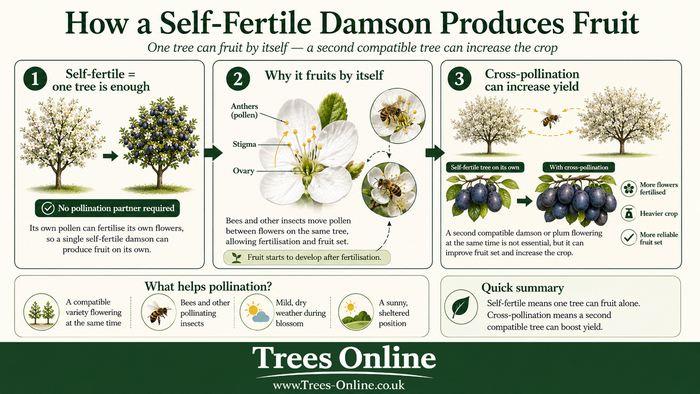
How a self-fertile damson tree can set fruit without a second tree.
View larger imagePollination Groups
Cross-pollination occurs when suitable pollen from one tree fertilises the flowers of another tree. Some fruit trees require a compatible pollination partner to produce fruit. Damsons are self-fertile, so one tree can produce a crop on its own, although cross-pollination with another compatible variety can improve fruit set and increase the harvest.
Pollination groups indicate approximately when a fruit tree flowers and are shown by a number or letter. Each group represents a period during which the flowers are normally open.
Two damsons in group 3 should flower at broadly the same time, giving pollinating insects plenty of opportunity to move pollen between them. Varieties in adjacent groups, such as groups 2 and 3, also normally have enough overlap to cross-pollinate successfully. Varieties several groups apart may have little or no flowering overlap.
Aylesbury Prune (2)
Blue Violet (3)
Bradley’s King / King of the Damsons (2)
Early Rivers (3)
Farleigh (3)
Langley Bullace (2)
Merryweather (3)
Shepherd’s Bullace (3)
Shropshire Prune (3)
Sweet Prune / Hauszwetsche (4)
When Do Damsons Ripen in the UK?
Most of the damson trees in our range are late-season varieties, with fruit normally ready during September. Picking dates are only guides because location, weather, tree age and crop size can move the harvest earlier or later.
How Do You Know When Damsons Are Ready to Pick?
Do not pick damsons simply because they have developed their final colour. They produce their best flavour when allowed to ripen fully on the tree. A ripe damson should feel slightly soft when gently squeezed. Fruit on the same tree may ripen at different times, so the crop normally needs picking more than once. Handle ripe fruit carefully because it bruises easily. [1]
Damson storage life varies considerably between varieties. Under professional cold-storage conditions close to 0°C, plums and fresh prune plums may keep for one to eight weeks, depending on the cultivar [20]. Ordinary domestic refrigerators are warmer and less controlled, so ripe home-grown damsons should normally be used, frozen or preserved promptly. The takeaway is the lower the temperature and closer to 95% humidity you can get, the longer they are likely to store well.
Damson Tree Size and Rootstocks
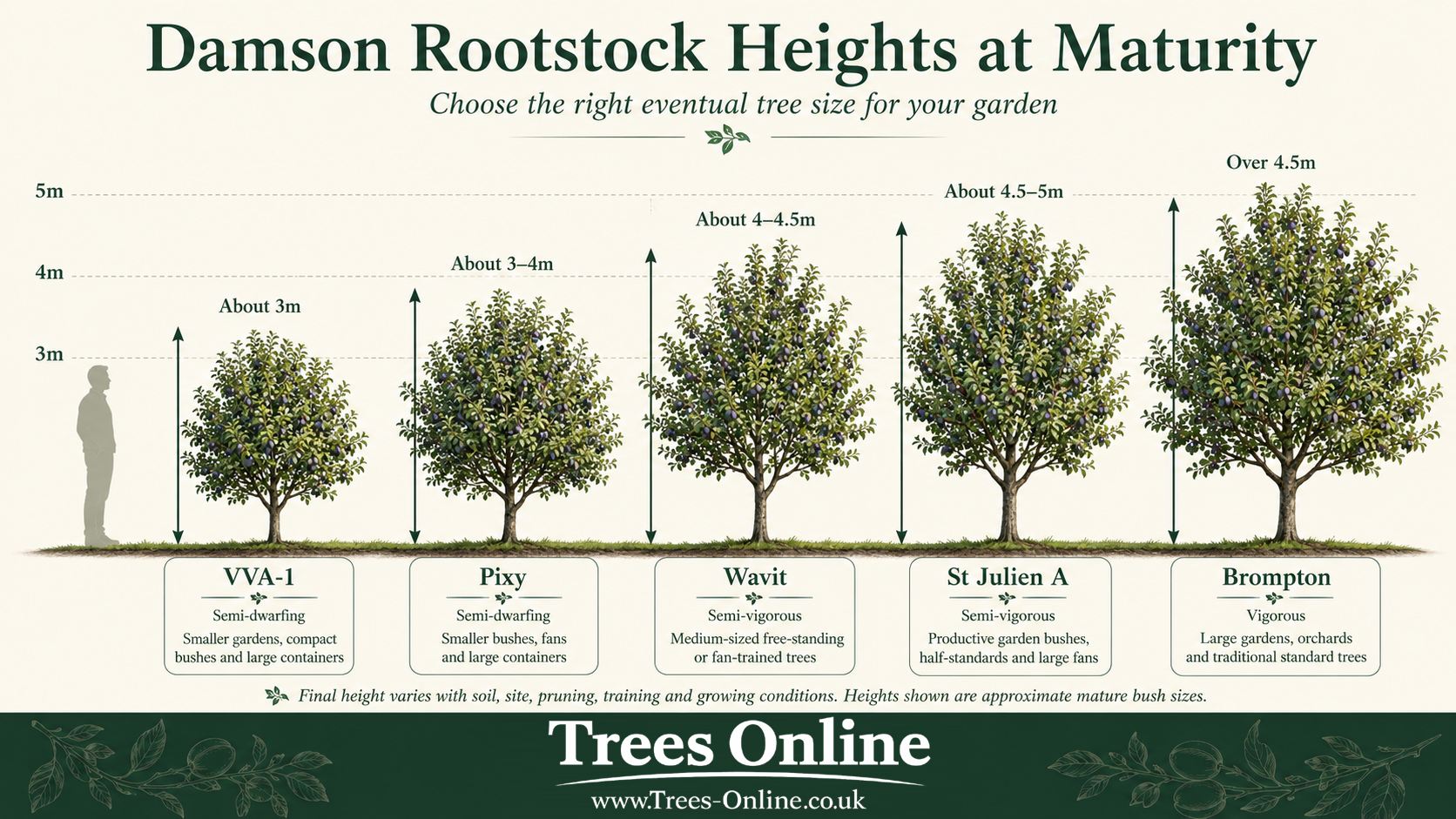
The height of a damson tree when delivered does not tell you how large it will eventually become. Its mature size is controlled mainly by the rootstock, together with the variety, training method, pruning and growing conditions.
A rootstock is the lower, root-forming part of a grafted fruit tree. The chosen damson variety forms the upper fruiting part, while the rootstock controls much of the tree’s vigour and eventual size. [1]
Common Damson Rootstocks
| Rootstock |
Vigour |
Approximate bush height |
Best suited to |
| VVA-1 |
Semi-dwarfing |
About 3m |
Smaller gardens, compact bushes and large containers |
| Pixy |
Semi-dwarfing |
About 3–4m |
Smaller bushes, fans and large containers |
| Wavit |
Semi-vigorous |
About 4–4.5m |
Medium-sized free-standing or fan-trained trees |
| St Julien A |
Semi-vigorous |
About 4.5–5m |
Productive garden bushes, half-standards and large fans |
| Brompton |
Vigorous |
Over 4.5m |
Large gardens, orchards and traditional standard trees |
These heights describe approximate mature sizes and should not be treated as guarantees. Variety, soil, pruning and local growing conditions also affect the finished tree. [1]
Which Damson Rootstock Should I Choose?
The biggest driver of rootstock choice is ultimate tree height. If you have a large garden, you can choose any you like so long as you are comfortable harvesting fruit on ladders from the larger ones, but for container growing, we suggest VVA-1 or Pixy. A naturally smaller tree is less risk for pot growing than a vigorous one but it can be done. The general rule is the larger the pot, the lower the risk, and we advise an absolute minimum of 50L, preferably more like 100+L .[1]
Potted vs Bare-Root Damson Trees
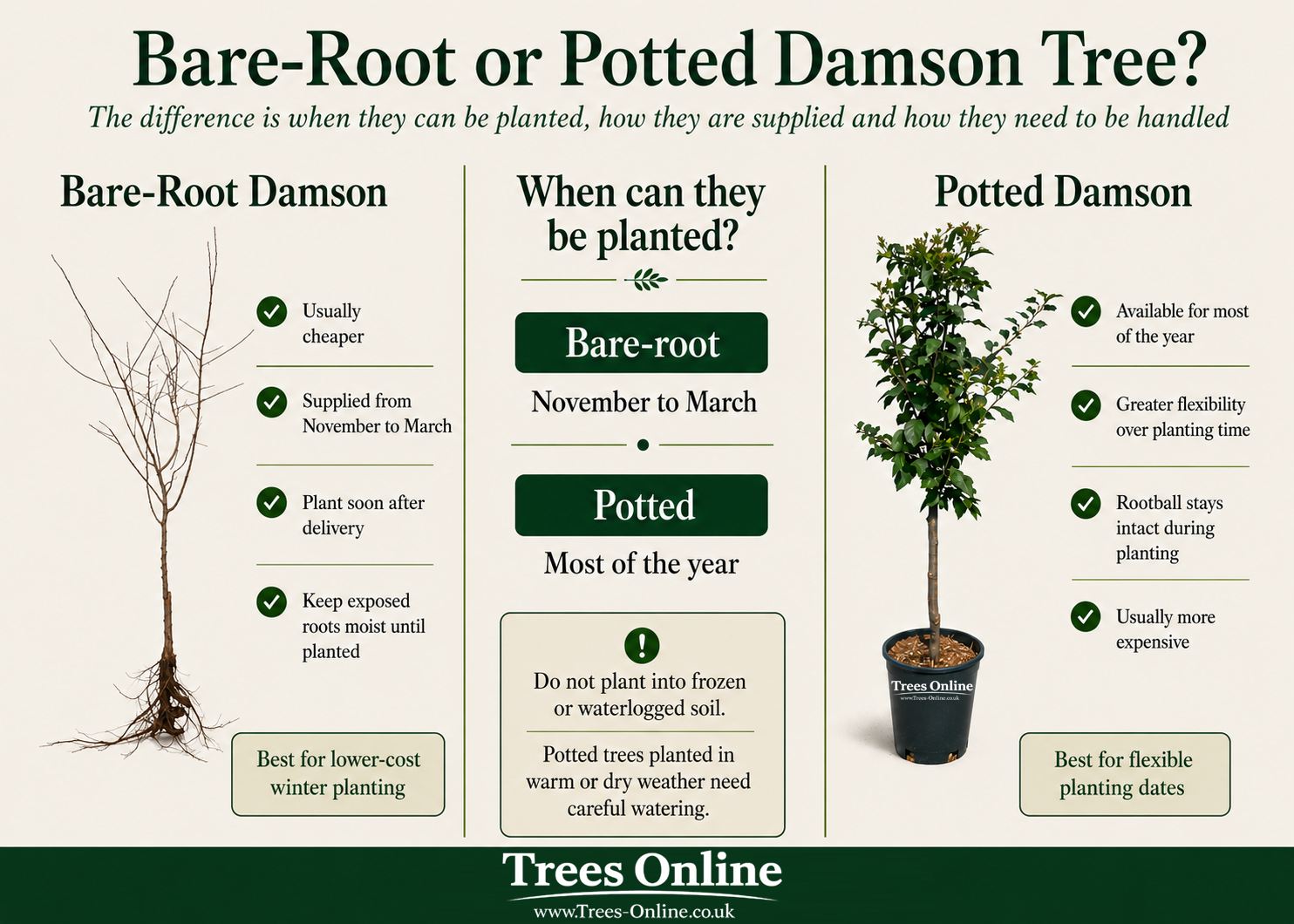
Damson trees are sold either in containers or with bare roots. The variety and rootstock determine the eventual tree, so the choice between potted and bare-root mainly affects availability, planting time, handling and price.
Potted Damson Trees
A potted damson tree is supplied with its roots growing in compost. Container-grown trees are available throughout the year and can potentially be planted at any time, although they establish most easily from late autumn to early spring. Planting during very hot, dry weather should be avoided unless the tree can be watered carefully. [1]
Advantages
- Available for most of the year
- More flexibility over when you plant
- Roots remain protected in compost during delivery
- Convenient for buyers who cannot plant during the bare-root season
Disadvantages
- Usually more expensive than bare-root trees
- Heavier and more costly to transport
- Still require regular watering during establishment
Bare-Root Damson Trees
Bare-root trees are lifted from the nursery field while dormant (November to March) and supplied with no soil around their roots and should be planted promptly after delivery.
Advantages
- Usually cheaper
- Lighter to transport and handle
- Often available in a wider range of young tree forms
Disadvantages
- Restricted to the dormant planting season
- Roots must not be allowed to dry out
- Need planting soon after arrival
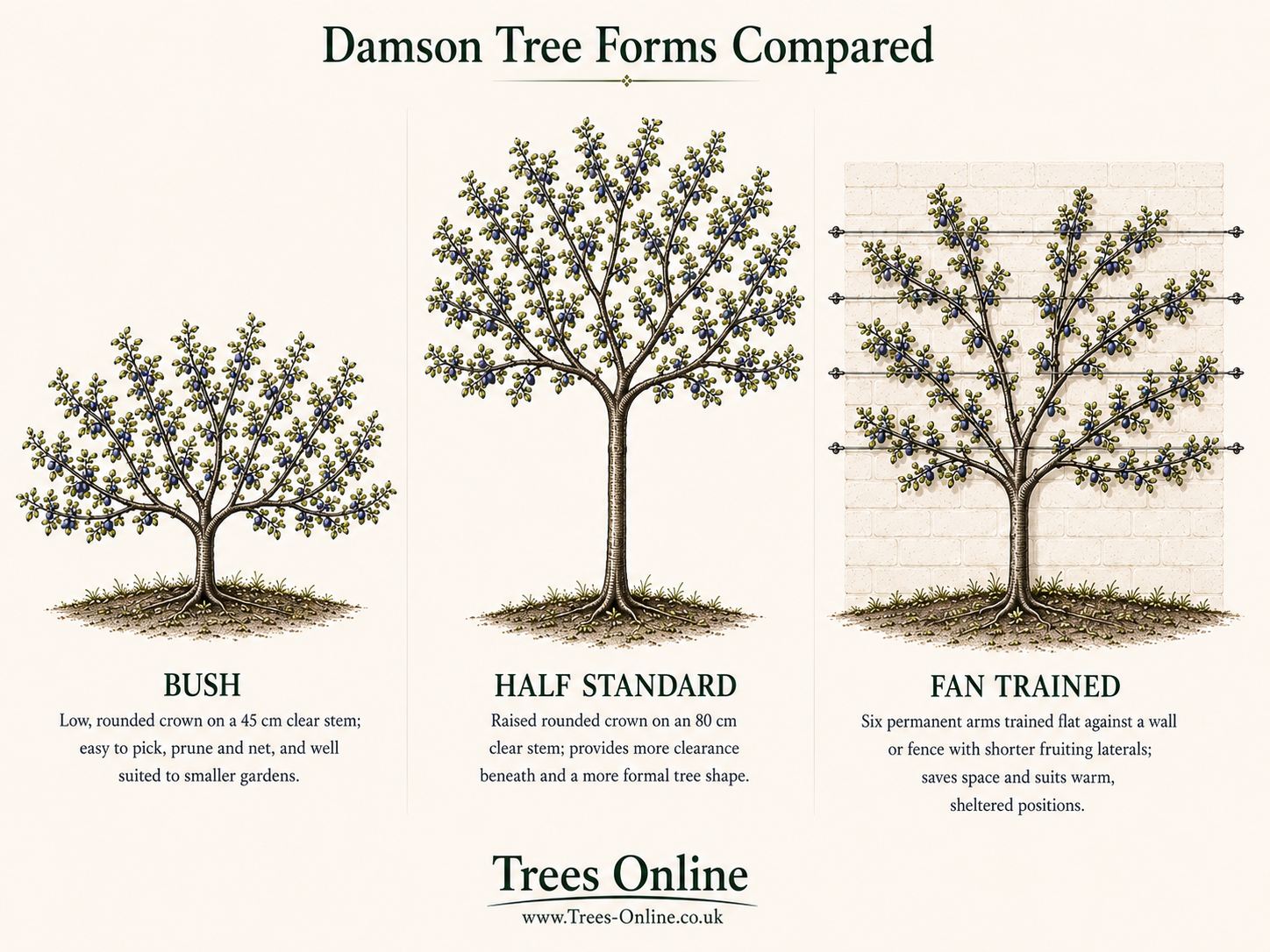
A damson tree’s form describes the shape and height at which its branches have been trained. It is separate from the rootstock: the form affects how the tree uses space, while the rootstock largely controls its eventual vigour and mature size.
Bush Damson Trees
A bush has a relatively short trunk with the main branches starting lower down. It is the most practical free-standing form for many gardens because the fruit and branches remain easier to reach for picking and pruning. The RHS describes bush damsons as open-centred trees with a trunk of about 75cm and three or four main branches. [1] Some growers will have shorter clear stems of around 45cm
Half-Standard Damson Trees
A half-standard has a taller clear trunk before the main branches begin. This creates more space beneath the canopy and gives the tree a more traditional appearance, but the fruit is harder to reach. Clear stem is usually around 80-100cm before side branching starts.
Fan-Trained Damson Trees
A fan-trained damson has its main branches spread across supporting wires against a wall or fence. It can be useful where there is insufficient room for a free-standing tree or where a colder garden would benefit from the warmth and shelter of a suitable wall.
The RHS recommends a south-, south-west- or west-facing wall in colder locations because they store the midday sun whereas an east-facing one would not. Fan-trained trees should be planted about 25–35cm away from the wall, with support wires fitted before planting. Pixy and St Julien A can both be used for fan-trained damsons. [1]
| Form |
Best suited to |
| Bush |
Most buyers wanting easier picking and pruning |
| Half-standard |
A more ornamental shape and easier to underplant or mow. |
| Fan-trained |
Walls, fences, narrower spaces and colder or more exposed gardens |
Can You Grow a Damson Tree in a Pot?
Yes, but the RHS advises choosing a compact damson variety grafted onto Pixy or VVA-1 for permanent container growing. Damsons crop better when planted in the ground, so pots are mainly useful where suitable garden soil or planting space is unavailable or if you need to move the tree to protect from frost and other harsh conditions. [1]
What Size Pot Does a Damson Tree Need?
Use a container at least 50cm wide and 50cm deep, but if possible go for 100L or more. A larger container will generally hold more moisture, provide greater root space and remain more stable. Suitable options include large terracotta pots and half-barrels. Fill the container with a loam-based compost such as peat-free John Innes No. 3. [1]
Caring for a Damson Tree in a Pot
- Water regularly from spring through summer.
- Keep the compost evenly moist without leaving the roots standing in water.
- Feed during the growing season with a high-potassium liquid fertiliser, or apply a suitable granular fertiliser in spring.
- Protect the blossom from frost where practical.
Container-grown damsons need more attention than trees planted in the ground, particularly for watering and feeding. [1]
Best Position for a Damson Tree
Damson trees crop best in a warm, sheltered position in full sun. The trees themselves are hardy, but their early spring blossom can be damaged by frost, strong winds and cold weather. Avoid exposed sites and low-lying frost pockets where possible. [1]
In colder gardens, a fan-trained damson against a south-, south-west- or west-facing wall or fence can benefit from additional warmth and shelter. This can also make frost protection, pruning and harvesting easier. [1]
Best Soil for Damson Trees
Damsons prefer fertile, moisture-retentive but well-drained soil. Loamy or clay soil can suit them well, and the RHS gives a slightly acidic pH of about 6–6.5 as ideal, although damsons tolerate a wider range of soils. They should not be planted where the roots will remain waterlogged. [1]
How Much Space Does a Damson Tree Need?
There are no official width measurements for damson trees that we could find, but images of mature damson trees tend to support the view that they are as tall as they are wide, sometimes even a little more. This means if your tree grows to 5m then you don't want anything like walls and fences within a 2.5m radius of the tree i.e. nothing within 2.5m of the trunk. You can keep the width down with manual pruning if there is no getting away from them, because it is not a good idea for the wind to be scraping your branches against something that damages the bark.
When planting a fan-trained tree against a wall, position the trunk approximately 25–35cm away from the wall rather than placing it directly against the brickwork or fence. This gives the roots better access to rain and soil moisture. [1]
Positions to Avoid
- Permanently waterlogged ground
- Deep shade
- An exposed, windy position
- A frost pocket
- A position too close to buildings, drains or boundaries for the tree’s mature rootstock size
- Lawn where grass has not been removed around the planting area
Grass competes with a newly planted tree for moisture and nutrients. The RHS recommends removing a circle of grass at least 1m across around a newly planted damson. [1]
How Soon Will a Damson Tree Produce Fruit?
A newly planted damson tree may take a few years to become fully established and start fruiting. There is no reliable fixed number because the result depends on the tree’s age, rootstock, variety, growing position, weather and care after planting. [1]Dwarfing rootstocks often bring damson trees into cropping sooner than more vigorous rootstocks, although the timing still depends on the variety, age of the supplied tree, growing conditions and aftercare. In summary, a dwarfing rootstock will get you damsons a little quicker but there is less of it because it is a smaller tree.
What Affects How Soon It Fruits?
- Tree age: an older grafted tree may crop sooner than a very young tree.
- Rootstock: vigour affects eventual size and how quickly a tree settles into cropping.
- Establishment: insufficient watering during the first growing season can delay healthy growth.
- Spring frost: damaged blossom cannot develop into fruit.
- Pollination weather: cold, wet or windy conditions can reduce insect activity.
- Pruning: excessive or badly timed pruning can remove fruiting wood.
- Growing position: full sun and shelter generally encourage stronger flowering and ripening.
The RHS advises watering newly planted damsons regularly during dry periods throughout at least their first growing season. It also notes that early spring blossom is vulnerable to frost, which can reduce or eliminate that year’s crop even on an established tree. [1]
Grafted Tree vs Growing from a Stone
Choose a named grafted damson tree if you want fruit with the known size, flavour and cropping characteristics of that variety. A tree grown from a damson stone is genetically different from its parent, so the fruit may not be the same. Seed-grown trees also usually grow larger and take longer to begin fruiting. [1]
Common Damson Tree Problems Buyers Should Know
Damsons are generally hardy, vigorous and productive trees. Reduced crops are often caused by frost, unfavourable weather at pollination time or insufficient water. [1]
Frost-Damaged Blossom and Poor Pollination Weather
Damsons flower in spring, so late frost can damage open blossom and reduce or eliminate the crop. Cold, wet and windy weather can also damage blossom and discourage pollinating insects. A sheltered position helps, and smaller trees can be covered overnight with horticultural fleece when frost is forecast. Remove the covering during the day so insects can reach the flowers. [1]
Lack of Water and Early Fruit Drop
Insufficient water can cause young damsons to fall before ripening. Newly planted trees, container-grown trees and trees positioned close to walls are most vulnerable. Water newly planted trees during dry periods and keep container compost evenly moist. [1]
Branches Breaking Under Heavy Crops
Damsons can produce crops heavy enough to damage branches. The RHS recommends thinning heavy crops where necessary to reduce the risk of branches breaking under the weight. [1]
Silver Leaf and Pruning Time
Damsons should not be pruned while dormant or in mid- to late autumn because this increases the risk of silver leaf and bacterial canker entering through fresh cuts. Young trees should be pruned in early spring after the buds open, while established trees should be pruned during summer. [1]
Bacterial Canker
Bacterial canker affects Prunus trees and can cause sunken areas of dead bark and small holes in the leaves. Avoid autumn and winter pruning, and remove infected wood during summer using clean tools where appropriate. [12]
Brown Rot, Plum Moth and Aphids
Brown rot can cause a spreading brown decay in ripening fruit. Plum moth caterpillars may feed inside developing fruit, while plum leaf-curling and mealy plum aphids can occur on damsons. These are recognised damson problems, but they do not make damsons unusually difficult fruit trees. [1]
Birds
Birds may take ripe damsons before they are harvested. Smaller trees or individual branches can be protected with securely fitted, taut netting so wildlife cannot become trapped. Established trees often produce enough fruit for some losses to be tolerated. [1]
Damson Tree FAQs
What is the best damson tree to buy?
It depends on what you want from the fruit. Merryweather is a strong choice for relatively large damsons and can be eaten fresh when fully ripe. Farleigh produces reliable crops of smaller traditional damsons. Shropshire Prune is particularly suited to cooking, while Sweet Prune is a sweeter damson-like plum suitable for eating and baking. [2] [4] [6] [7] [8]
Are damson trees easy to grow?
Yes. Damsons are generally hardy, easy to grow and capable of producing heavy crops. Once established in suitable soil, they need relatively little maintenance apart from annual pruning. Their main vulnerability is the early spring blossom, which can be damaged by frost. [1]
Do I need two damson trees?
No. The five varieties in this guide are self-fertile, so one tree can produce fruit without another damson nearby. [2] [4] [5] [6] [7] [8]
What is the difference between a damson and a plum?
Damsons are closely related to plums but are normally smaller, sharper and less sweet. They are especially valued for cooking, jam and preserves, while ordinary plums include a wider range of sweet dessert and culinary varieties. [1]
Is a bullace the same as a damson?
No, although the names are sometimes used loosely and the fruits are closely related. Shepherd’s Bullace produces unusual yellow, sweet-sharp cooking fruit, unlike the familiar dark-blue fruit of most traditional damsons. [5] [11]
Can damsons be eaten raw?
Yes, but traditional damsons are usually tart or astringent when raw and develop a richer flavour when cooked. Merryweather can be eaten fresh when fully ripe, while Sweet Prune has sweeter, high-sugar flesh and is suitable for both fresh eating and baking. [1] [2] [7]
When do damsons ripen in the UK?
Damsons generally ripen from late summer into early autumn, with the precise date depending on the variety, location, weather and growing conditions. Most varieties in our current range are picked during September. [1] [3] [4] [5] [6] [7] [8]
How large does a damson tree grow?
Mature size depends mainly on the rootstock and tree form. A bush on VVA-1 may reach about 3m, Pixy about 3–4m, Wavit about 4–4.5m and St Julien A about 4.5–5m. Brompton produces a larger tree exceeding 4.5m. [1]
Can I grow a damson tree in a pot?
Yes, but choose a compact variety grafted onto Pixy or VVA-1. The RHS recommends a container at least 50cm wide and deep. A tree merely supplied in a nursery pot is not automatically suitable for permanent container growing. [1]
Is St Julien A suitable for a patio damson tree?
St Julien A is a useful semi-vigorous garden rootstock, but it is not genuinely dwarf. A bush can eventually reach about 4.5–5m, so Pixy or VVA-1 is normally more suitable where permanent container growing or restricted space is the priority. [1]
How long does a damson tree take to produce fruit?
A newly planted damson may take a few years to establish and begin fruiting. The timing depends on its age, rootstock, variety, growing position, weather and care after planting. [1]
Should I buy a potted or bare-root damson tree?
Choose a potted tree when you want more flexibility over delivery and planting. Container-grown trees are available throughout the year, while bare-root damsons are cheaper but normally available only from late autumn to early spring and need planting promptly. [1]
Where is the best place to plant a damson tree?
Choose a warm, sheltered position in full sun with fertile, moisture-retentive but well-drained soil. Avoid waterlogged ground, deep shade, exposed sites and frost pockets. In colder gardens, a fan-trained tree against a south-, south-west- or west-facing wall can provide additional warmth and protection. [1]
Can damson trees grow in wet or partially shaded gardens?
Damsons prefer fertile soil that retains moisture, and loamy or clay soils can suit them well. However, the ground must drain properly because damson roots should not remain waterlogged. For the best flowering, fruit development and ripening, plant a damson in full sun rather than treating partial shade as equally suitable. [1]
When should a damson tree be pruned?
Damsons should be pruned during spring or summer rather than autumn or winter. Young trees should be pruned in early spring after the buds open, and established trees should be pruned during summer. This reduces the risk of silver leaf and bacterial canker entering through fresh cuts. [1]
Still Not Sure Which Damson Tree To Buy Online?