Hazel Trees for Sale UK: Hazelnut, Cobnut and Filbert Buying Guide
If you want an edible nut tree for a UK garden, you are usually looking at a hazel tree, hazelnut tree, cobnut tree or filbert tree.
This guide focuses on edible nut-producing hazels, not ornamental witch hazel or corkscrew hazel.
Quick answer: I just want to buy a good hazel tree
If you just want to buy a nut tree and not go nuts reading a thesis, then go for an all-rounder like Kent Cob. For sweetness and thin shell then buy a Cosford Hazel, and for large crops a Hall’s Giant / Merveille de Bollwiller. All will likely need a pollination partner to provide fruits which are listed on each product page. Click the link to view all Hazelnuts we sell online.
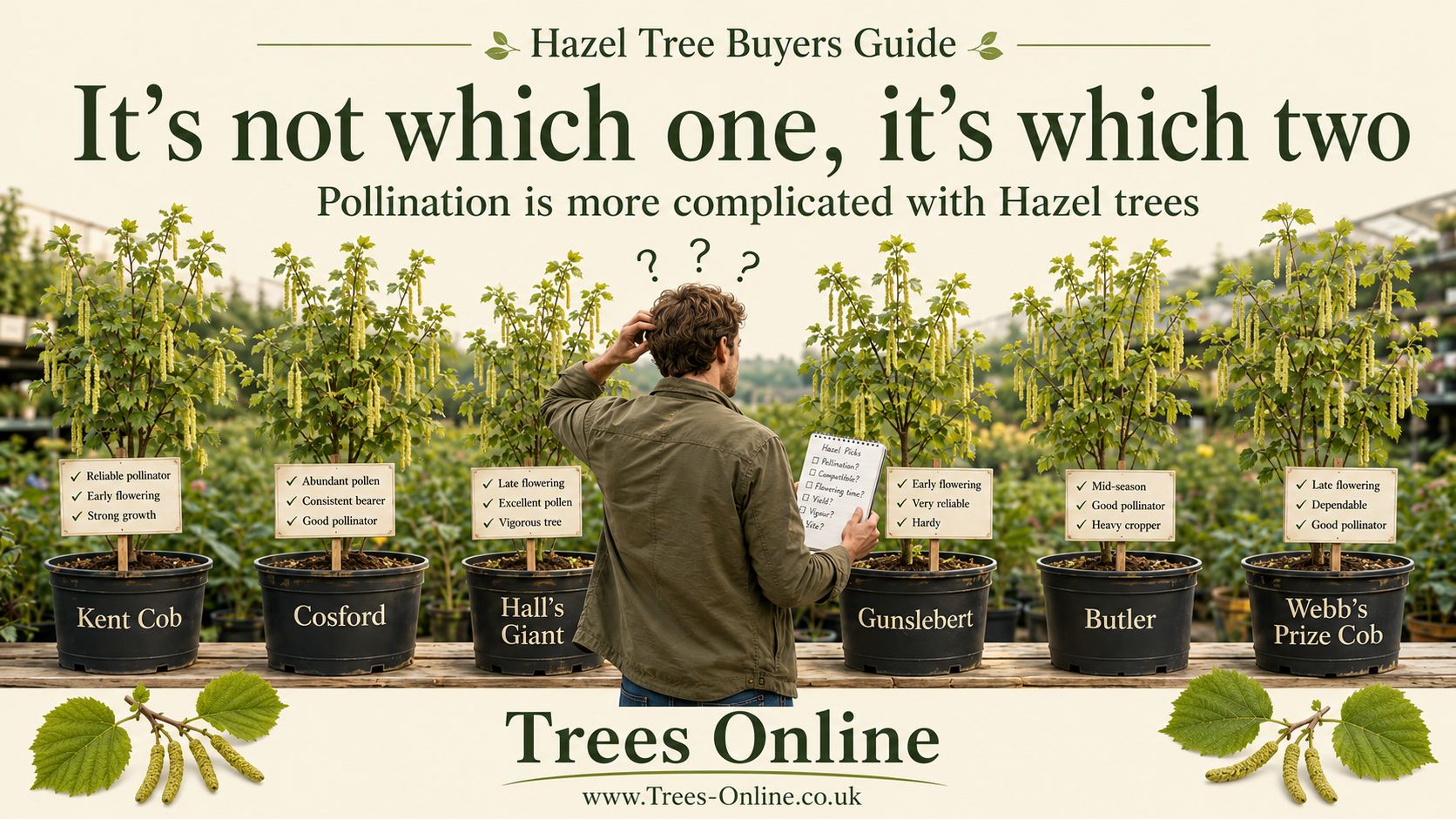
The biggest issue with hazel is pollination so you need to understand the basics before we bamboozle you with jargon.
Pollination
When suitable pollen is given to the female flower by wind, insect or hand-pollination to start the fruit-growing process.
Pollination Partner
A tree that is known to provide pollen at the right time for your tree.
A single tree may crop if another suitable hazel is nearby as pollen can theoretically travel from wild hazel planted in the countryside and other hazels planted nearby but if a nut harvest is your aim, then buying a second pollination partner is your best bet. [1]
Planting two compatible hazel nut varieties gives better pollination and a better chance of a useful crop.
View larger imageOverview of hazelnut, cobnut and filbert trees to buy
RHS describes hazelnuts as the fruit of Corylus trees and bushes, with cobnuts mainly from Corylus avellana and filberts from Corylus maxima.[1] Cobnuts usually have shorter husks where the nut protrudes, while filberts usually have longer husks that cover the nut.[1] These are all in the same family and can cross-pollinate each other.
Below is a list of common nut trees usually available and their pollination partners, but there is a caveat. You need to choose a pairing that works both ways if you want nuts on both trees. Take Corabel and Gunslebert. The latter will pollinate the former, but if you check the Gunslebert column you will notice Corabel is not listed so the Gunslebert will produce little to no nuts. Pick two hazelnut trees where both are listed as pollination partners for each other e.g. Butler and Gunslebert.
The overly simplified explanation for this is.....it just is, don't make us explain it.
For those that enjoy a brain numbing session, here goes. The catkins have different pollen release times across all the varieties. The female flowers have different windows when they can accept the pollen and start the nut growing process. Also, the pollen has to be genetically compatible as well as available at the right time. All of these factors have to align, which is why hazel pollination is so complicated and restrictive.
As most cobnuts, filberts and hazelnut trees are self-sterile, this means for whatever reason, their pollen will not pollinate their own flowers so have to rely on a different variety. Plant close together for maximum cross-pollination, ideally next to each other and less than 15m.
| Variety |
Tree overview |
Nut size |
Crop |
Pollination partners |
| Butler Hazelnut |
Large, sweet edible hazelnut with strong flavour and good texture. Useful for eating, cooking and pollination. |
Large |
Heavy |
Gunslebert, Cosford, Ennis, Hall’s Giant / Merveille de Bollwiller.[1] [14] |
| Corabel / Coribel |
Modern European hazelnut variety often grown for large, tasty nuts and orchard-style production. |
Large |
Heavy +
reliable
|
Gunslebert, Gustav Zeller, Hall’s Giant, Lang Tidlig Zeller, Tonda di Giffoni.[21] |
| Cosford Filbert / Cosford Cob |
Traditional English filbert/cobnut valued for sweet nuts, thin shells, excellent flavour and strong pollination value. |
Medium |
Reliable |
Gunslebert, Hall’s Giant / Merveille de Bollwiller.[15] |
| Ennis |
Large-nutted filbert/hazelnut with attractive round nuts and very good flavour. Also listed as a good pollinator. |
Large |
Good |
Butler, Hall’s Giant / Merveille de Bollwiller.[1] |
| Fertile de Coutard |
Old French hazelnut variety, useful in wider cultivar comparisons and collections. |
Large |
Good |
Cosford or Daviana.[28] |
| Gunslebert Hazelnut |
Old German hazelnut with good texture, strong nutty flavour, strong catkin display, RHS Award of Garden Merit status and good pollination value. |
Medium
or larger
|
Heavy +
reliable
|
Butler, Cosford.[16] |
| Gustav Zeller / Gustav’s Zeller |
Recognised European hazelnut cultivar included in cultivar and nutrition comparisons. |
Large |
Heavy |
Butler, Gunslebert.[22] |
| Hall’s Giant / Merveille de Bollwiller |
Hardy, vigorous and productive hazelnut with large edible nuts, attractive early catkins and excellent cross-pollination value. |
Large |
Good |
Butler, Ennis, Cosford, Gunslebert, Kent Cob / Kentish Cob.[17] |
| Kent Cob / Kentish Cob |
One of the best-known traditional UK cobnuts, valued for good flavour, fine texture, reliability and domestic use. |
Medium
or larger
|
Reliable |
Gunslebert, Cosford, Hall’s Giant / Merveille de Bollwiller.[18] |
| Lang Tidlig Zeller |
Hazelnut variety worth listing for completeness where broader Corylus collections are offered. |
Medium |
Good |
Gustav Zeller, Gunslebert.[23] |
| Longue d’Espagne |
Spanish-type hazelnut/filbert cultivar found in wider European hazel lists. |
Large |
Reliable |
Cosford / Coxford, Gunslebert, Impératrice Eugénie.[12] |
| Nottingham Hazelnut / Pearson’s Prolific |
Old English hazelnut grown for good-flavoured edible nuts, reliable garden usefulness and a long history as a productive garden nut. |
Medium |
Good |
Hall’s Giant / Merveille de Bollwiller, Webb’s Prize Cob.[19] |
| Red Filbert / Purple Filbert |
Red-leaved filbert grown mainly for ornamental value, with burgundy to purple spring foliage, purple catkins and red nuts. |
|
Variable |
Gunslebert, Nottingham, Webb’s Prize Cob.[24] |
| Red Majestic |
Compact ornamental red-leaved contorted hazel with dark purple foliage and purplish-pink catkins. Mainly ornamental, but may produce some edible nuts. |
|
Variable |
Cosford / Coxford, Gunslebert, Longue d’Espagne, Impératrice Eugénie.[12] |
| Ségorbe |
Spanish hazelnut cultivar found in European cultivar descriptors and trial material. |
Large |
Heavy |
Gunslebert, Tonda di Giffoni, Daviana.[25] [28] |
| Tonda di Giffoni |
Italian hazelnut variety valued for nut quality, good flavour and disease-resistance interest. |
Medium
or larger
|
Heavy |
Gunslebert, Butler.[26] |
| Tonda Gentile Romana / Tonda Gentile de le Romana |
Italian confectionery hazelnut variety associated with nut quality and commercial use. |
Medium
or larger
|
Heavy |
Tonda Gentile Trilobata.[27] |
| Tonda Gentile Trilobata / Tonda Gentile delle Langhe |
Highly regarded Italian confectionery hazelnut, widely valued for flavour and roasting quality. |
Medium
or larger
|
Heavy |
Tonda Gentile Romana, Fertile de Coutard, Negret, Daria, Pauetet.[29] |
| Webb’s Prize Cob |
Traditional English cobnut/hazelnut grown for large edible nuts, rich flavour, long storage and good disease resistance. |
Large |
Reliable |
Cosford, Hall’s Giant / Merveille de Bollwiller, Nottingham.[20] |
How big do hazel trees get, and can you keep them small?
RHS gives average cobnuts and filberts a potential size of around 6m by 5m if left unpruned.[1] Hazel should therefore be treated as a proper garden shrub or small tree, not a miniature patio plant.
You can manage hazel by pruning and shaping, but you still need to allow sensible space. Hazel is often naturally multi-stemmed, and it can be grown more like a bush than a clear-stemmed fruit tree.
Cobnuts and filberts are normally grown on their own roots, so rootstock choice is not usually part of the buying decision in the way it is with apples or pears.[1] If space is tight, choose the smallest suitable variety available and keep it managed from the start. Those listed by the RHS at 2.5-4m tall are Cosford, Kent, Webbs Prize Cob and Red Majestic.
Should you keep a hazel tree in a pot?
Generally, no. Hazel is best planted in the ground. It is naturally a large shrub or small tree, so long-term container growing is a compromise rather than the ideal method. As most people grow them for the fruits then there is a higher maintenance commitment in terms of watering and feeding when growing in a pot.
If you must try a container, choose a small variety e.g. Cosford, Kent, Webbs Prize Cob and Red Majestic, use a large heavy pot, keep watering consistent, and expect more feeding, more attention and possibly reduced long-term cropping.
Where to plant a hazel tree
Plant hazel nuts in a sunny or lightly shaded position. They will tolerate some shade, but if your main aim is a good nut crop, give them as much sun as you reasonably can. RHS says cobnuts and filberts crop best in full sun or light shade, in a sheltered position, and prefer well-drained soil.[1]
For the best crop, plant hazel nuts in sun or light shade, in a sheltered position with well-drained soil.
View larger imageShelter matters because hazel nuts flower early, with male catkins and tiny female flowers appearing before most of the garden has woken up. A cold, exposed site is less likely to give reliable crops than a warmer, calmer position. Avoid obvious frost pockets where cold air sits, especially in lower parts of the garden.[1]
The soil should be moisture-retentive but well drained. A neutral to alkaline soil is ideal, although good results can also be had in more acidic soil if drainage is good.[2] Avoid waterlogged ground, compacted soil and places that stay wet for long periods after rain. Hazel nuts like moisture, but wet feet are a poor long-term choice. Very fertile soil can also push too much leafy growth at the expense of cropping.[1] Stay away from waterlogged clay, very dry soils and exposed, windy sites.[30]
Allow enough space. Hazel nuts can become sizeable shrubs or small trees, and RHS gives cobnuts and filberts a potential size of about 6m high by 5m wide if left unpruned.[1] They can be managed by pruning, but they are not true dwarf patio fruit trees.
Hazel nuts can grow widely in the UK, but crops are usually more reliable in warmer, sheltered areas. The Kentish Cobnuts Association says cobnuts can be grown as far north as Scotland, but cropping is more regular further south.[2] RHS also notes cobnuts are the least hardy of the group and cropping may be affected below about -10°C.[1]
Planting and caring for hazel trees
Plant hazel in the ground at the same depth it was growing in the pot. Water well after planting, then keep it watered during dry spells while it establishes.
Do not leave a potted hazel sitting in its nursery pot for months and treat it as a finished patio plant. It is sold in a pot for safe transport and flexible planting, but it should usually be planted into the ground within a few months of delivery.
Mulch around young trees to help retain moisture and reduce weed competition, but keep mulch away from the stem.
For pruning, the simple aim is an open, manageable framework. RHS recommends an open-centred framework with no more than about 8–10 main leaders, keeping short twiggy growth because it carries many female flowers, and removing suckers if you do not want the plant to become a dense thicket.[1]
How soon will a hazel tree produce nuts?
RHS says cobnuts and filberts should start producing nuts after about 3–4 years.[1] Useful crops still depend on variety, age, pollination, site, pruning, weather and squirrels. The 7 L options we sell are 2-3 years old.
If your tree has catkins but few nuts, the likely causes are poor pollination, lack of a compatible partner, bad weather during flowering, poor kernel fill, or squirrels taking nuts before you get them.
Can you eat cobnuts and hazelnuts straight from the tree?
Yes, but we find picking them first is much easier. The Kentish Cobnuts Association describes a cobnut as a cultivated British hazelnut and says cobnuts are delicious eaten raw.[3] Fresh cobnuts are seasonal, with green husks and juicy kernels earlier in the season, while later nuts develop brown shells, brown husks and a fuller kernel flavour.[4]
RHS says cobnuts and filberts are usually harvested when the husks begin to turn yellow, around late September.[1] Woodland Trust gives September to October as the wider hazelnut ripening period, depending on the weather, and says ripe nuts are brown and ready when the papery covering starts pulling back from the nut.[5]
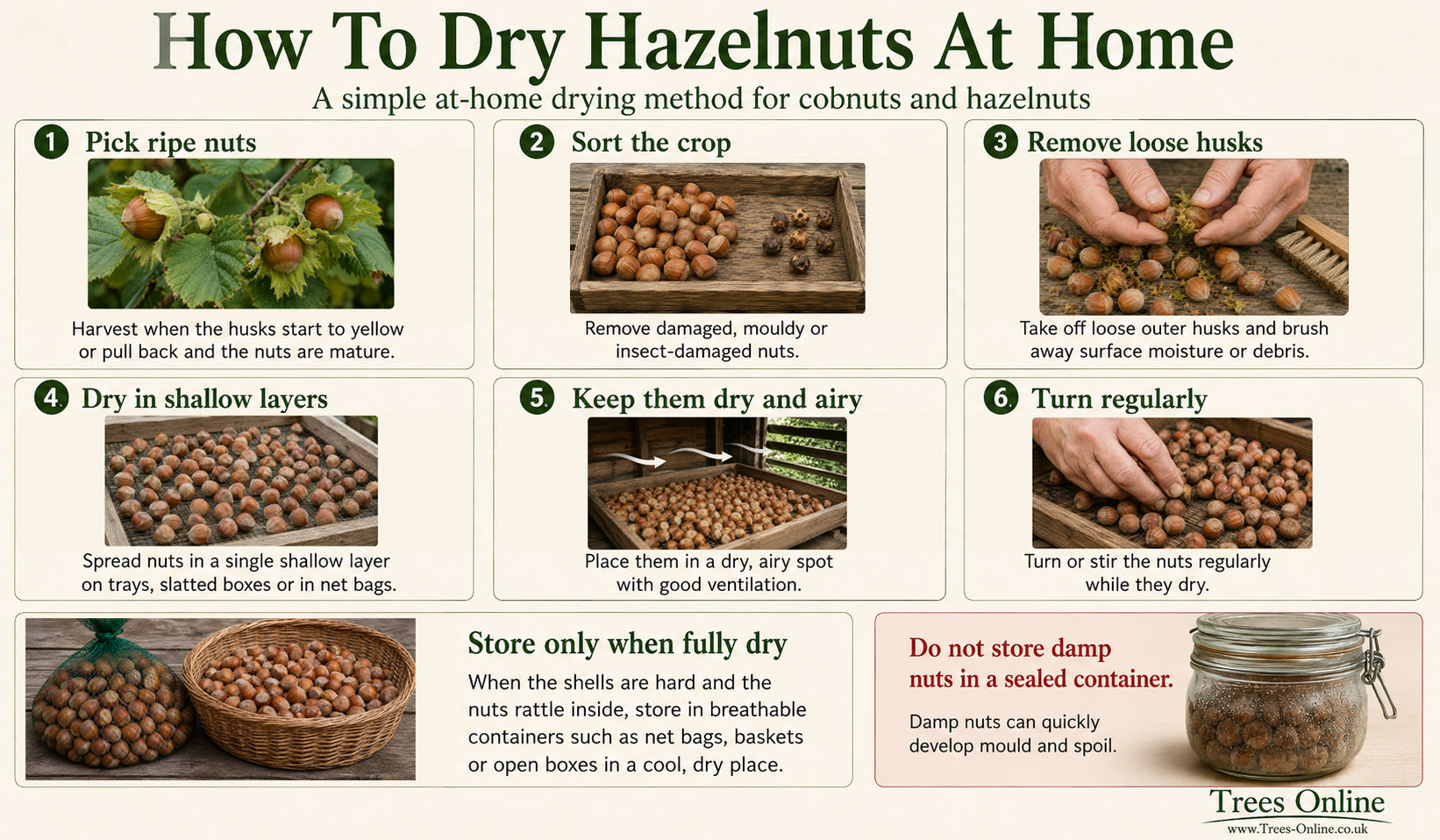
For storage, RHS advises drying nuts in shallow layers, slatted boxes or net bags in a dry, airy place, turning them regularly while drying.[1] Do not store damp nuts in a sealed container.
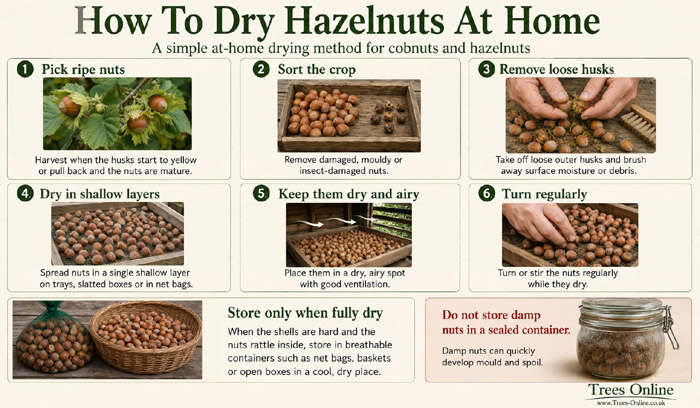
Dry hazel nuts in shallow layers in a dry, airy place, turning them regularly before storage.
View larger imageHazel garden benefits
Hazel nuts are useful wildlife trees as well as edible nut trees. Their catkins provide early pollen for bees when little else is flowering, the leaves support moth caterpillars, and the nuts are eaten by birds and mammals including woodpeckers, nuthatches, jays, dormice, bank voles and wood mice. Hazel also works well in mixed native hedgerows and woodland-style planting, where its dense growth gives cover and nesting/shelter value. RHS describes common hazel as excellent for wildlife gardens, hedgerows and woodland settings.[6][7][30]
Most people think of hazel nuts as something to eat, bake with, roast, or fight the squirrels for. But the shells are useful too. Once the kernel has been eaten, the hard outer shell is not just waste. It can be used in the garden, as fuel, and even in some industrial materials.
Hazel nut shells as garden mulch
One of the most practical uses for hazel nut shells is as a decorative mulch. Crushed shells can be spread around plants to help cover bare soil, reduce splashing, and give beds or pots a tidy natural finish. They break down slowly, so they last longer than many soft plant materials. For normal gardeners, this is probably the most useful shell use. Research has also tested hazelnut shells as mulch in nursery production, so this is not just an internet gardening myth.[31]
Can you compost hazel nut shells?
Yes, but expect them to break down slowly. Hazel nut shells are hard and woody, so they will not disappear quickly in a compost heap. Crushing them first will help them break down faster. If you do not want them sitting around in the compost for ages, use them as a surface mulch instead.
Fighting the squirrels
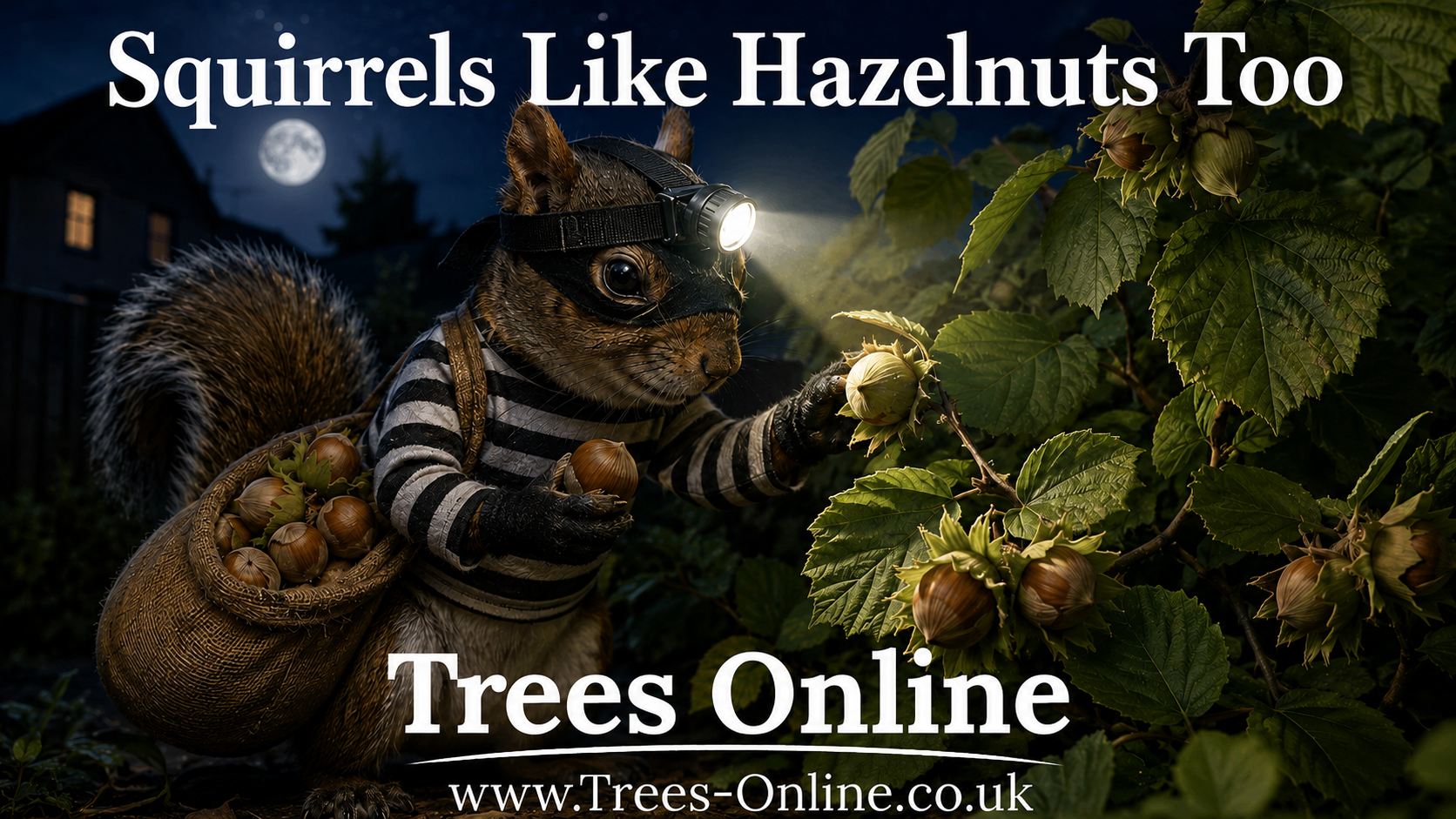
Squirrels are one of the biggest practical problems if you want to keep your hazel nut crop.
Squirrels are one of the biggest practical problems if you want to keep your hazel nut crop.
View larger imageThe most realistic approach is to reduce losses rather than expect perfect protection. Keep the hazel nut tree pruned and manageable so you can reach the crop, check it regularly as the nuts start to ripen, and pick early if squirrels are active. On smaller trees, netting may help, but it must be fitted securely and checked so birds and other wildlife do not become trapped.
What does the law say about squirrels?
In the UK, the important distinction is usually between red squirrels and grey squirrels. Red squirrels are protected and must not be harmed. Grey squirrels are an invasive non-native species, but that does not mean you can deal with them however you like.
If a grey squirrel is trapped, it is illegal to release it back into the wild without a licence. Government guidance says grey squirrels cannot normally be released once caught, and Natural England no longer issues licences to release them.[32] The RSPCA also says that if a live-catch trap is used, any captured grey squirrel must be dealt with humanely and must not be released elsewhere.[33]
You must also avoid causing unnecessary suffering. Traps must be lawful, suitable, checked regularly and used responsibly. If you are not trained or confident, do not trap squirrels yourself. Use prevention, early picking and crop protection instead, or contact a professional pest controller.
For most garden owners, the sensible legal and practical advice is simple: do not harm red squirrels, do not trap grey squirrels unless you understand the law and welfare responsibilities, do not release a trapped grey squirrel somewhere else, and focus first on keeping the tree manageable, protecting the crop where practical, and harvesting before squirrels take the lot.
Common hazel tree problems buyers should know about
| Problem |
Why it matters |
Buyer-friendly answer |
| Poor pollination |
Lots of catkins but few or no nuts. Catkins do not automatically mean the female flowers have received suitable pollen. |
Plant at least two compatible hazel nut varieties. Do not just plant any two; choose varieties that are listed as pollination partners for each other where possible. Keep them within about 15m for best pollination.[1][2] |
| Blank nuts / empty shells |
Nuts may form, but the shell contains no kernel or only a very small kernel. An empty shell is not always simple pollination failure; sometimes the shell forms but the kernel fails to develop properly.[8] |
Do not assume every empty nut means the wrong pollination partner. Improve the basics first: use compatible pollinators, avoid exposed or drought-prone sites, keep the tree watered in dry spells, and avoid overfeeding with nitrogen. |
| Squirrels |
They may take nuts before they are fully ready, and a good crop can disappear quickly. |
Pick early if squirrels are active, even if flavour is not quite as good.[1] Keep the tree pruned to a manageable size, check the crop daily as husks start to yellow, and net smaller trees or branches if practical. Store picked nuts somewhere dry and rodent-proof. |
| Bud mite / big bud mite |
Buds can become swollen, rounded or distorted and may fail to develop properly.[9] |
Inspect the tree in winter and early spring. Remove and dispose of badly affected buds or shoots where practical. If a variety is repeatedly badly affected, choose a more resistant variety next time. RHS says hazel big bud mite is rarely sufficiently abundant to affect growth or fruiting, so do not panic over a few swollen buds.[30] |
| Hazel nut weevil |
Hazel nut-feeding weevils can damage developing nuts, leaving small round holes in the shell, damaged kernels, or grubs inside the nut.[10] |
Collect and dispose of damaged nuts. Clear fallen nuts and debris under the tree. RHS says there is no direct remedy, but cultivating or breaking up the ground beneath bushes in winter can destroy some overwintering grubs.[1] In a garden, good hygiene and removing affected nuts is the most realistic response. |
| Powdery mildew |
Large hazel nut leaves can suffer from powdery mildew, especially in dry seasons or where bushes are crowded and air circulation is poor.[1] |
Improve air circulation by pruning out crowded growth. Keep the framework open rather than letting the tree turn into a dense thicket. Water young or stressed trees in dry spells, but avoid soaking the leaves late in the day. |
| Too little space |
Hazel nuts can become sizeable shrubs or small trees, making them harder to harvest, prune or protect from squirrels. |
Do not treat hazel nuts as patio miniatures. Plant in the ground with room to manage them. RHS gives cobnuts and filberts a potential size of about 6m high by 5m wide if left unpruned.[1] Keep an open framework and remove unwanted suckers. |
| Poor site |
Very wet, exposed, very cold, very dry or badly shaded sites can reduce growth and cropping. |
Plant in sun or light shade, in a sheltered position with moisture-retentive but well-drained soil.[1] Avoid waterlogged clay, very dry soils, frost pockets and exposed windy sites. A warmer, calmer site gives better odds of regular crops. |
| Overfeeding / too much leafy growth |
Very fertile soil or too much nitrogen can encourage strong leafy growth at the expense of flowers and nuts.[1] |
Do not overfeed with nitrogen-rich fertiliser. If the tree is growing strongly but cropping poorly, focus on pollination, pruning, light and site rather than adding more feed. |
FAQs
Are hazel trees and hazelnut trees the same?
In normal buying language, yes, they usually overlap. Hazelnuts are the fruit of Corylus, or hazel, trees and bushes.[1]
Are cobnuts and hazelnuts the same?
They are closely related and often discussed together. The Kentish Cobnuts Association describes a cobnut as a cultivated British hazelnut.[3]
Are filberts and hazelnuts the same?
They are closely related edible hazels. In everyday buying language the terms are often mixed, but RHS separates filberts under Corylus maxima.[1]
Do hazel trees need a pollination partner?
For reliable crops, yes. RHS says it is best to plant at least two different cultivars to ensure good nut set.[1] Read the above article to find a pollination partner.
Can you eat hazelnuts from a hazel tree?
Yes, but we find picking them first is easier. Hazelnuts are the edible nuts produced by hazel trees and bushes.[1]
Can you eat cobnuts straight from the tree?
Yes. Cobnuts can be eaten raw, and fresh cobnuts are traditionally eaten while green earlier in the season.[3][4]
How big does a hazel tree grow?
RHS gives cobnuts and filberts a potential size of around 6m high by 5m wide if unpruned.[1] Managed garden plants can be kept smaller, but hazel still needs proper space.
Can you keep a hazel tree small?
Yes, within reason. Pruning and management can control size, but hazel is not a true dwarf patio fruit tree.
Are hazel tree roots invasive?
Hazel is not usually bought as an aggressively invasive-rooted tree, but it can become a large shrub or small tree. Give it sensible space away from drains, walls and small paved areas. Usually old paths and clay drains are the biggest problem with tree roots because they are weak and allow the roots in.
Where is the best place to plant a hazel tree?
Plant in sun or light shade, in a sheltered position with well-drained soil.[1]
When should you prune a hazel tree?
RHS gives specific pruning guidance for cobnuts and filberts, including summer pruning/brutting for established bushes.[1] The simple buyer answer is: prune to keep an open, manageable framework and avoid letting it turn into an unmanaged thicket.
Is hazel a bush or a tree?
Both descriptions are common. RHS describes hazels as deciduous trees and large shrubs, and Corylus avellana as a large shrub or small multi-stemmed tree.[6][11]
Sources
- RHS — Cobnuts and filberts growing guide: https://www.rhs.org.uk/nuts/cobnuts-filberts
- Kentish Cobnuts Association — Growing nuts / pollination: https://kentishcobnutsassociation.org.uk/growing-nuts/
- Kentish Cobnuts Association — What is a cobnut?: https://kentishcobnutsassociation.org.uk/the-cobnut/
- Kentish Cobnuts Association — FAQs: https://kentishcobnutsassociation.org.uk/faqs/
- Woodland Trust — Hazelnuts: where and when to forage: https://www.woodlandtrust.org.uk/blog/2019/08/hazelnuts-where-and-when-to-forage/
- RHS — Hazel plant guide: https://www.rhs.org.uk/plants/hazel
- Woodland Trust — Hazel / Corylus avellana: https://www.woodlandtrust.org.uk/trees-woods-and-wildlife/british-trees/a-z-of-british-trees/hazel/
- Pacific Northwest Pest Management Handbooks — Hazelnut blanks: https://pnwhandbooks.org/plantdisease/host-disease/hazelnut-corylus-avellana-blanks
- Pacific Northwest Pest Management Handbooks — Hazelnut-Filbert bud mite: https://pnwhandbooks.org/insect/nut/hazelnut/hazelnut-filbert-bud-mite
- Journal of Integrated Pest Management — Biology, Ecology, and Management of Hazelnut-Feeding Weevils: https://academic.oup.com/jipm/article/13/1/16/6590885
- RHS — Corylus avellana plant profile: https://www.rhs.org.uk/plants/4511/corylus-avellana-%28f%29/details
- Plantes Avenue — Noisetier avellana Red Majestic: https://plantes-avenue.fr/arbustes/38312-noisetier-avellana-red-majestic-3565420383128.html
- Trees-Online — Hazelnut & Cobnut Trees category: https://www.trees-online.co.uk/fruit-trees/hazelnut-cobnut-trees
- RHS — Cobnuts and filberts growing guide / Butler pollination: https://www.rhs.org.uk/nuts/cobnuts-filberts
- RHS — Cobnuts and filberts growing guide / Cosford pollination: https://www.rhs.org.uk/nuts/cobnuts-filberts
- RHS — Cobnuts and filberts growing guide / Gunslebert pollination: https://www.rhs.org.uk/nuts/cobnuts-filberts
- RHS — Cobnuts and filberts growing guide / Hall’s Giant / Merveille de Bollwiller pollination: https://www.rhs.org.uk/nuts/cobnuts-filberts
- Kentish Cobnuts Association — Growing nuts / Kentish Cob pollination: https://kentishcobnutsassociation.org.uk/growing-nuts/
- RHS — Cobnuts and filberts growing guide / Pearson’s Prolific / Nottingham Prolific: https://www.rhs.org.uk/nuts/cobnuts-filberts
- Trees and Shrubs Online — Corylus avellana × maxima / Webb’s Prize Cob: https://www.treesandshrubsonline.org/articles/corylus/corylus-avellana-x-maxima/
- Frank P Matthews — Corabel: https://www.frankpmatthews.com/catalogue/fruit-trees/hazel/corabel/
- Frank P Matthews — Gustav Zeller: https://www.frankpmatthews.com/catalogue/fruit-trees/hazel/gustav-zeller/
- Frank P Matthews — Lang Tidlig Zeller: https://www.frankpmatthews.com/catalogue/fruit-trees/hazel/lang-tidlig-zeller/
- Frank P Matthews — Red Filbert: https://www.frankpmatthews.com/catalogue/fruit-trees/filbert/red-filbert/
- Frank P Matthews — Ségorbe: https://www.frankpmatthews.com/catalogue/fruit-trees/hazel/segorbe/
- Frank P Matthews — Tonda di Giffoni: https://www.frankpmatthews.com/catalogue/fruit-trees/hazel/tonda-di-giffoni/
- Frank P Matthews — Tonda Gentile de le Romana: https://www.frankpmatthews.com/catalogue/fruit-trees/hazel/tonda-gentile-de-le-romana/
- Acta Horticulturae — Effect of pollen source on nut and kernel characteristics of hazelnut: https://www.actahort.org/books/556/556_55.htm
- Creso Ricerca — Il nocciolo: cultivar e impollinatori: https://nocciolare.it/wp-content/uploads/2016/03/CresoRicerca_1027_11.pdf
- RHS — Why hazel is the small tree that has it all: https://www.rhs.org.uk/garden-inspiration/plants-we-love/hazel-the-wildlife-wonder-tree
- HortTechnology — Hazelnut shells as mulch in container nursery production: https://journals.ashs.org/view/journals/horttech/36/1/article-p86.xml
- GOV.UK — Invasive non-native species and grey squirrels: https://www.gov.uk/government/news/march-2019-update-invasive-non-native-species-and-grey-squirrels
- RSPCA — How to keep squirrels out of your garden: https://www.rspca.org.uk/adviceandwelfare/wildlife/squirrels/garden