Walnut Trees for Sale UK: Buying Guide
Buying a walnut tree can be daunting due to the similar-sounding product descriptions with little to separate them. What they all have in common is that you are going to need space and patience if you are going to buy any of them.
Some walnuts are prized more for their size, ornamental value and timber than for their nut harvest e.g.
Black walnut — Juglans nigra
Common / English / Persian walnut — Juglans regia
Butternut — Juglans cinerea
Heartnut — Juglans ailantifolia var. cordiformis
Manchurian walnut — Juglans mandshurica.
If you want nuts, a grafted variety is usually the safest route (one that has not been grown from seed and is two parts of trees grafted together).
I Just Want to Buy a Good Walnut Tree — What Should I Choose?
If you want one walnut tree just for nuts, then two walnut trees stand out, Lara and Chandler. Both have large, good-quality edible nuts and grafted modern varieties. Just click the links, part with your money and no need to read the rest of this thesis. Thanks for your business, adios amigo and see you again soon.
.....
.....
....
Still here? Ok, let's do this.
Before we dive into the comparison, you need to know what a pollination partner is. This is when another suitable tree is close enough that its pollen reaches your tree and fertilises the flowers to start the fruit-growing process. A non-self-fertile tree will not provide fruit unless a pollination partner is nearby. A partially self-fertile will provide some fruits but not enough to be considered a full harvest and a self-fertile tree will give you a good harvest. Both harvest sizes can be improved with a pollination partner nearby.
When comparing the two, Lara has the RHS Award of Garden Merit, meaning overall, the RHS considers it to be one of the best walnuts but for a variety of reasons and is listed as partially self-fertile. An early fruiting variety that is considered more compact than most walnuts growing to around 12m tall and 8m wide but this can vary wildly.
Chandler has no RHS Award but is listed as self-fertile, so technically a single Chandler tree should produce a larger crop without the need of another walnut nearby. Ultimate height is expected to be around 15 x 8m but this can vary wildly.
Both are highly regarded in the walnut community and often suggested by suppliers as good choices.
For ornamental walnut trees and timber sources, Juglans regia is the better all-round ornamental garden walnut; Juglans nigra is the better wood/timber-interest walnut. Both also provide edible walnuts.
Harvesting, Processing and Storing Walnuts
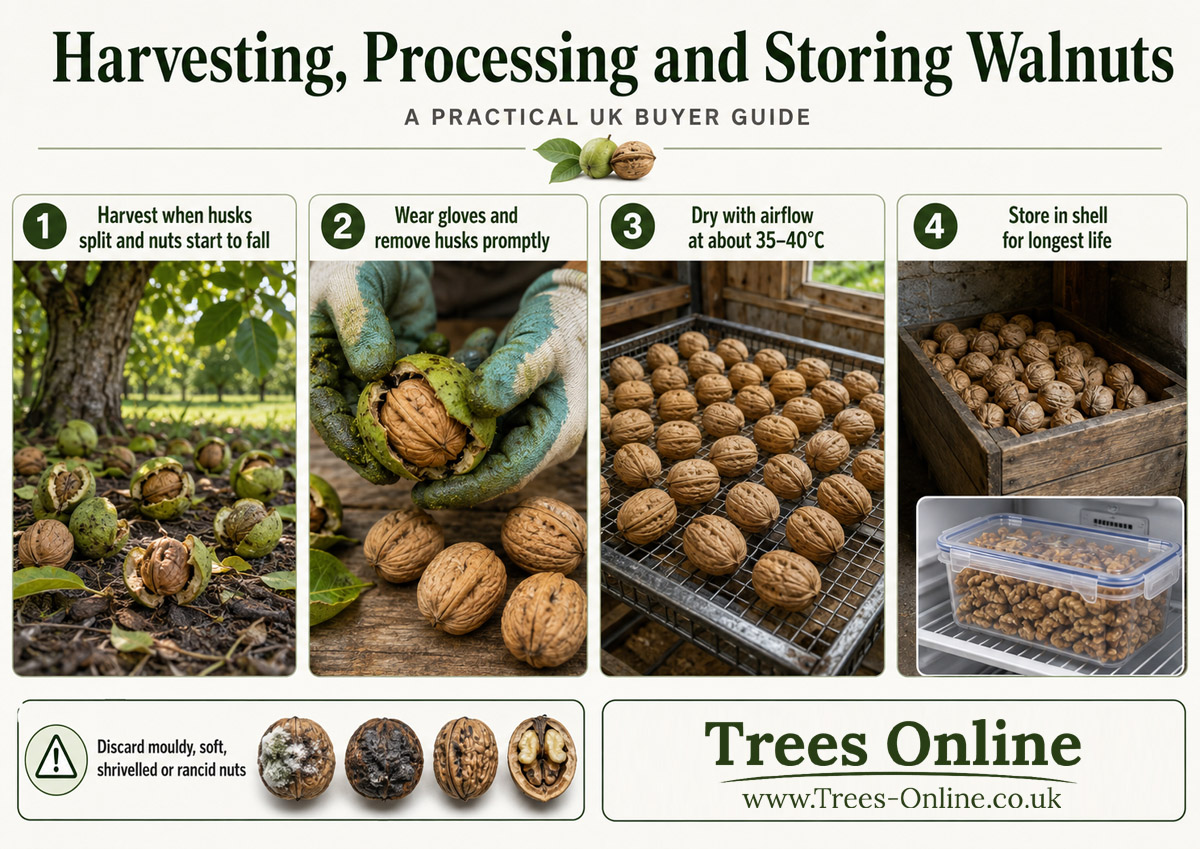
Walnuts are ready when the green outer husks start to split and the nuts begin to fall. Do not leave them lying around. Collect them quickly before squirrels, wet weather or mould ruin them. A daily check will be your best approach. [1] [25]
Wear gloves. Walnut husks stain hands and clothing. Remove the green husks soon after picking. If they are difficult to remove, roll the nut under your foot on a hard surface to loosen the husk, then pull the husk off by hand. Brush or rinse the shell clean. [30] One neat trick we saw was putting the nuts into a wire grill cage and use a pressure washer to clean them off.
Throw away bad nuts. Do not keep nuts that are mouldy, rotten, soft, very light, shrivelled, insect-damaged, badly filled or rancid-smelling. [30]
Dry soon after harvest and within 24 hours is optimal. The best drying temperature is around 35–40°C, or 95–105°F. Oregon State says walnut quality suffers if the temperature goes above 110°F / 43°C. WSU gives similar advice and says 36 hours may be enough if the drying temperature is close to 100°F, but a week or more may be needed without artificial heat. Iowa State gives two to three weeks for black walnuts dried in a cool, dry, well-ventilated place. [25] [30] [31]
Do not use a normal hot oven unless you can keep the temperature low. Many ovens are too hot and have poor airflow. Too much heat can shrivel the kernels and reduce quality. [25] [31]
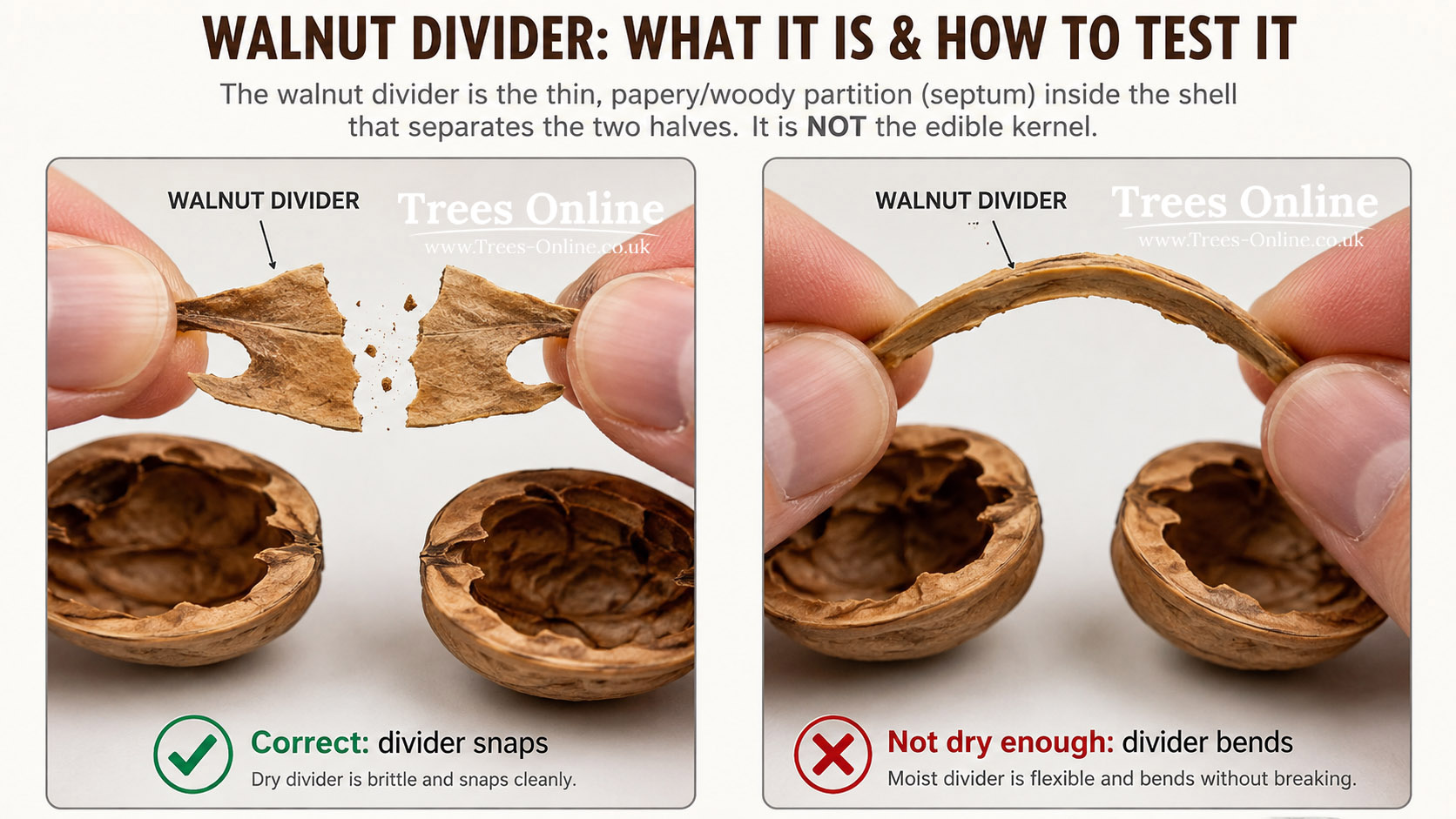
The nuts are dry enough when the thin divider between the two kernel halves snaps cleanly instead of bending. If it is still rubbery, keep drying. [25]
Properly dried walnuts store best in their shells. Keep them cool, dry and dark. They should easily keep for a few months in a cool room, up to a year in the fridge, or up to two years or more in the freezer. For best quality, storage research and industry guidance both point to the same thing: lower temperature and controlled humidity slow rancidity and quality loss. Aim for below 10°C / 50°F and below 65% relative humidity; around 5°C with 40–60% relative humidity is better still. Avoid warm rooms, damp sheds, sealed damp containers and anywhere around 25°C, because warmer, damper storage is linked with faster oxidation, rancidity, darkening and quality loss.
Some home growers and foragers report well-dried in-shell walnuts tasting fine after two to three years. A few people also report much longer freezer storage. Treat those longer claims as "at your own risk" rather than food-safety guidance. [25] [32] [34] [35] [36] [37] [38] [39] [40]
Shell them only when needed, because shelled kernels spoil faster. [25] [32]
Throw away walnuts that show mould, smell musty, taste stale or bitter, feel soft, look unusually dark or oily, or have damaged shells with suspicious staining. Mouldy nuts should be discarded, not trimmed or cleaned.
Will Walnut Trees Grow and Crop in the UK?
Yes.....and no....sort of. The RHS warns that nut crops are unreliable north of the Midlands. [1] That does not mean any walnut north of the Peak District will be bare of nuts, it just means your crop size likely will be smaller. Saying that, there is some evidence to the contrary.
There are plenty of walnut trees that seem to grow just fine as far north as Norway.
The Old and Remarkable Walnut Trees in Scotland was an article by Egbert Hutchison of Carlowrie, published in Transactions of the Highland and Agricultural Society of Scotland, Fourth Series, Vol. XVI, in 1884. It records old Juglans regia trees fruiting in Scotland, including an Altyre, Morayshire walnut, east of Inverness, said to produce large crops that ripened almost every year: https://fruitandnut.ie/walnutsinscotland.pdf
2015 was a good year for walnuts in Scotland and reports that a neighbour’s Buccaneer walnut produced a good crop of nuts. The tree was said to be about 8 years old, already around 12 m, and probably self-fertile because there were no other walnuts nearby. https://plantsandapples.com/2016/01/14/walnuts-in-scotland/
Juglans regia has been planted in Norway since at least the 18th century, and the University of Bergen says that in favourable places the nuts mature in most years. https://www.uib.no/en/universitygardens/136497/juglans-regia-walnut
Norway’s official biodiversity information centre, and its page specifically says Juglans regia produces mature fruit, i.e. walnuts, in mainland Norway:https://lister.artsdatabanken.no/fremmedartslista/2023/336
Walnut Tree Varieties at a Glance
Mature heights vary wildly based on location. Dimensions given are averages expected under average conditions.
AGM: Short for RHS Award of Garden Merit. It means it has traits that make it stand out from other walnut trees.
| Walnut tree |
Approx. mature size |
Fertility |
AGM |
Buyer use / key point |
| Lara |
12m x 8m+ |
Partially self-fertile |
Yes |
Large, creamy, good-quality nuts; heavy crops from a young age, but better with a pollination partner. |
| Chandler |
15m x 8m |
Self-fertile |
No |
Modern heavy-cropping walnut with thin shells and a high yield of light-coloured kernels. |
| Fernette |
20m x 10m |
Self-fertile |
No |
Large rounded nuts, good crops and a useful pollination partner for Fernor, Lara and Chandler. |
| Fernor |
15m x 10m |
Partially self-fertile |
No |
Late-leafing, heavy-cropping French walnut for cooler or frost-prone sites; large nuts with light kernels. |
| Franquette |
20m x 15m+ |
Partially self-fertile |
Yes |
AGM French walnut; late leafing, large nuts and useful where spring frost is a concern. |
| Broadview |
12m x 8m |
Self-fertile |
No |
Compact, popular garden walnut; crops young with good-quality medium nuts. |
| Buccaneer |
12m x 8m+ |
Self-fertile |
No |
Hardy, upright walnut that crops young; good for pickling in July or eating later in autumn. |
| Europa |
around 5m x width not confirmed |
Needs pollinator |
No |
Very compact walnut for smaller gardens; useful where normal walnut varieties are too large. |
| Jupiter |
20m x 15m |
Self-fertile |
No |
Czech walnut with large, good-quality sweet nuts; mid-to-late flowering and reliable cropping. |
| Mars |
20m x 15m |
Self-fertile |
No |
Czech walnut with tasty large nuts, late flowering and good suitability for colder regions. |
| Red Danube / Rote Donaunuss |
12m x 8m |
Needs pollinator |
No |
Red-kernel walnut with medium-sized flavourful nuts; distinctive, but needs a pollination partner. |
| Rita |
12m x 8m |
Partially self-fertile |
No |
Early-cropping walnut bred from Carpathian stock; avoid frost-prone sites because it leafs and flowers early. |
| Saturn |
12m x 10m |
Self-fertile |
No |
Czech walnut with large oval nuts and good sweet flavour; suited to garden or orchard planting. |
| Common Walnut, Juglans regia |
30m x 15m |
Partially self-fertile |
No |
Classic large edible walnut for spacious gardens, orchards, paddocks and parkland. |
| Black Walnut, Juglans nigra |
40m x 30m |
Partially self-fertile |
Yes |
Huge ornamental, shade and timber-interest tree; edible nuts, but with harder shells than common walnuts. |
Do You Need One Walnut Tree or Two?
Partially self-fertile and self-fertile walnut trees will get you somewhere between a partial walnut harvest and a good one if planted by themselves and so you only need one walnut tree. Adding a walnut pollination partner nearby should increase the size of your walnut harvest. Very close is best and less than 50m is next best.
If your walnut tree above is listed as "needs a pollinator", then it is unlikely to produce any meaningful nut harvest if planted by itself, and you will need a pollination partner. The chart below lists suitable pollination partner pairings taken from research establishments and walnut retail outlets.
| Walnut variety |
Suggested pollination partner(s) |
| Lara |
Chandler [13]; Fernette [13]; Franquette [13]; Fernor [13]; Ronde de Montignac [13] [16] |
| Chandler |
Cisco [5]; Franquette [5] [24]; Fernette [5] [23]; Ronde de Montignac [15] [16] |
| Fernette |
Fernor [21]; Ronde de Montignac [15] [16] |
| Fernor |
Fernette [14] [21]; Franquette [14]; Ronde de Montignac [14] [15] [16]; Lara [14] |
| Franquette |
Chandler [24]; Ronde de Montignac [16] |
| Broadview |
Buccaneer [22] |
| Buccaneer |
Broadview, Ronde de Montignac |
| Europa |
Ronde de Montignac, Meylanaise |
| Jupiter |
Mars [16] |
| Mars |
Jupiter [16] |
| Red Danube / Rote Donaunuss |
Buccaneer [17]; Broadview [17] |
| Rita |
Ronde de Montignac, Meylanaise, Corne du Perigord, Fernette |
| Saturn |
Apollo [16] |
| Common Walnut / Juglans regia |
Franquette [16] |
| Black Walnut / Juglans nigra |
Emma K [18] [19] |
Small, Compact and Dwarf Walnut Trees
Searches for small walnut tree, compact walnut tree and dwarf walnut tree need careful handling. Some walnut varieties can be smaller or more compact than others, but that does not usually mean small in the way a patio apple tree is small.
The smallest we found was the Europa with a mature height of 5m.[10]
Other walnut trees we found that were described as "compact" still had the potential to grow to 12m which is a lot taller than almost every other fruit tree described as compact, patio, small, iddy biddy etc.
Can Walnut Trees Grow in Pots?
The practical answer is mostly no but the technical answer is possibly, just look at bonsai. Even then, bonsai experts struggle to get it right with walnut.
An internet search will show very few successful attempts at keeping a walnut in a pot but if you decide to give it a go, then watering and feeding will be your biggest issues. Use the largest pot you can find and put it somewhere sheltered and sunny. The large pot helps reduce water and nutrient shortages but also makes it harder to blow over.
RHS Plants describes Europa as naturally dwarf, but that should not be stretched into a claim that all walnuts are good long-term pot trees. [10]
Mature Walnut Trees for Sale
A larger walnut gives quicker visual impact and can reduce or even eliminate any wait time for a walnut harvest, but it costs more, is harder to plant and needs more aftercare e.g. needs more watering than usual compared to planting other mature trees.
The most common forms of mature walnut trees sold online are:
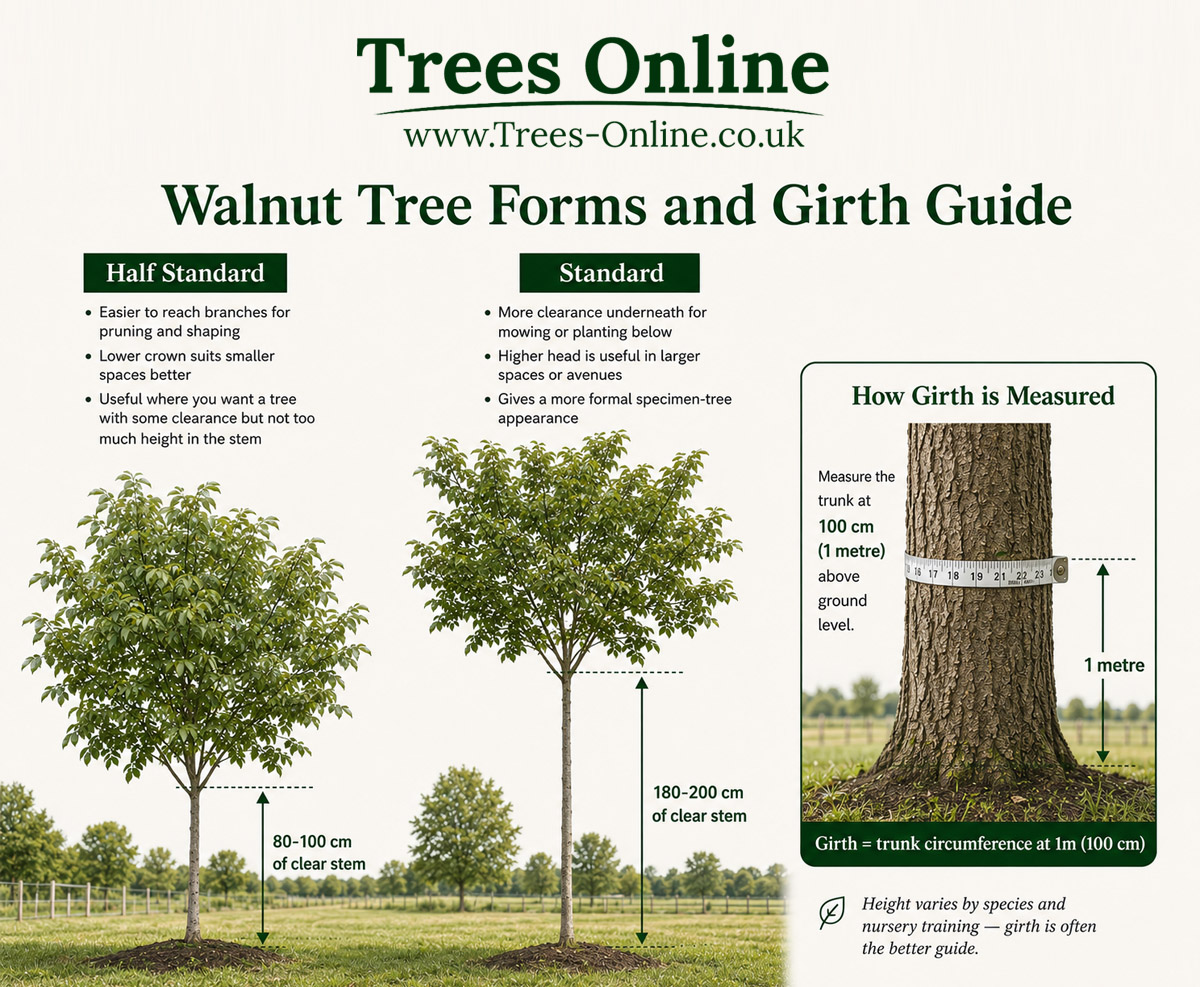
- Half-standard. 80-100cm of clear straight stem before and side branching.
Pros: cheaper, easier to plant, lower crown, quicker garden-level impact, easier to inspect and harvest when young.
Cons: less clearance under the canopy, less formal shape, may get in the way sooner in tight spaces.
- Standard. 180-200cm of clear straight stem before and side branching.
Pros: Taller clear stem, better clearance underneath, more formal appearance, stronger instant specimen look.
Cons: more expensive, harder to plant, the crown can look high or top-heavy in smaller gardens.
Mature Tree Girth Measurements
Tree girth is the measurement around the trunk or circumference, usually taken 1 metre above ground level. It is not an absolute measure of maturity but better than using height because tree growth rates vary wildly by species and location.
For every 1cm of girth, an average tree would be around 30cm, so an average 8-10cm girth tree would be expected to be 240-300cm tall. This is a very rough method of working out tree heights based on girth but they are not absolute. A slow-growing species could be less than that, and many fast-growing ones are regularly a lot more than that. Most walnuts fit in the 30-60cm a year growth range
Mature walnut trees are usually sold in 2cm girth increments, e.g. 6-8cm girth, 8-10cm girth etc. If they are listed in that format, then they will be a standard. If they are a half-standard, then that should be listed somewhere, e.g. 6-8cm half standard. Each increment usually represents a 12-18month period of growth.
How Long Before a Walnut Tree Produces Nuts?
A seedling walnut is one grown from a seed. A grafted named walnut is a tree made up of two parts grafted together i.e. the roots with a very short stump and a section of another walnut tree. Grafting allows us to manipulate tree characteristics such as height, disease resistance, nut quality etc.
Walnuts are slow to crop properly. A grafted named walnut is the best choice if you want nuts, because it crops sooner and more predictably than a seed-grown tree.
RHS says grafted walnuts begin cropping after about four years. Oregon State says most walnuts may produce a few nuts at 5–6 years, but are not mature cropping trees until around 10 years. First nuts are not the same as a proper crop. [1] [25] A half-standard walnut tree sold by us at 150-180cm tall will be 2-3 years old.
Good cropping needs sun, shelter, water and pollination. Plant in full sun, avoid frost pockets, keep grass and weeds away from the base, mulch, and water deeply in dry spells while the tree establishes. [1] [19] [25]
Girdling is a specialist orchard technique used to influence cropping and nut maturity. It involves removing a narrow ring of bark from a branch or shoot. It is not normal garden advice because it can damage or kill branches if done badly. [26]
Where to Plant a Walnut Tree
The best place to plant a walnut tree is an open, sunny, sheltered position with enough room for the mature tree. RHS says walnuts prefer well-drained, fertile, moisture-retentive, alkaline loam, and advises avoiding frost pockets and exposed sites because spring frosts and strong winds can damage foliage and flowers. [1]
If your main aim is nut production, site matters even more. A sunny, sheltered position gives the tree a better chance of establishing, flowering and cropping well. A cold frost pocket, exposed boundary or cramped shaded corner is a poor place to try to force a walnut.
Walnut Tree Problems, Diseases and Buyer Warnings
Walnuts are not usually high-maintenance trees once established, but buyers should know the main issues before ordering: poor site choice, lack of space, frost damage, squirrels, leaf diseases, and confusion between ordinary walnut trees and black walnuts.
RHS says grey squirrels can devastate the entire crop. That matters if your main reason for buying is nuts. [1] The most realistic protection is a smooth trunk guard and not providing an access point for them to jump across such as fences or other nearby trees.
RHS says walnut leaf blotch and anthracnose can affect leaves, and that diseased leaves should be collected and disposed of to help break the infection cycle. RHS separately explains that walnut leaf blotch is favoured by wet weather, can affect leaves, young shoots and fruits, and can ruin the fruit, although mature trees usually suffer little long-term loss of vigour. [1] [8]
RHS says walnut blister mite causes blistering on the upper surface of leaves and hairy growths underneath, but also says it does not harm tree health. [9]
Generally, growing walnuts in the UK is relatively problem free and most issues you might face are not terminal.
What Grows Under Walnut Trees?
Some plants struggle near walnuts, especially black walnut. Commonly listed sensitive plants include tomatoes, potatoes, peppers, aubergines, asparagus, rhubarb, apples, pears, birch, alder, spruce, pine, yew, azalea, rhododendron, hydrangea, lilac, peony, petunia and chrysanthemum. The risk is highest under the canopy and near the root zone, especially in wet, poorly aerated soil where fallen leaves and nut hulls are left to rot.
Penn State Extension explains that sensitive plants beneath a walnut canopy are most susceptible where their roots make direct contact with juglone from walnut roots. [12]
Walnut Tree Care in the UK and Pruning
Once established in the right place, walnut trees are not normally high-maintenance fruit trees. RHS says established walnut trees are largely trouble free, but young trees still need proper planting, watering during dry spells and protection while they settle in. [1]
Walnut pruning is mainly structural. It is not routine fruit-tree spur pruning like you might use on apples or pears. Once the main framework is formed, less is best unless you need to remove dead, diseased, crossing, rubbing or damaged branches. [1] [27]
Prune walnuts from mid-summer to early autumn, ideally when the weather is forecast to stay dry for a few days. Do not use wound sealant. Let cuts dry naturally, because sealants can trap moisture and problems inside the wound. [27]
When the tree is young, keep one main leader and select well-spaced main branches to form the framework. Remove the following: [27] [28]
Competing leaders. The main leader is the upright stem continuing in line with the trunk. If another strong shoot is trying to become a second main stem, remove it. [27] [28]
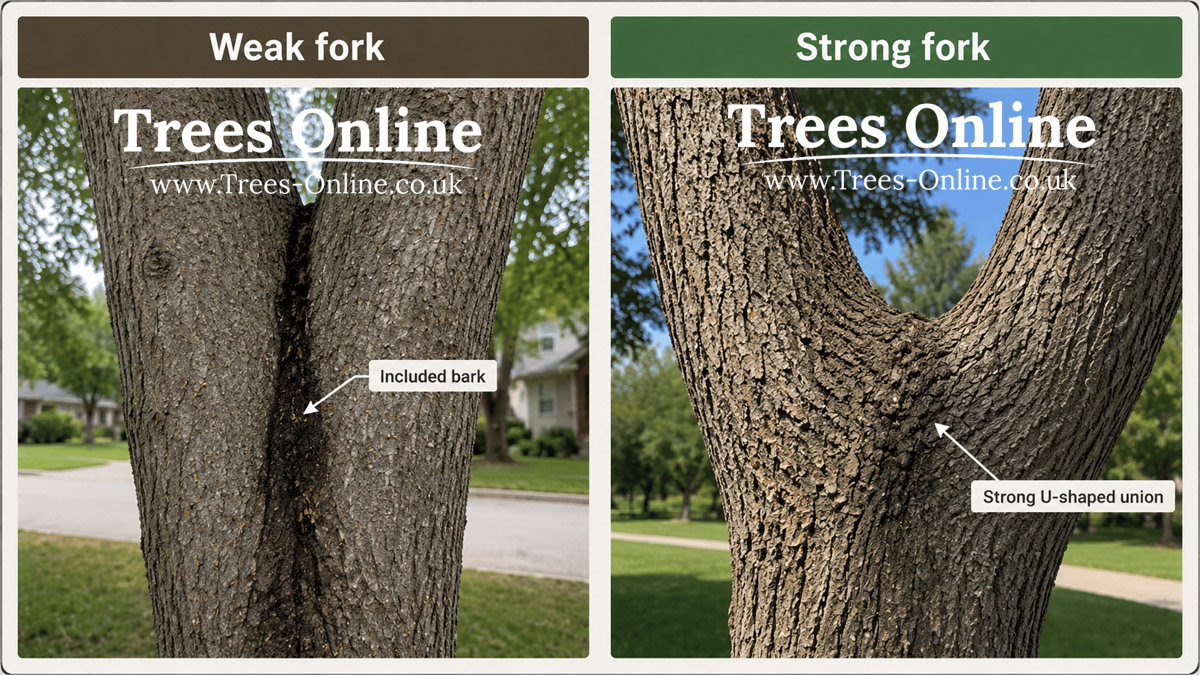
Weak forks. This is not cutlery that doesn't work out. This is where both branches are headed to almost the same place so the angle between them is low. This creates a weak point and can cause splitting later. The start of a competing leader often creates a weak fork. [28]
Crossing, rubbing, damaged, diseased or badly placed branches. Avoid hard annual cutting, because walnuts dislike heavy pruning and young fruit/nut trees establish better when they keep plenty of leaf area. [27] [28] [29]
Walnut Tree FAQs
What is the best walnut tree to buy in the UK?
For a one-tree buyer, Lara is the strongest starting point because RHS lists it as self-fertile, disease resistant, heavy cropping and relatively compact for a walnut. For a modern cropping walnut, compare Chandler. For a planned two-tree setup, compare Fernor with Fernette. [3] [5] [6]
Can walnut trees grow in the UK?
Yes. RHS says walnut trees can produce a good crop in a large garden, but crops are unreliable north of the Midlands. Site and variety matter. [1] However, if you take the time to look, Walnut trees are grown in Norway so take that information with a pinch of salt. See above.
Do I need two walnut trees?
Not always. Some walnut varieties are self-fertile, but crops can be better with cross-pollination. Choose a self-fertile variety for one tree, or a planned pairing if you have room for two. [1] [3] [5] Read the above article for more information.
Are English or black walnuts better?
For familiar edible walnuts in UK gardens, English walnut or common walnut, Juglans regia, is usually the main choice. Black walnut, Juglans nigra, is a different, larger tree with timber and specimen value. [1] [7]
Can walnut trees grow in pots?
Walnut trees can be sold in pots, but most walnuts should not be treated as permanent patio trees. A potted walnut is usually container-grown for supply and planting. [1]
How long does a walnut tree take to produce nuts?
RHS says grafted walnut trees begin cropping after about four years. Seed-grown trees are less predictable. [1]
Can you keep a walnut tree small?
You can prune a walnut carefully, but it is not sensible to buy a walnut expecting to keep it permanently tiny. Choose a more compact variety if size is a concern, and still allow for a proper tree. [1] [3]
What grows under walnut trees?
Some plants can struggle near walnuts because of juglone and shade. Give walnut trees space and avoid relying on delicate underplanting directly beneath the canopy or root zone. [12]
Are walnut trees messy?
They can be. Walnut trees drop leaves, nuts and husks, and mature trees can cast shade. This is usually more acceptable in larger gardens, orchards, paddock edges or parkland-style sites. [1]
Should I buy a grafted walnut tree or a seedling?
Buy a named grafted walnut tree if your main aim is predictable nuts. A seedling can still become a good tree, but its cropping time and nut quality are less predictable. [1]
When are walnuts ready to pick in the UK?
RHS says walnut nuts ripen in autumn, when the fibrous casing around the shell splits. Nuts can be eaten at this stage, but are usually better dried if they are to keep well. [1]
Can you eat walnuts straight from the tree?
Yes, ripe walnuts can be eaten when the casing splits, although RHS says they tend to have a rubbery texture at this stage and are usually better dried for storage. [1]
Can green walnuts be used?
Yes. RHS says nuts that may not fully ripen in cooler areas can be pickled at the green stage before the outer casing begins to toughen. [1]
Sources