Nectarine Trees for Sale UK: Buying Guide
If you have questions about nectarines, then we have answers. It is not just about getting tasty fruit; there are things you need to know to get them consistently.
I Just Want a Good Nectarine Tree — What Should I Buy?
OK, if you don't want to read our nectarine thesis, these are our quick picks.
Lord Napier for taste, crop size, reliability and it also has the RHS Award of Garden Merit. [2] [3] [8]
Choose Nectarella if you want a compact patio or pot-grown nectarine.
All nectarines are self-fertile so will produce fruit without another nectarine nearby.
If that is enough for you, thanks for visiting our website, click the links to start the buying process and thanks for buying nectarines online from us.
Keep reading if you want to know just a little bit more.
Nectarine Trees vs Peach Trees
Nectarines are closely related to peaches. The practical difference is that nectarines have smooth skin, while peaches have fuzzy skin and some describe nectarines as smooth-skinned peaches. [4]
For growing, treat them in much the same way. Both need warmth, shelter and sun, and both can be affected by peach leaf curl. [1] [5]
Best Nectarine Trees for Patios, Pots and Small Gardens
Pot growing comes with more challenges[1] [6] e.g. watering/feeding issues, and trees that make smaller demands on the soil usually fare better in pots. This means naturally compact and small nectarines are better suited to growing in containers. Your choices at the time of writing are Nectarella[2] [6] and Garden Beauty. Both are described by the growers as being suitable for pot and patio growing.
The biggest advantage to pot growing a nectarine is having the ability to move it when the weather threatens your crop. You can move it to a sunnier spot or even better under glass or indoors. [1]
Common Nectarine Varieties Sold in the UK
| Variety |
Brief description |
Freestone |
Container
Grown |
| Convoitise |
Yellow-fleshed nectarine bred by INRA / CEP Innovation, with regular cropping, good fruit size and bright red skin. |
No |
No |
| Garden Beauty |
Naturally dwarf nectarine with deep pink semi-double flowers and sweet yellow-fleshed fruit. |
|
Yes |
| Lord Napier |
Classic early UK garden nectarine with white, melting, juicy flesh. |
Yes |
No |
| Mesembrine / Flat Nectarine |
Flat nectarine with yellow-red fruit and juicy yellow flesh. |
No |
No |
| Nectarella |
Genetic dwarf patio nectarine, sweet orange-red flesh; slow-growing and suited to pots. |
Yes |
Yes |
| Pineapple |
Traditional English nectarine with yellow flesh and aromatic pineapple-like flavour. |
|
No |
| Snow Queen |
White-fleshed nectarine described as one of the sweetest and juiciest. |
Yes |
No |
Are Nectarine Trees Self-Fertile?
Yes. RHS says all nectarines are self-fertile, so you only need one tree for it to provide nectarine fruits. [1] This means the pollen and female flower are in the same place and pollination will happen, but a little help from the bees and buzzies to move the pollen around will mean more flowers will be pollinated.
Nectarines flower early, when cold weather can reduce insect activity, and if temperatures are around 8° C [24] or less, insect activity is going to be very low. RHS advises hand pollination with a soft brush when needed, especially for trees grown under cover. [1] [2] This is best done every few days while new flowers emerge.
Nectarine Tree Size, Rootstock, Final Height and Yield
Rootstock: Many fruit trees are made up of two parts grafted together, one of which is the rootstock. Using different rootstocks means you can change tree characteristics e.g. size, disease resistance etc.
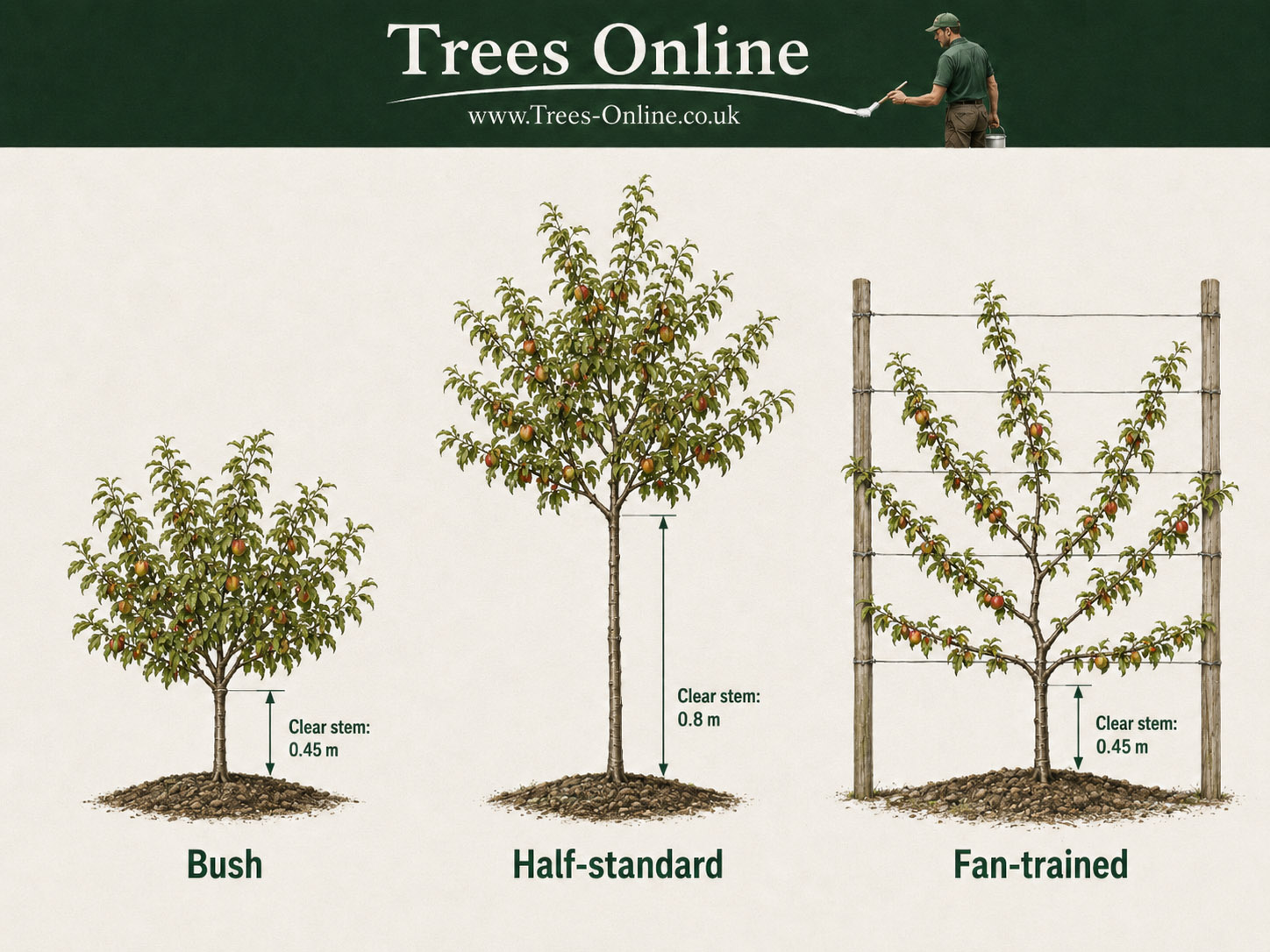
Peach and nectarine trees grown on St Julien A rootstock have an approximate final height of around 3.5m+ as a bush.
Compact patio nectarines grown on St Julien A are different. Nectarella nectarine is a genetic dwarf, so it stays smaller because of the variety itself and not because of the rootstock. [2][3] These typically grow to around 2.0m
For fruit yield, expect approximate mature figures for peach and nectarine trees on St Julien A of about 19kg for a bush tree and about 9kg for a fan-trained tree. These are mature-tree estimates, not guaranteed crops. [14] These figures will likely be smaller for the compact and dwarf varieties.
Fan-Trained Nectarine Trees and Growing Against a Wall
Fan-trained: A tree growing flat to a wall or trellis in the shape of a fan to improve growing conditions for the tree. A great way of improving warmth if done against a wall[1] and well-suited for smaller gardens. A south or south-west-facing wall or fence is best because it captures the midday sun and acts like a thermal battery to release the stored heat. An east-facing wall doesn't see the midday sun, which is why it is not as good as south and south-west facing walls. It should go without saying that north-facing walls are a non-starter.
Advantages of Fan Training
- Improves the amount of light to the branches
- Makes better use of wall or fence space
- Useful for smaller gardens
- Helps create a warmer growing position
- Provides more shelter for blossom and fruit
- Makes frost and rain protection easier
- Makes pruning, tying in, and fruit checking easier
- Makes harvesting easier
- Can look attractive on a wall or fence
- Good for more northerly gardens
Disadvantages of Fan Training
- Needs support wires or a suitable frame
- Needs regular pruning and new growth tying in to maintain the fan shape.
- Wall-base soil can be dry and poor, so it needs more watering and mulching
- Takes more effort to train than a free-standing tree
- Usually more expensive compared to a bush or half-standard
- Less fruit compared to a bush.
Many suppliers will suggest that if you live north of the Midlands, then your chances of growing peaches, nectarines and apricots are not great. We certainly agree that the chances of failure are higher, but people have fan-grown peaches in Scotland so that tells us one experiment is worth 1,000 expert opinions.
Examples of North UK fan training
Although these examples quote peach fan training, the sun requirements are roughly the same as nectarines.
Kiplin Hall, North Yorkshire: "apricots, peaches and sweet cherries are fan-trained on a south-facing wall in the walled garden, and they report getting ripe apricots and peaches in North Yorkshire."
Kinlochlaich Garden Plant Centre, Argyll, Scotland: "We have Fan trained Fruit – Apple, Plum, Peach, and Kiwi against the Wall"
Summary of Fan Training
You need to consider all the variables to decide if fan training is for you. It takes more work and expense to do, but it looks great, and your chances of a good quality harvest are increased, however your harvest can be about half of what a bush would get. The further north of the Midlands you are, the more you might want to consider fan training.
It is not just about getting the sun, in fact some research[25] [26] indicates warmth is also important. This can influence your planting spot e.g. a darker wall will be better than a lighter one, and a sunny wall in a frost pocket is not as good as you thought it might be. Even going to the extremes of adding darker coloured thermal mass at the base of your fan can be considered e.g. blue engineering bricks.
Flowering, Fruiting and Frost Protection
Nectarines flower early in the season, so blossom frost is one of the main risks for UK buyers. RHS advises protecting blossom from frost and says potted nectarine trees can be moved into a frost-free place during flowering. [1]
Below are the average times for last spring frosts across the UK.[27] If you see flowers on your nectarine and you are still within the frost window for your area then it is time to pay close attention to the weather forecast.
| City |
Average last frost |
| London / Kew Gardens |
Mar 11–20 |
| Manchester |
Apr 1–10 |
| Birmingham |
Apr 21–30 |
| Newcastle upon Tyne |
Apr 21–30 |
| Edinburgh |
May 1–10 |
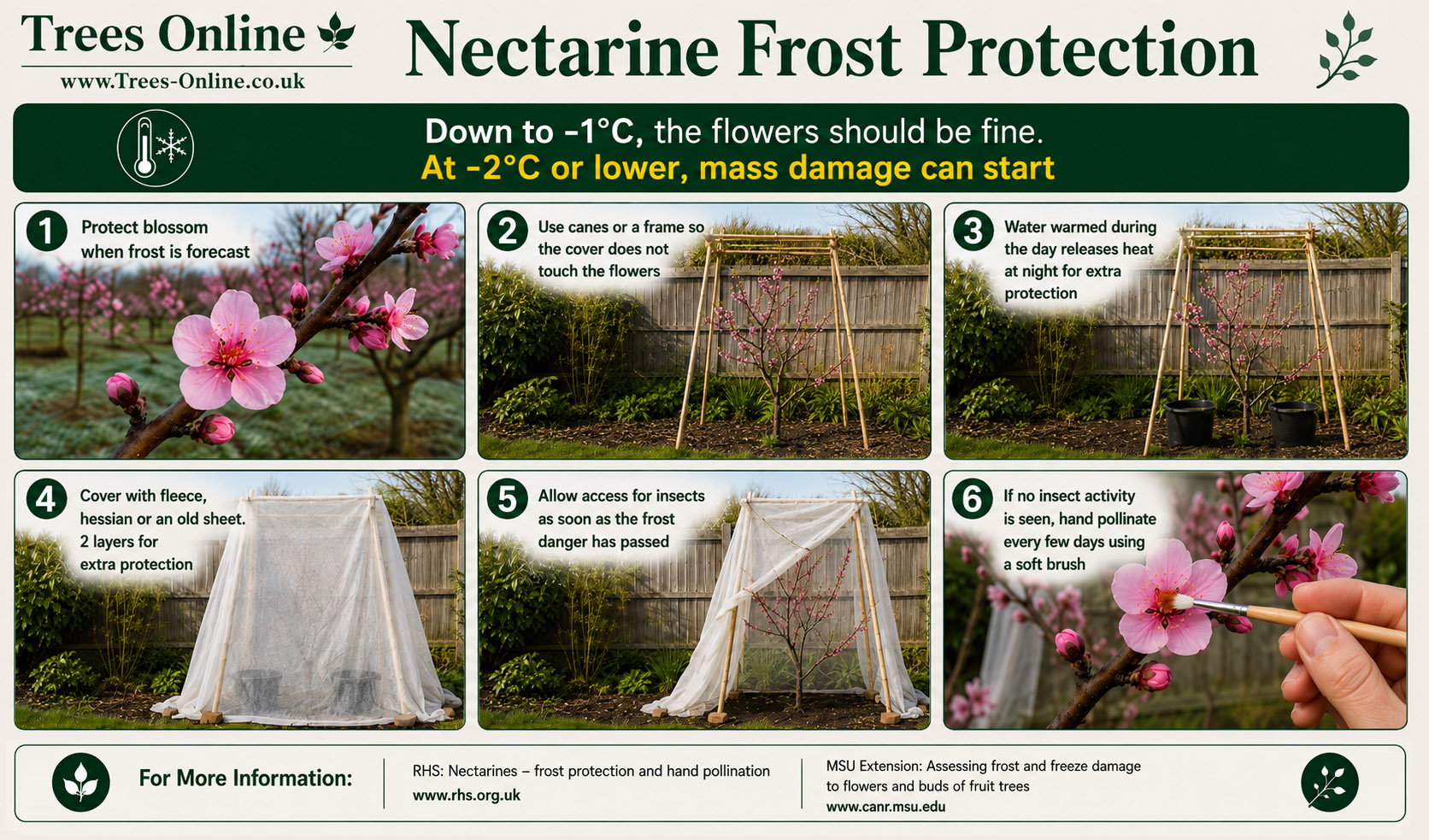
If frost is forecast while the tree is in flower, cover small trees or trained forms overnight with horticultural fleece, keeping the fleece off the flowers with canes or a simple frame. [28] Remove the cover during the day so the blossom gets light and pollinating insects can reach the flowers. A double layer of fleece can give useful extra protection.
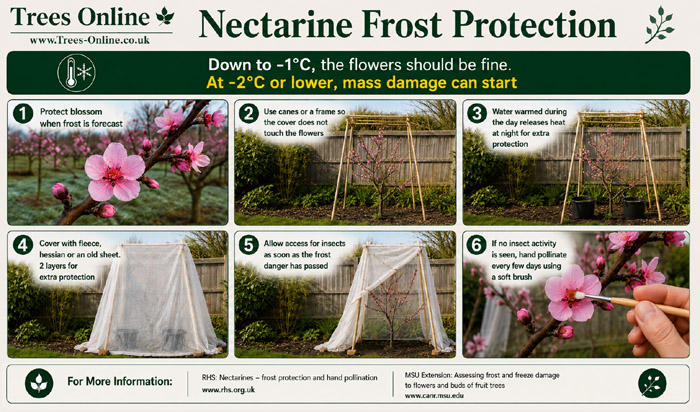
Protect nectarine blossom from late frost while keeping the cover off the flowers.
View larger image
Growing Under Cover
Under-cover growing can help if your garden is exposed, wet or frost-prone. [15] This can mean a greenhouse, conservatory etc., but these are not essential. For many gardens, a warm wall, sheltered spot, movable pot or temporary spring protection may be enough.
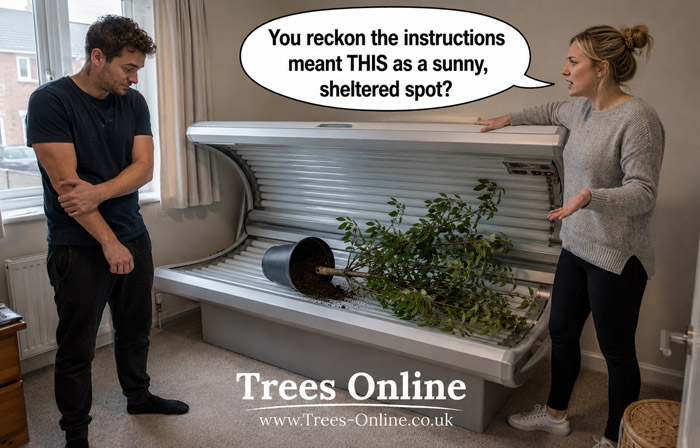
A warm, sunny, sheltered spot gives nectarines the best chance of cropping well.
View larger image
Planting Time and Soil
Nectarines need fertile, moist but well-drained soil. For container-grown trees, use a suitable loam-based compost and make sure the pot drains freely. [1] [6] Water the pot before planting. Nectarines are not a fan of light or shallow soil and will grumble massively if drainage is poor.
You can plant potted trees all year round, but it is usually best from autumn to spring whereas bare root is only available through the dormant season (around November to March) and is marked by full leaf fall to start the season and new foliage breaking through to mark the end. Ensure you soak bare roots for 30 minutes before planting.
Mulch helps keep moisture levels steadier, reducing the dry-then-soaked conditions that can contribute to nectarine fruit splitting. Use composted bark, garden compost or leaf mould around the root area, but keep it clear of the trunk so the bark does not stay damp and rot.
Bare Root vs Potted Nectarine Trees
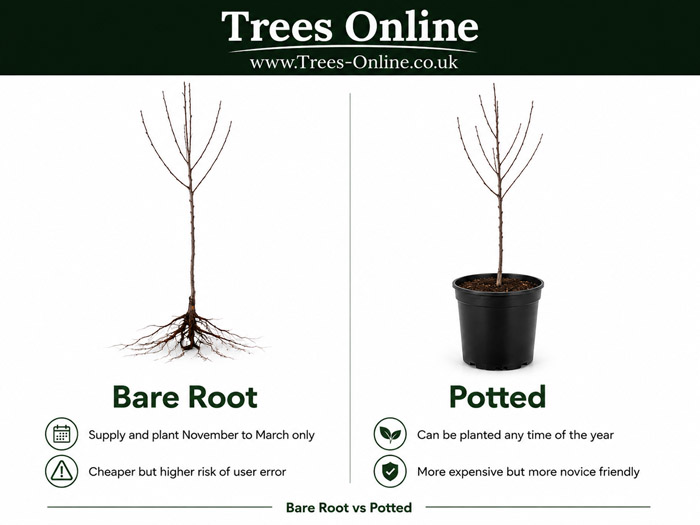
Bare-root and potted trees are supplied differently and need handling differently.
View larger image
Bare root nectarine trees are field-grown trees sold without a pot while they are dormant, usually from November to March, but some suppliers may keep them in cold storage and sell into April. This is important to know because it means you need to plant as soon as possible. They arrive with the roots wrapped rather than sitting in compost. They need to be planted while still dormant and handled carefully until they are in the ground.
The main advantage is price. Bare root trees are usually cheaper than potted nectarines, but they are less forgiving. The roots need to stay damp, be spread naturally in the planting hole, and must not be forced into a cramped space or bent sharply. Poor planting or dry roots can make establishment much less reliable.
Some bare root nectarines are sold as young, one-year-old trees, often called maidens. These are useful if you want to create your own trained form, such as a fan-trained tree, bush or half-standard. They give more control over the shape of the tree, but they also need more pruning skill than a simple beginner guide can cover.
Potted nectarine trees are supplied growing in containers. They usually cost more, but they are easier to manage and can be planted through more of the year. For most beginners, a potted tree is the simpler option because the roots are already established in compost when the tree arrives.
Container-grown nectarines benefit from regular feeding because they have only a limited volume of compost to draw nutrients from. RHS advises either using an organic high-potassium liquid fertiliser every fortnight during the growing season, from April to August, or sprinkling a handful of granular general-purpose fertiliser onto the compost each spring.
Pruning Nectarine Trees
Nectarines and other stone fruit should not be treated like apples and pears for pruning. RHS advises pruning trained stone fruit in spring or summer and completing summer pruning by late August to reduce disease risk. [13] This is because wet conditions increase disease risk so try to prune when the weather is forecast to be dry for a few days. [13]
Formative pruning is to create or keep the form or shape. A 2–3-year-old nectarine tree should have had the majority of shape already formed before you get it. If you have a bush-shaped nectarine then keeping the centre open is best to allow the most light and air into the canopy. [1] [29] You maintain this by cutting back any growth that is heading inwards and you do this after your harvest. [1] This is not a large job and needs to be done once a year. [1]
Maintenance pruning is where you prune to maintain the shape and promote new growth to become fruiting wood. [1] [13] Always cut out any dead, diseased or crossing branches. [29] New, vigorous upright growth should be removed or shortened, as it usually becomes leafy growth rather than fruiting wood. [29] New wood longer than around 60cm needs to be reduced to around 30cm and the short spindly branches need cutting back. [29] These are the basics of nectarine pruning and takes longer than formative pruning.
Pruning a fan-trained nectarine follows similar principles in terms of generating new wood for next year but there are other issues, such as tying in, which can be another lengthy subject. [13]
You just need to know as a potential buyer that to get the best out of your nectarine tree, it is worth reading up on. Fortunately YouTube has plenty of nectarine pruning videos. If you don't prune, your canopy can become dense and reduce the amount of light and air getting in which is how disease problems start. [29] Your fruit harvest will move to the outer edges of the canopy, reducing your fruit harvest. [1]
Freestone, Clingstone and Fruit Storage
Freestone means the flesh separates more easily from the stone making them easier to eat and process. Clingstone means the flesh tends to cling to the stone and needs cutting out or eating around.
Freshly picked nectarines are best eaten soon after harvest, but for maximum storage life pick them carefully, avoid bruising, and sort out any damaged fruit straight away. Do not store in direct sunlight, and keep slightly under-ripe fruit at room temperature until it gives slightly i.e. feels a little softer, and smells sweet, then move ripe nectarines to the fridge in a loose bag or covered container and use within a few days.
Watering, Feeding and Fruit Thinning
A nectarine tree in a pot needs more regular attention than one planted in the ground. Container trees depend on you for watering and feeding, especially during warm weather and while fruit is swelling. It makes it harder to move them but the larger the pot you use, the more risk you mitigate in terms of water stress, being blown over in the wind, overheating, freezing and other issues. The RHS suggests a pot around 45–50cm diameter which is roughly 50L.[30] We would advise using that as a minimum as other authoritative sources suggest around 75L [31] Using a larger pot will make it harder to move, but going smaller increases the risk of problems.
Fruit thinning is worth mentioning because too many small fruits can reduce final fruit size and quality. Most trees shed a portion of their fruit in June, and this is nothing to worry about. RHS says nectarine fruitlets should be thinned after the natural June drop, with final spacing around 15cm apart. [1] Sometimes the tree will do things contrary to your best desired outcome e.g. set too many fruit and you need to step in.
Peach Leaf Curl and Other Issues
Peach leaf curl is the main disease problem buyers need to know before choosing a nectarine tree. Despite the name, it affects nectarines as well as peaches. It is a fungal disease caused by Taphrina deformans and usually shows soon after leaf burst in spring as distorted, puckered, thickened or reddish leaves. [5] The fungus is always on the tree so it is something you are always going to have to keep an eye on.
The disease is encouraged by wet spring weather as the buds open, so prevention is mainly about keeping the new spring growth as dry as possible. Once leaves are infected, you cannot really cure them that year. Remove affected leaves promptly and keep the tree roots watered and healthy so it can recover and produce fresh growth. [5]
For a potted nectarine, the practical advantage is that you can move it. A bright porch, greenhouse, lean-to or sheltered covered spot can help protect the tree from wet spring weather, provided it still gets good light and ventilation.
For a planted nectarine, a warm sunny wall or fence is usually the better option. Fan-trained trees are easier to protect than free-standing trees, and RHS advises covering susceptible trees from after leaf fall until mid-May, while leaving the sides open for airflow and pollinating insects. [5]
Severe peach leaf curl can reduce tree vigour, fruit quality and yield, and may contribute to early leaf fall, fruit drop, drought stress and winter-injury risk. [23]
Splitting Fruit
Splitting fruit is usually caused by too much watering as the fruits are developing. The best defence against splitting nectarines is steady moisture. Fruit is most likely to split when the tree goes from dry conditions to heavy rain or heavy watering, especially as the fruit is ripening. Keep potted nectarines evenly watered, mulch the compost surface, and move the pot under cover during heavy rain if the fruit is close to ripening. For planted trees, mulch the root area and water during dry spells so the tree is not suddenly soaked after drought. Avoid overwatering and avoid late or excessive nitrogen feeding, as both can increase the risk of cracking.
Brown Rot and Bacterial Canker
Brown rot and bacterial canker are two diseases that can affect nectarines. Brown rot is a fungal disease that causes fruit to turn brown and rot, often entering through wounds caused by birds or damaged fruit. Remove affected fruit promptly, do not leave mummified fruit hanging on the tree, protect ripening fruit from bird damage where practical, and dispose of infected fruit rather than leaving it around the tree. Bacterial canker affects Prunus trees and can cause sunken dead patches of bark, gumming, shoot dieback and small “shothole” marks in leaves. To reduce the risk, prune nectarines only in spring or summer, avoid unnecessary wounds, cut out infected wood back to healthy growth where practical, and dispose of infected prunings. RHS lists both brown rot and bacterial canker as common nectarine problems.
Harvesting Nectarines
Nectarines are usually ready from July to September. They are ready when fully coloured and slightly soft near the stalk, and should come away easily when lifted. They are best eaten soon after picking, and fruit picked before fully ripe may ripen indoors but will not taste as good.
Nectarine Tree FAQs
Are nectarine trees self-fertile?
Yes. RHS says all nectarines are self-fertile, so one tree is enough for pollination. [1]
Can you grow a nectarine tree in a pot?
Yes, if you choose a suitable compact variety. RHS lists Nectarella as suitable for container growing, and Frank P Matthews describes it as ideal for pot growing. [3] [6]
Is Nectarella a dwarf nectarine tree?
Yes. RHS describes Nectarella as dwarf and slow-growing, while Frank P Matthews describes it as a genetic dwarf and very slow growing. [2] [3]
Do nectarine trees need hand pollination?
They may benefit from it. RHS advises hand pollinating nectarines with a soft brush when flowers are open, especially where insect activity is limited or the tree is grown under cover. [1] [2]
What is the main problem with nectarine trees?
Peach leaf curl is the main disease problem to know about. It affects nectarines as well as peaches and causes distorted spring leaves. [5]
How much fruit can a nectarine tree produce?
Frank P Matthews gives approximate mature peach and nectarine yields on St Julien A of 19kg for a bush tree and 9kg for a fan-trained tree. These are rough mature-tree figures, not guaranteed yields. [14]
Sources