Peach Trees for Sale UK: Buying Guide
This guide is written for UK gardeners who want to buy a peach tree online and make an informed decision. It covers the most important things you need to know before buying one because peach trees are higher-maintenance than many other fruit trees.
You cannot know which is the best peach tree to buy for you until you know how your circumstances change the options.
I Just Want to Buy a Good Peach Tree
If you are determined NOT to read all of our peach tree literary masterpiece, then go for an Avalon Pride because it has the highest resistance to peach leaf curl than all the others. [4] [13] This fungus issue is the biggest threat to your fruit bounty. Then you are looking at Amsden June, Red Haven / Redhaven, and Rochester for resistance to peach leaf curl.
If you want a good one for patio or container growing then go for Bonanza.
If you want to be informed more than that, then sorry, you have some reading to do.
Can Peach Trees Grow in the UK?
Definition: Fan-Training.
This is where a wire support or framework is provided on a wall or fence for you to train the branches to grow out into a flat fan shape. It keeps all the foliage and blossom close to the wall or fence where it is warmer and more sheltered. It is easier to protect from rain and frost. The colder your location or the further north you are, the more we suggest fan-training. A south-facing or south-west facing wall is one of the best positions because south-east is not as good because it does not collect the midday sun i.e. is cooler than South and South-west. [1]
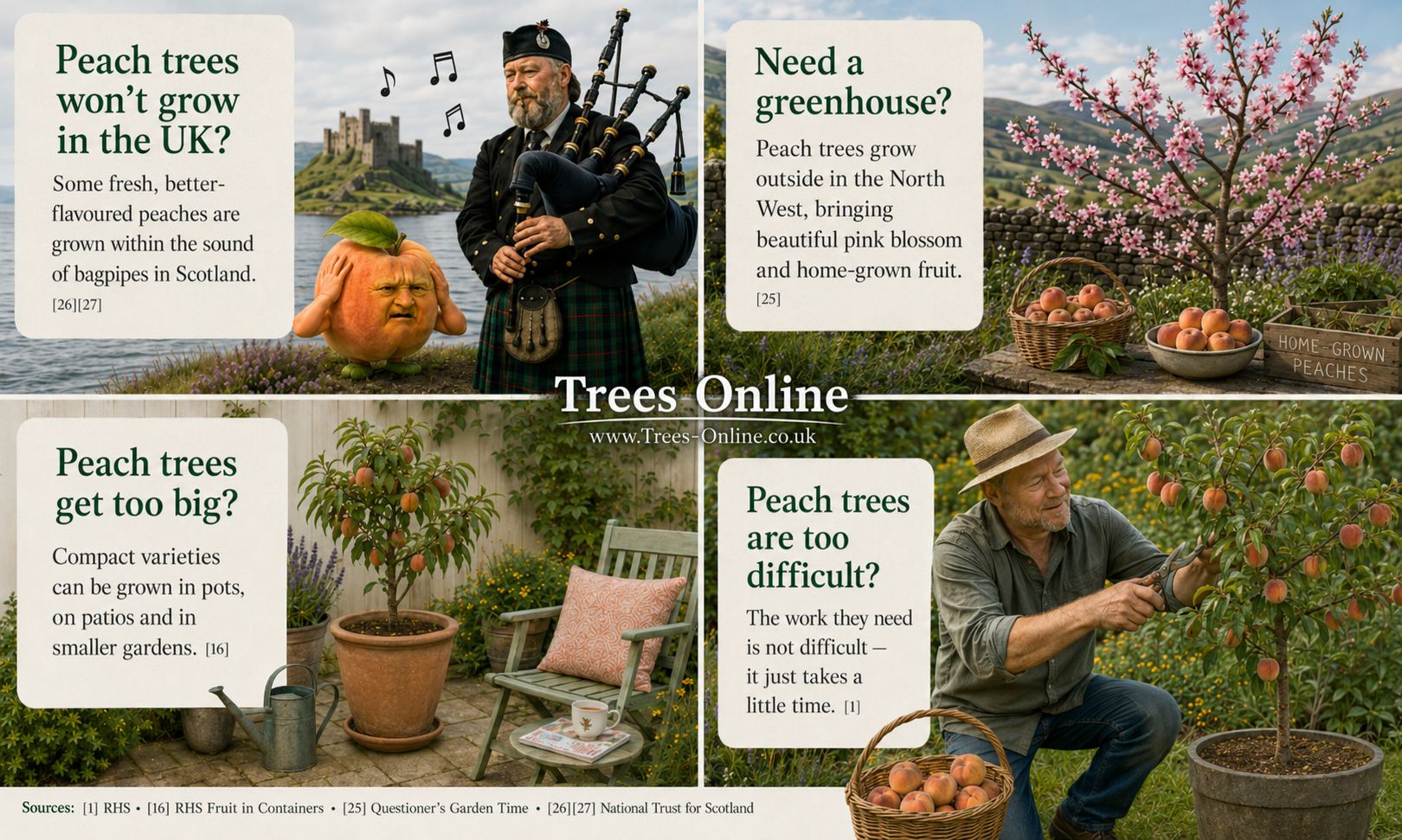
To answer the question, yes. Peaches, Prunus persica, can grow outdoors in the UK, especially in sunny, sheltered gardens and fan-trained peaches in Scotland have been grown [26] [27] along with an organically grown and freestanding Avalon Pride in the North West with a healthy crop of 80 peaches 4 years after planting. [25]
Peaches can also be grown in containers on a sunny patio, or in a greenhouse or polytunnel in cooler areas. [1] Potted peaches have the advantage of being able to be moved out of the frost.
Peach trees prefer deep, fertile, well-drained soil. Avoid cold, wet ground where roots may sit in water, and avoid exposed frost pockets where early blossom is more likely to be damaged. [1]
Buyer takeaway: the best peach tree position is full sun, shelter from cold wind, good drainage, and ideally a warm wall or protected patio.
Quick Guide to the Main Groups of Peach Trees
Definition: Peach leaf curl.
This is a fungal disease, caused by Taphrina deformans, that distorts young peach and nectarine leaves in spring. Affected leaves can curl, thicken, redden and fall early, which weakens the tree, reduces vigour and can reduce the crop. Severe infections can cause serious crop loss.
Peach leaf curl fungus overwinters on the tree and infects new growth when conditions are cool and wet. Rain, overhead watering and prolonged wet conditions can help the disease spread or infect young leaves as they emerge. This is why outdoor peach trees are often protected from winter and spring rain, especially from around November to May, keeping the buds and young shoots as dry as practical during the danger period.
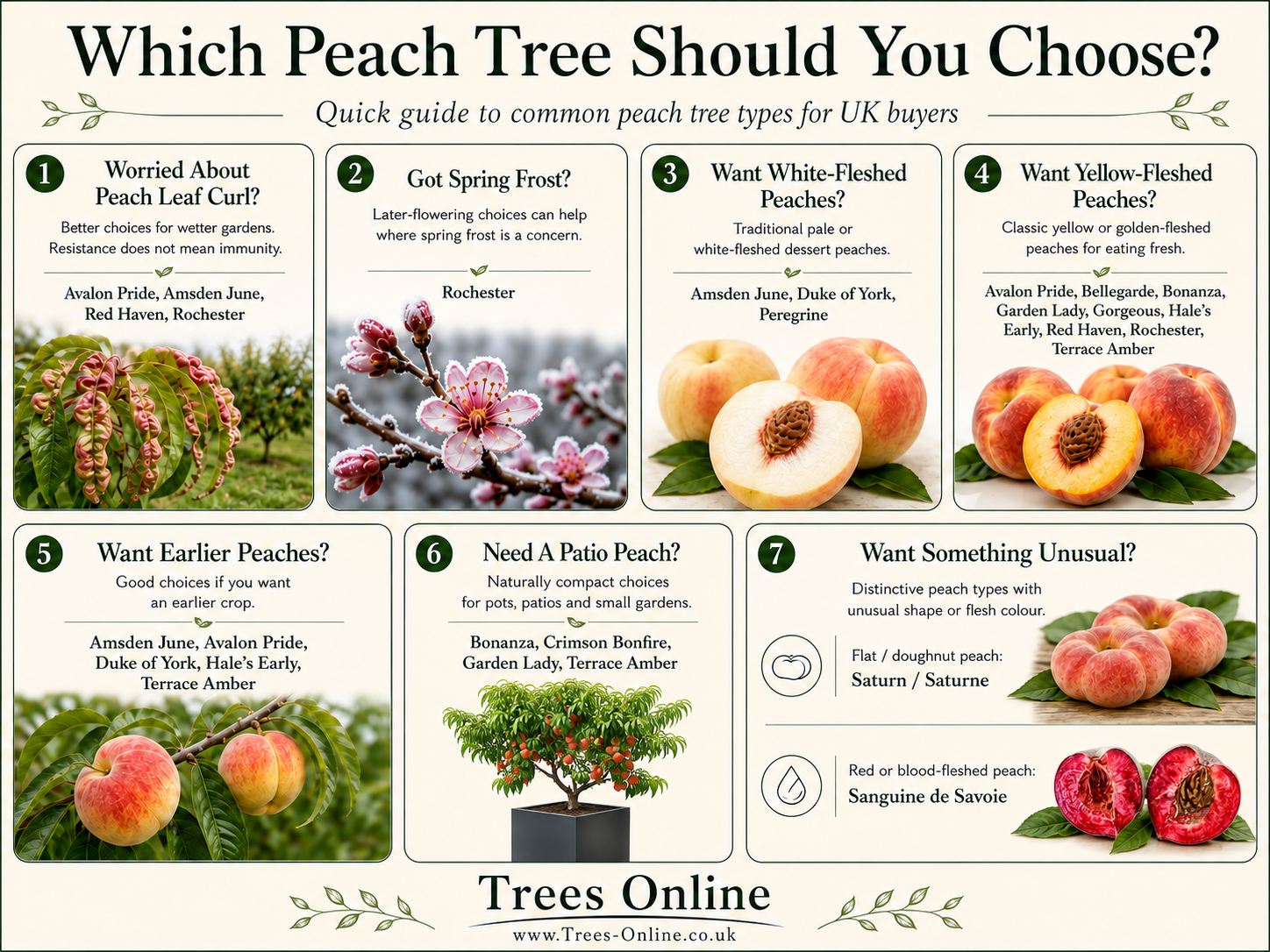
There are many peach tree varieties sold in the UK, but most buyers can narrow the choice down by the type of peach tree they want, rather than comparing every variety one by one. The examples below are drawn from commonly sold UK peach trees, specialist nursery lists and RHS variety guidance. [28] [29] It is important to note that peach leaf curl resistance does not mean immunity and you may still experience it at some point.
| Peach Tree Group |
Best For |
Common UK-Available Varieties to Look For |
| Mainstream UK garden peaches |
Most buyers wanting a recognised peach variety commonly listed for UK garden growing or UK nursery supply. |
Avalon Pride, Amsden June, Bellegarde, Duke of York, Gorgeous, Hale’s Early / Hales Early, Peregrine, Red Haven / Redhaven, Rochester. |
| Peach leaf curl resistant choices |
Wetter areas or buyers worried about peach leaf curl. Resistance does not mean immunity. |
Avalon Pride [4] [13], Amsden June [45], Red Haven / Redhaven [8] [13], Rochester [13] [44] |
| Later-flowering / frost-risk choice |
Gardens where spring frost is a concern and buyers want a peach with later-flowering evidence. |
Rochester [9] [28] [44] |
| Classic white-fleshed peaches |
Traditional pale or white-fleshed dessert peaches. |
Amsden June [39] [45], Duke of York [42], Peregrine [5] [28] [43] |
| Yellow-fleshed peaches |
Buyers wanting classic yellow or golden-fleshed peaches for eating fresh. |
Avalon Pride [4] [28], Bellegarde [40], Bonanza [10] [29], Garden Lady [33] [36], Gorgeous [12], Hale’s Early / Hales Early [28] [41], Red Haven / Redhaven [7] [8] [28], Rochester [9] [28] [44], Terrace Amber [32] [35] |
| Early-season peaches |
Buyers wanting earlier crops, especially where late-season ripening may be harder. |
Amsden June [39] [45], Avalon Pride [4] [28], Duke of York [28] [42], Hale’s Early / Hales Early [28] [41], Terrace Amber [35] |
| Flat / doughnut peaches |
Unusual flattened fruit, often sold as flat peach, doughnut peach, donut peach or Saturn peach. |
Saturn / Saturne [11] [29] [37] |
| Patio and dwarf peaches |
Pots, patios, courtyards, balconies and small gardens where a naturally compact peach tree is needed. |
Bonanza [1] [10] [29], Crimson Bonfire / Bonfire [1] [34] [46], Garden Lady [1] [33] [36], Terrace Amber [32] [35] |
| Late-season / under-cover peach |
Warmer gardens, greenhouse growing or buyers wanting a late-ripening peach where enough warmth is available. |
Bellegarde [40], Gorgeous [12] |
| Red or blood-fleshed peach |
Unusual fruit colour and a more distinctive peach flavour. |
Sanguine de Savoie [38] |
Peach Leaf Curl Resistant Peach Trees
Definition: Patio Variety. A tree that is naturally dwarfing i.e. its mature size is small enough to be able to grow in the confines of a pot. The bigger the better usually.
Peach leaf curl is a good reason to hesitate before ordering a peach tree because it threatens the whole reason for buying one i.e. juicy peaches. Although increased resistance to the disease has been proven, it is not immunity and you still may experience it in the best UK conditions. It is most noticeable in spring, when young leaves become curled, thickened, distorted and often red or pink. [13] By this time, the damage has been done, and no treatment is available so prevention is your best option.
Even in the warmest and driest parts of the UK, it could only take one bout of rain at the wrong time to provide the conditions for the fungus to grow. In short this is about managing risk. The cooler and wetter you are, the more you will benefit from a peach leaf curl-resistant tree i.e. see less of it compared to other varieties. This doesn't mean those in the Midlands are restricted to just a few options, it just means you need to be more vigilant about keeping the buds and emerging foliage dry between November and May, consider buying a patio variety or grow under glass.
Summary
If you take one thing from this section, keep water off the canopy from November to May.
Do You Need Two Peach Trees?
Definition: Pollination
The moving of pollen to the female flowering parts to start the process of growing fruit. [47]
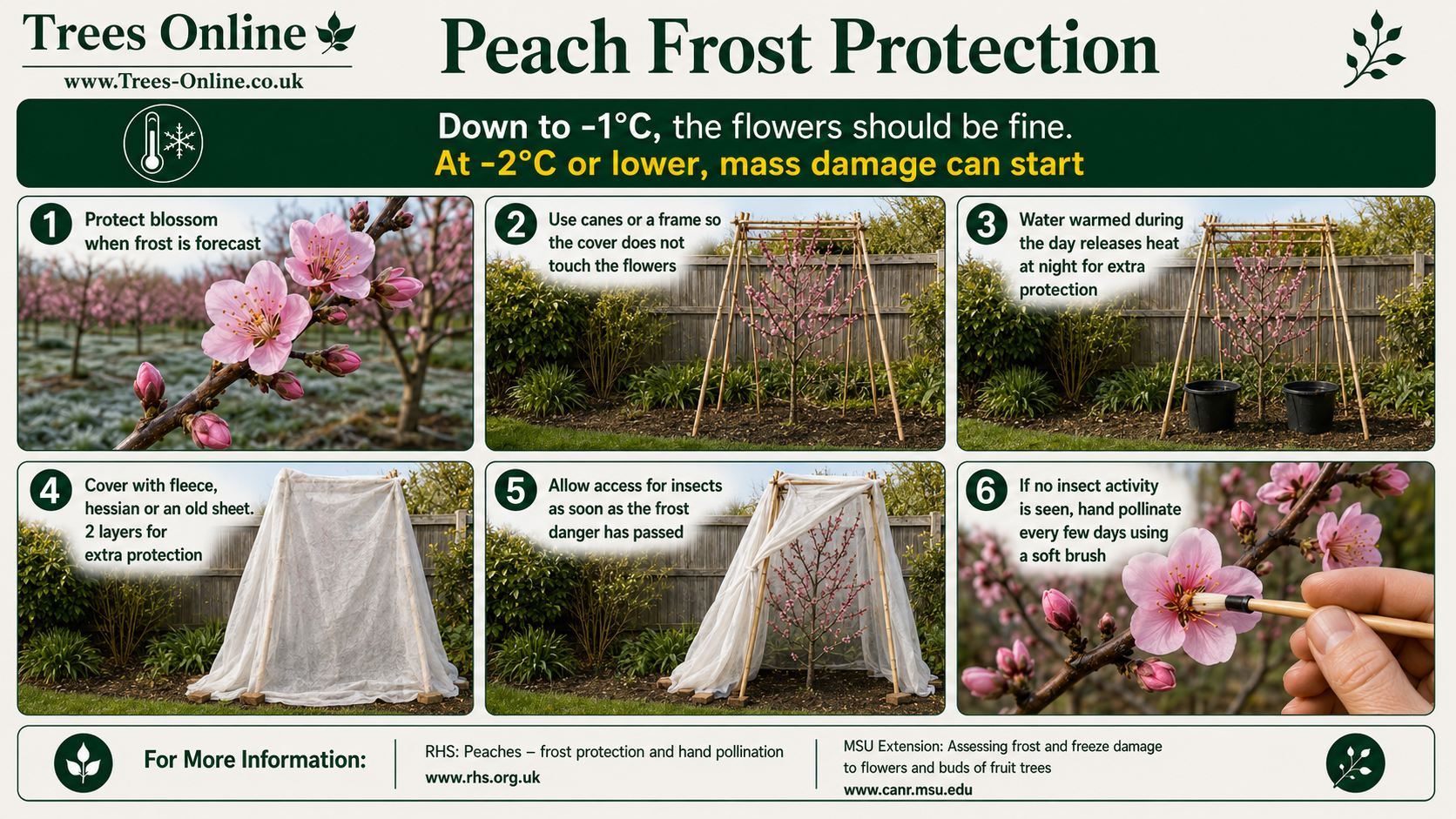
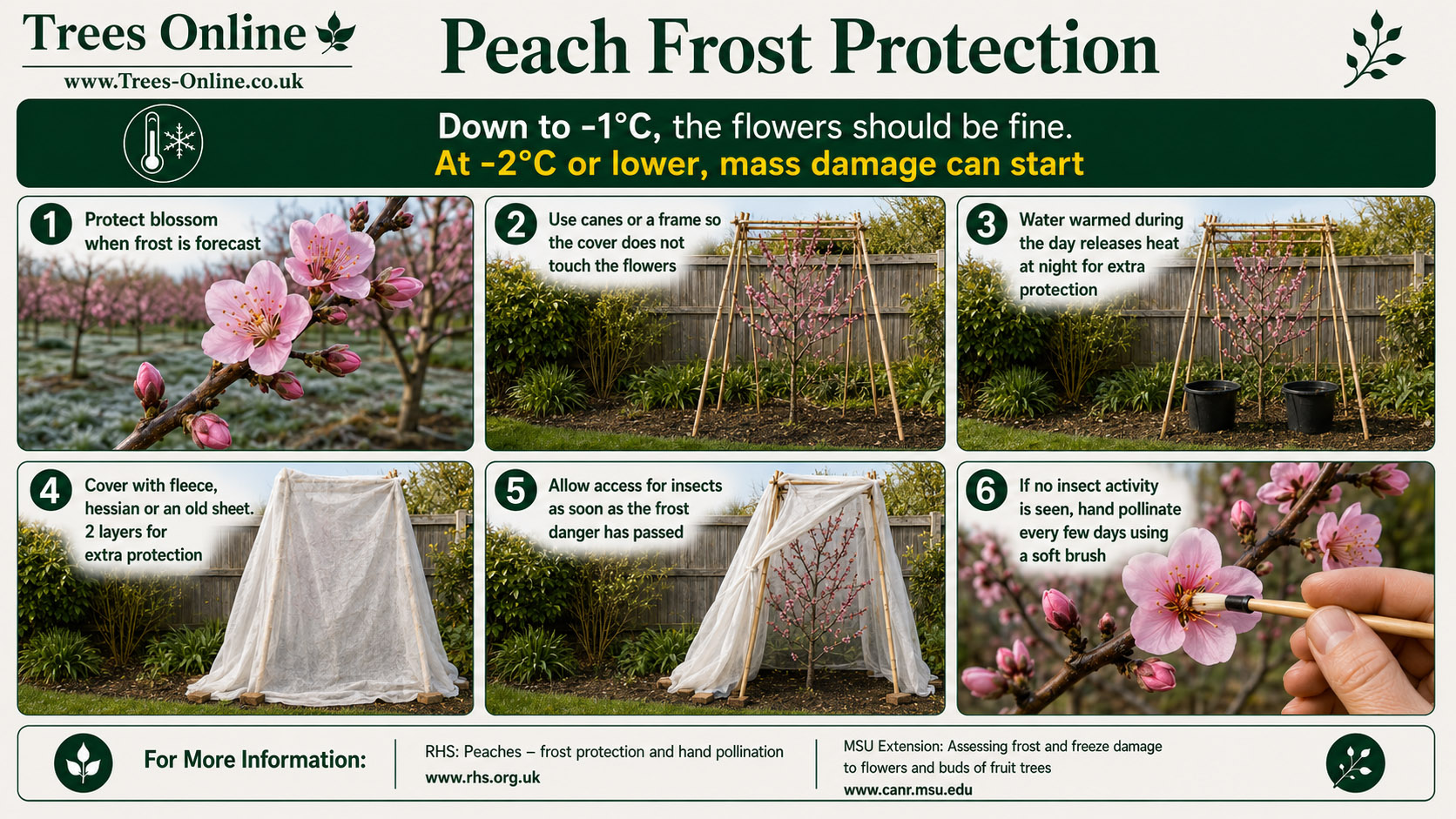
To answer the question, no. Peach trees are self-fertile, so one peach tree can produce fruit without a second peach tree nearby, but pollen still needs to be moved, usually by insects. [1] [47] Most fruit trees flower at a sensible time i.e. when it is warm but peach flowers are like little kids and like to make a break for the outside without giving a single thought to the weather. This means they are flowering when pollinating insect activity is usually lower. The colder your location, the lower your insect activity will likely be. If you see no insect activity during peach flowering then consider hand-pollinating to get a larger crop. This is where you use a small soft brush to gently dab inside each flower to move pollen around. Do this every few days until flowering has stopped. [1] [47]
Once temperatures drop to around 8°C, and/or if it is wet and windy, insect activity will be greatly reduced. [48] [49] If you are growing under glass, for maximum crop size, you will need to consider hand pollination or even tapping/shaking the branches. [1]
If a peach tree flowers well but sets little or no fruit, poor pollination and frost-damaged blossom are two of the first things to consider. The tree may be healthy, but the weather may have beaten it at flowering time. [22] [47]
Peach Tree Sizes, Pots, Rootstocks, Bare-Root and Fan-Training
Peach Tree Sizes
There are two things to know about peach tree heights. The height it is supplied at and the height it will grow to.
You would think the taller a tree is, the more value for money it is, not always so. A 1-year bare-root maiden can be over 2m tall, which sounds great, but come year 2, it can be cut back to 45cm tall to be the start of a bush. The takeaway for a buyer is that when purchasing a 1-year maiden peach tree, the height is meaningless.
Then there are dwarfing varieties i.e. those that do not grow as tall so it may look like you are getting shortchanged when you buy a 2-3 year old peach tree at around 1m tall when others are closer to 1.5+m. This is perfectly normal, you will appreciate picking peaches off a 2m tall tree compared to the 5+m some of them can get to.
Small, Patio and Potted Peach Trees
If you want a peach tree for a patio, courtyard or small garden, choose a naturally compact variety such as Bonanza Peach Tree. A patio peach is easier to fit into a pot, easier to move under cover and easier to protect during poor spring weather. In short, one of the best ways to avoid peach leaf curl.
A potted peach tree still needs proper care. Use a large container, good drainage, full sun and regular watering in dry weather. A minimum starting point for a patio fruit tree is around 50L. Our advice is to go more. The larger the pot, the less problems you will have with it. Fruit trees in containers stay smaller than trees planted in open ground, but they rely more heavily on the buyer for watering and feeding. [16]
Peach Tree Rootstocks
Rootstocks are the lower root part of a grafted fruit tree i.e. the process of joining the roots of one tree to a section of another tree. Nurseries use different rootstocks to control final tree size, vigour, soil tolerance, disease resistance and suitability for pots, gardens, fan-training or larger orchard-style planting. [50]
St Julien A is popular because it is a good all-round UK stone-fruit rootstock with a bush height of around 4.5–5m and tolerance of heavy soils. [1] [17] [50] For most UK buyers, St Julien A is the simple, safe choice because it gives a strong garden peach tree without being a full-size orchard monster. Smaller rootstocks are useful where space is limited, but they usually need better watering, staking and aftercare.
Below are other rootstocks usually available from UK retail outlets.
| Rootstock |
Expected final height |
Main advantage |
| Adaptabil |
3–4.5m |
Similar vigour to St Julien A, with good tolerance of drought, waterlogging, poorer soil and grassed orchard conditions. [51] |
| Krymsk 86 |
Around 3.6–4m |
Semi-dwarfing to semi-vigorous peach rootstock; useful where a slightly smaller but still proper garden peach tree is wanted. [50] |
| VVA-1 / Krymsk 1 |
2–2.7m |
Dwarfing option for smaller trees, small fans and tighter garden spaces. Needs good soil, staking and watering in dry weather. [51] [52] |
| VSV-1 |
2–3m |
Compact semi-dwarfing rootstock for smaller peach trees, bush forms, pyramids and small fans. [51] |
| Torinel / Torrinel 24 |
2.4–3m |
Semi-dwarfing rootstock suitable for bush, half-standard, fan-trained trees and containers. [50] [53] |
| Montclare / Mont Clare |
Around 3m |
Compact stone-fruit rootstock used to restrict peach, plum, apricot and nectarine trees compared with stronger rootstocks. [52] |
| Wavit / WA-VIT |
3–4.5m |
Semi-dwarfing to semi-vigorous option suitable for peaches and other stone fruit, including relatively dry conditions. [51] [50] |
| Brompton |
Over 4.5m, up to around 6m |
Very vigorous rootstock for larger free-standing trees and orchard-style planting, not small gardens. [54] |
Bare-Root vs Potted Peach Trees
Bare-root Peach Tree
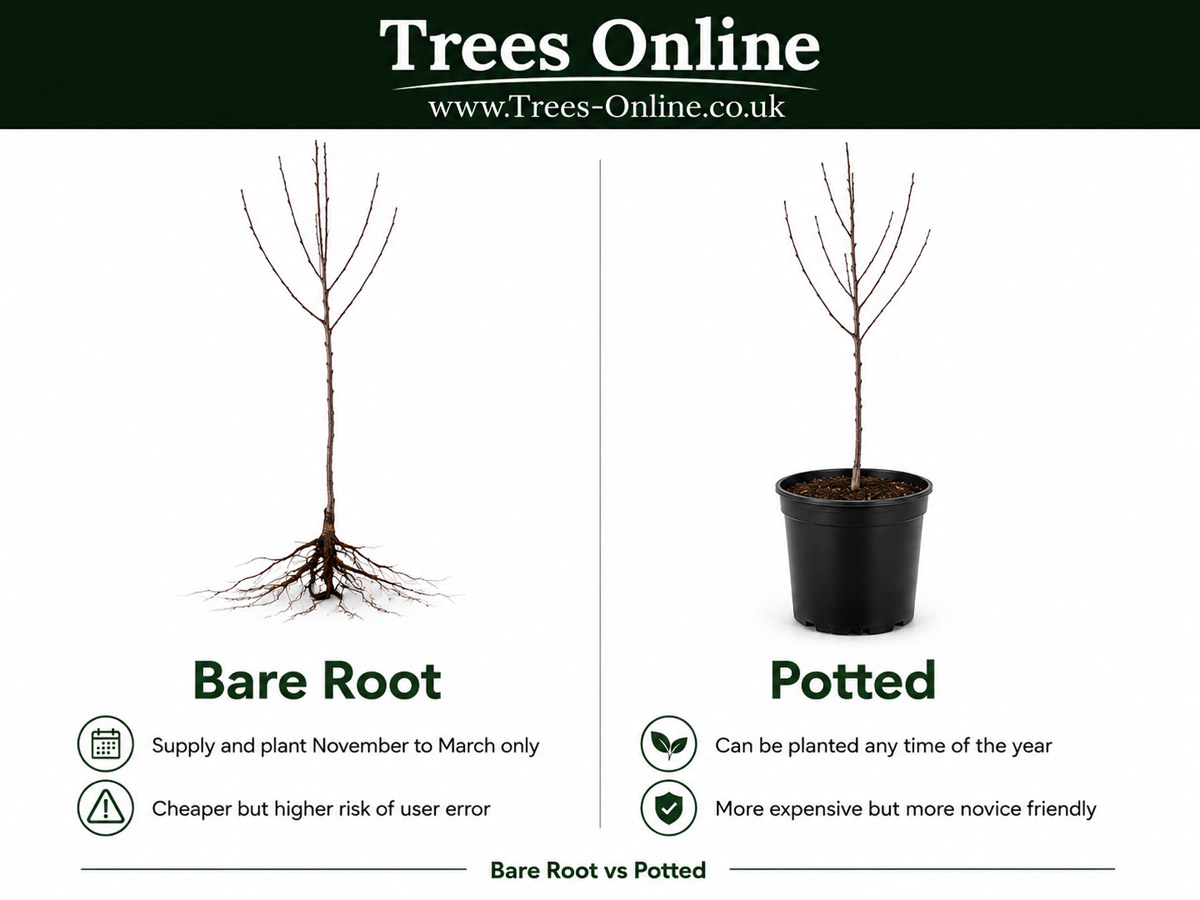
A bare-root peach tree is one that has no compost around the roots, literally bare roots. These can only be sold from November to March or after leaf fall and before new foliage comes through.
Bare-root Advantages
- They are usually cheaper
- Can be available with extra options e.g. maiden.
Bare-root Disadvantages
- Need quicker handling after delivery because the roots must not be allowed to dry out. [18]
- Slightly higher failure rate for novice gardeners.
Potted Peach Tree
This has been grown in the pot for at least a season and is available all year round, depending on stock levels. Growers release the new seasons stock around August so the most availability will be then.
Potted Advantages
- Can be planted almost anytime
- Lower failure rate for the novice
Potted Disadvantages
- More expensive to buy and ship
If you are new to gardening, a potted version is your safest option.
Fan-Training or Under Cover
A peach tree grown against a sunny wall will always be the lower risk option for growing a peach tree in the UK, even for those in the south of UK. It provides a microclimate by providing shelter and trapping warmth and peaches love both. A south-facing or south-west-facing wall gives extra warmth, shelter and support for fan-training. [1] East or south-east facing walls are not as good because they are not exposed to the warmest midday sun and therefore have less heat to give back.
The shape makes pruning, picking and covering the tree during frost or wet spring weather much easier. [1] [19]
Under-cover growing is also worth considering in cooler or wetter areas. A greenhouse, polytunnel or conservatory can improve warmth and reduce rain on new growth, but flowers may need hand pollination because insects may not reach them easily. [1]
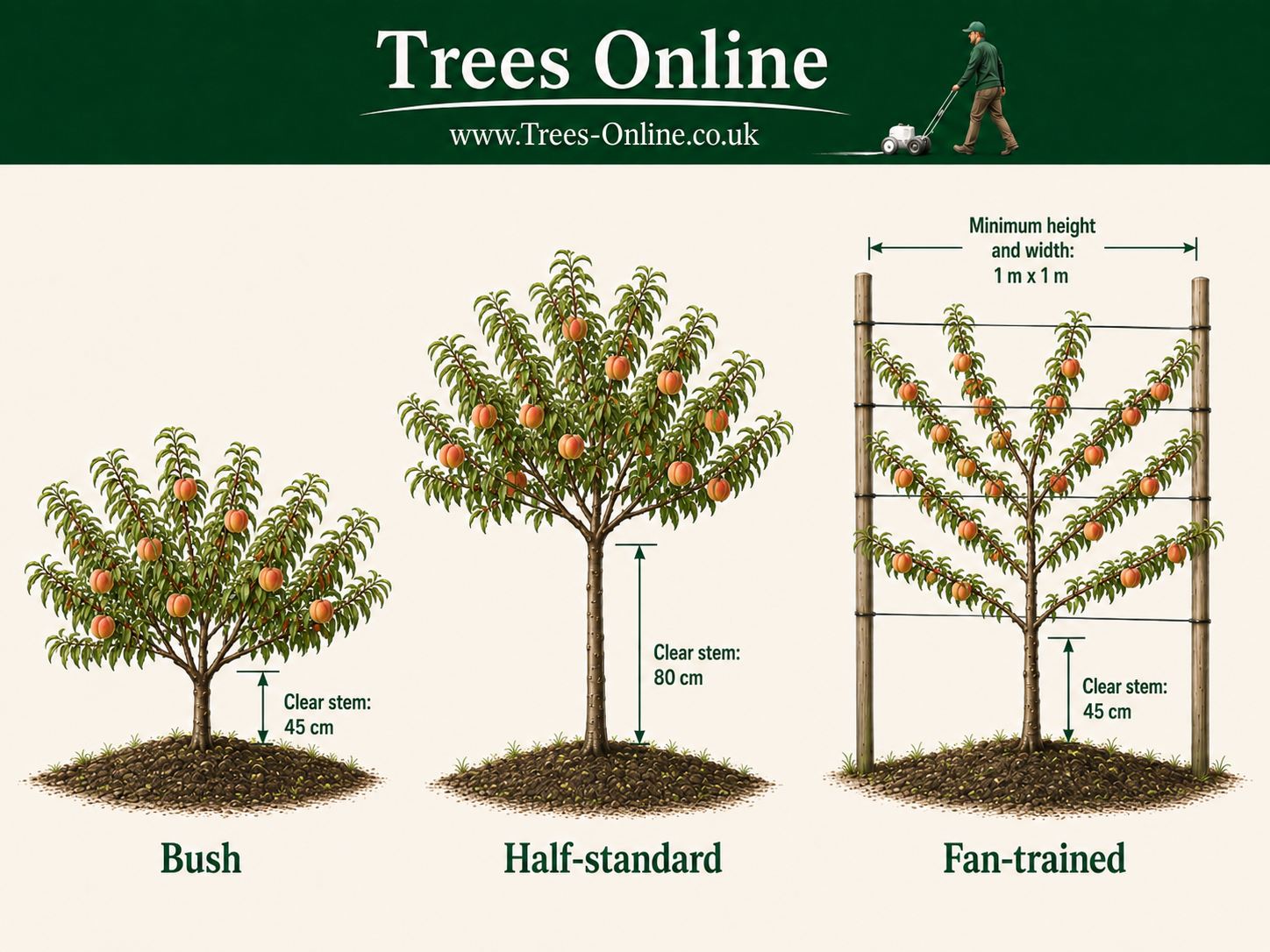
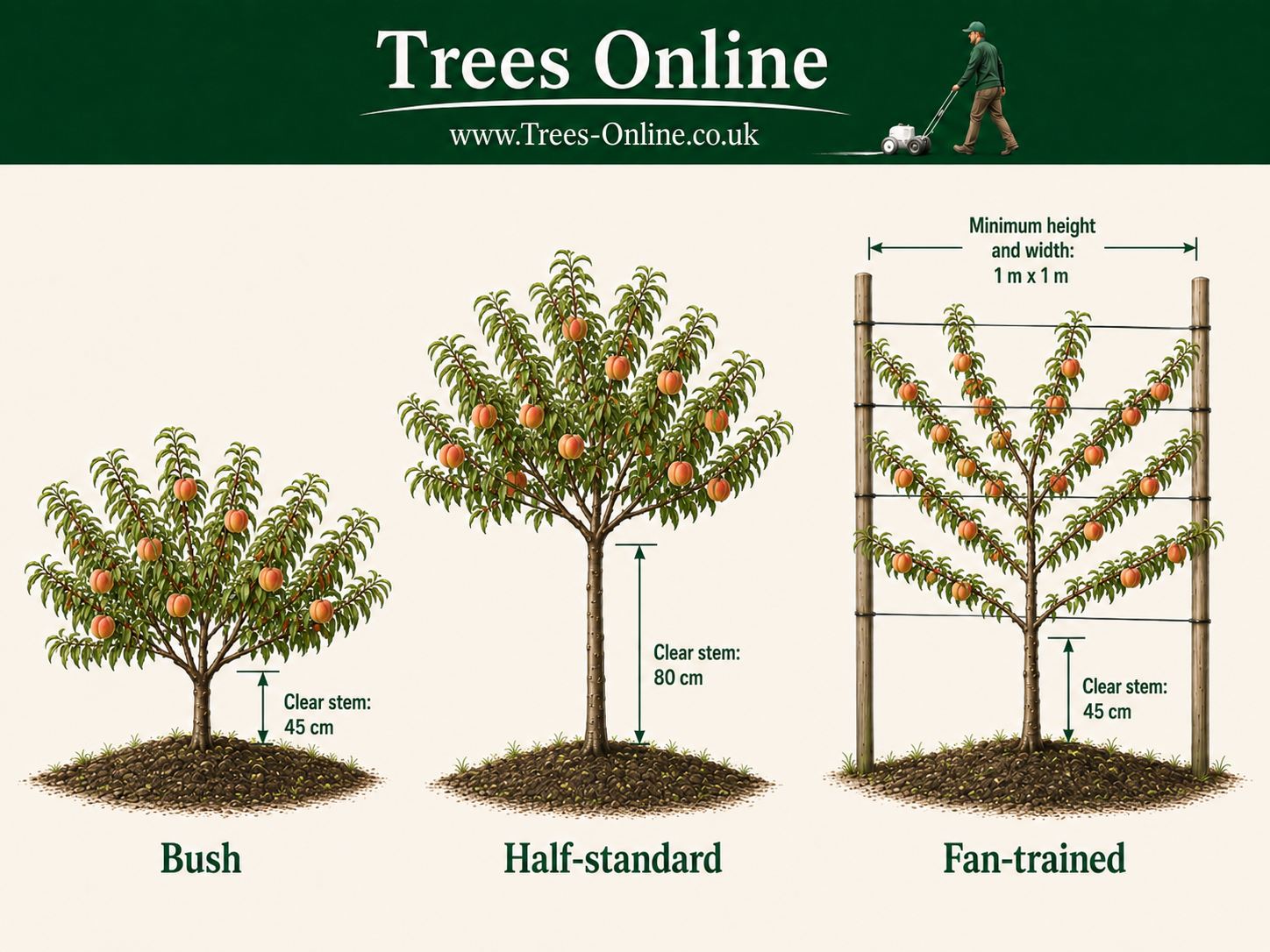
A peach tree’s form is the shape it has been grown or trained into before sale. Each has its ups and downs.
- Maiden tree: A 1-year old, mostly untrained tree. Best if you want to train it yourself into a bush or fan.
- Bush tree: The normal free-standing garden form, with a short trunk and a rounded head of branches. Good for open-ground planting where there is enough space. Usually 2-3 years old but sometimes available older.
- Patio / dwarf peach tree: A naturally compact variety for pots, patios and small gardens. This is the best choice where space is limited or you need to move your tree to shelter. Again, usually sold as a 2-3 year old tree.
- Fan-trained peach tree: A tree trained flat against a wall or fence. Often the best UK form because the wall gives warmth and shelter, and the flat shape makes pruning, frost protection and peach leaf curl protection easier.
- Half-standard / standard peach tree: A taller clear-stem tree. Less common for peaches and harder to protect from frost, rain and peach leaf curl. Usually a form more for ornamental use than practical.
When Do Peach Trees Fruit and Ripen?
A peach tree can fruit while still fairly young, but a newly planted tree should be allowed to establish before you expect a proper crop. A 2–3 year old peach tree may fruit sooner than a very young sapling, but cropping depends on variety, weather, pollination, pruning, fruit thinning and how well the tree establishes after planting. Many 2-3 year old planted trees will do little for the first season or two.
Peaches usually ripen in the UK from mid to late summer, with some later varieties carrying into early autumn. RHS gives July to September as the general peach cropping period, depending on variety and growing conditions. [1]
| Season |
Typical timing |
Example buyer point |
| Early to mid-season |
Late July to August |
Useful if you want peaches earlier in summer. |
| Mid-season |
August |
The main peach season for many garden varieties. |
| Late-season |
September |
Useful if you want a later peach, but late fruit needs enough warmth to ripen properly. |
Do not treat picking dates as fixed promises. A sunny sheltered wall, greenhouse or warm patio can bring fruit on better than a cool exposed garden. A cold spring, poor pollination or heavy crop can delay or reduce the harvest.
Common Peach Tree Problems Buyers Should Know
Peach trees are worth growing, but they are more demanding than apples or pears. The main problems are not reasons to avoid buying one; they are reasons to choose the right variety and position from the start.
Peach Leaf Curl
Peach leaf curl is covered above because it is one of the main peach-buying issues in the UK. The short version: choose a resistant or tolerant variety where possible, especially Avalon Pride, and use shelter or rain protection in wet spring weather. [13] [14]
Frost-Damaged Blossom
Peaches flower early, which is lovely but risky. Late frost can damage blossom and reduce or wipe out the crop. Frost protection may be needed in late winter and spring, especially on cold nights after flower buds start opening. [22]
Buyer takeaway: a warm wall, sheltered garden, horticultural garden fleece protection and later-flowering varieties such as Rochester can all help reduce risk.
Poor Pollination
Peaches are self-fertile, but cold, wet or windy weather can limit pollinating insects during flowering. Under-cover trees may also get fewer insect visits. [1]
Buyer takeaway: you normally do not need a second peach tree, but hand pollination can improve fruit set.
Fruit Drop and Fruit Thinning
Peach trees can set more fruit than they can carry well. Thinning removes excess fruit so the remaining peaches have more space and energy to size up properly. RHS lists peaches and nectarines among the fruit trees where thinning can improve fruit size and quality. [21]
Penn State also links pruning and crop load management with light, tree size and fruit quality. In practical buyer terms, a peach tree needs managing; it is not a tree to plant and ignore for ten years. [20]
Buyer takeaway: some fruit drop is normal, but overcrowded fruit should be thinned rather than left in heavy clusters. When the fruits are about marble size, thin out the smallest and most deformed. When they get to walnut size, thin them out to about 15cm or more apart.
Pruning Timing
Peach pruning is different from apple and pear pruning. Peaches are stone fruit, and UK advice is to prune in spring or summer on a dry day, not in winter, to reduce disease risk. [19]
Buyer takeaway: if you buy a peach tree, expect annual pruning and training. This is especially important for fan-trained trees and wall-trained peaches.
Brown Rot and Bacterial Canker
Brown rot affects stone fruit and can damage blossom, shoots and ripening fruit, especially in wet conditions. Official guidance from wet-climate fruit regions also highlights brown rot and bacterial canker as important peach problems. [2] [23]
Bacterial canker affects Prunus trees, including peaches, and can cause sunken dead patches of bark, dieback and leaf spotting. [24]
Buyer takeaway: good airflow, sensible pruning, removing diseased material and avoiding a cold wet position all matter. A peach tree in the wrong place is far more likely to become hard work.
Peach Tree FAQs
Do peach trees grow in the UK?
Yes. Peach trees can grow and fruit almost anywhere in the UK, especially in sunny, sheltered gardens, against warm walls, on protected patios or under cover. [1]
Can peach trees grow in Scotland?
Yes, but Scotland and colder northern areas are more challenging. A warm wall, protected patio, greenhouse or polytunnel is usually a safer choice than planting a free-standing peach tree in an exposed position. [26] [27]
Do I need two peach trees?
No. Peach trees are self-fertile, so one tree can produce fruit. Hand pollination can still help because peaches flower early, often when pollinating insects are less active. [1]
Are peach trees self-fertile?
Yes. Peach trees are self-fertile, so they do not normally need a second peach tree for pollination. [1]
Which peach tree is best for leaf curl resistance?
Avalon Pride [4] [13], Amsden June [45], Red Haven / Redhaven [8] [13], Rochester [13] [44]
Can I grow a peach tree in a pot?
Yes. Choose a compact patio variety such as Bonanza Peach Tree, use a large pot with good drainage, and keep up with watering and feeding. [16]
Can I grow a peach tree against a wall?
Yes. A sunny south-facing or south-west-facing wall is one of the best UK positions for a peach tree. It gives warmth, shelter and support for fan-training. [1]
Can I grow a peach tree in a greenhouse or conservatory?
Yes. Growing under cover can improve warmth and reduce rain on new growth. Hand pollination may be needed because insects may not reach the flowers easily. [1]
When should I prune a peach tree in the UK?
Prune peaches in spring or summer on a dry day. Avoid winter pruning because peaches are stone fruit and are more vulnerable to disease if pruned at the wrong time. [19]
When do peaches ripen in the UK?
Most garden peaches ripen from July to September, depending on variety, weather and growing position. [1]
How long before a peach tree fruits?
Fruiting depends on variety, establishment, pollination, pruning and weather. Expect a 2-3 year old tree to do very little for the first 1-2 seasons.
Why is my peach tree dropping fruit?
Some fruit drop is normal. Heavy crops may also need thinning so the remaining fruit can size up properly and branches are not overloaded. [21]
Should I thin peaches on the tree?
Yes, if the tree sets too many fruit. Thinning improves fruit size and quality and helps prevent overloaded branches. [21]
Is a peach plant the same as a peach tree?
In normal shopping language, yes. Buyers may search for peach plants, peach fruit plants or peach trees, but a named grafted peach tree is the right choice if you want predictable fruit.
Can I grow a peach tree from a stone?
You can grow a peach seedling from a stone, but it will not reliably produce the same variety as the parent fruit. For predictable fruit quality, size and cropping, buy a named grafted peach tree.
Buy Peach Trees Online from Trees-Online