Quince Trees for Sale UK: Buying Guide
This guide is for UK gardeners choosing a fruiting quince tree online. It covers true quince, Cydonia oblonga, not ornamental Japanese quince shrubs.
Which Quince Tree Should I Buy?
To answer this, we need to make a few assumptions, e.g. you want them mostly for the fruit, have an average-sized garden and know that they are mostly used for cooking, preserving etc.
First of all, pick any that are listed as self-fertile and most of them are. Then look at the rootstock they are grown on, as that determines many things, but for you, height is usually the most important. The rootstocks most common for garden quince trees are "Quince A" (grows to around 3.0 - 4.5m) and "Quince C" (grows to around 2.5-3.0m). A smaller tree obviously gives you less growing real estate i.e. smaller crops and is more suitable for growing in pots.
The three most popular are
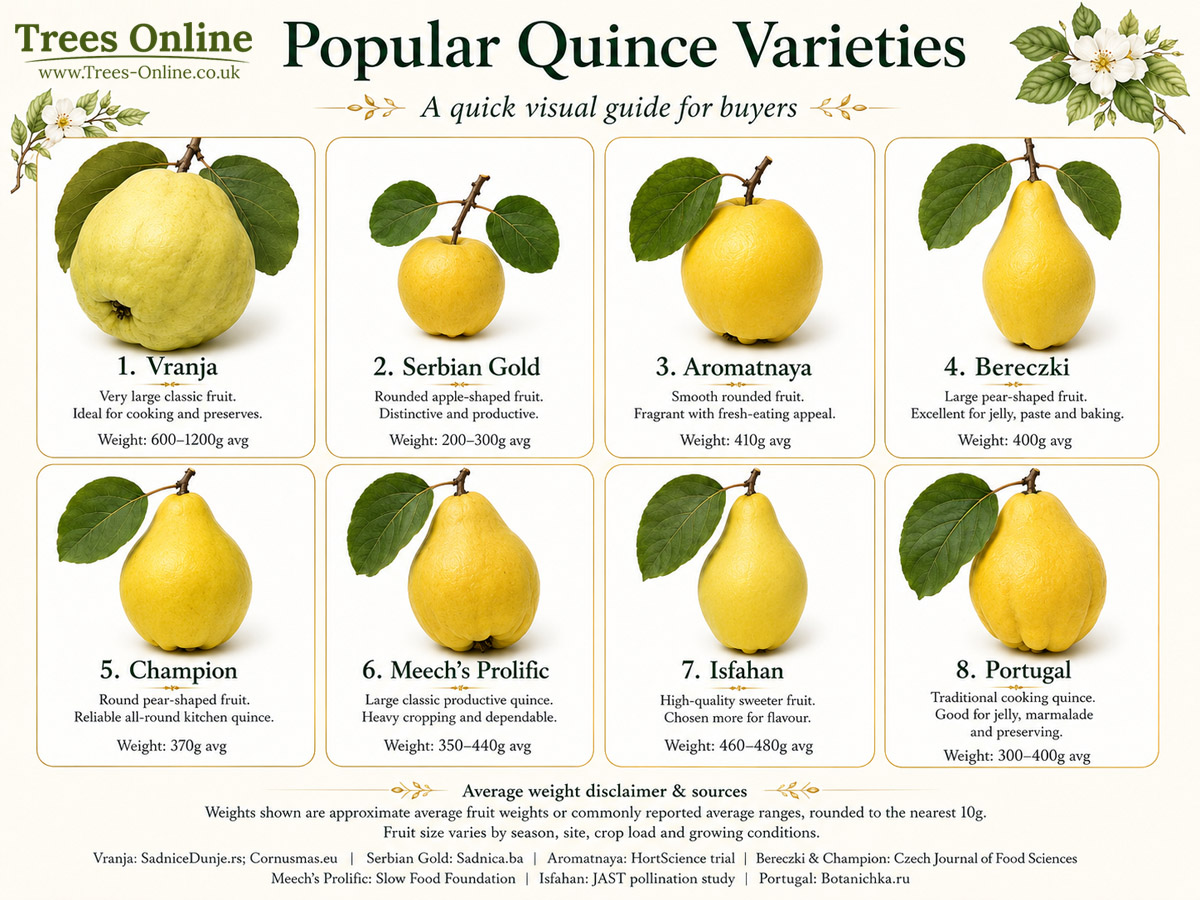
Meech’s Prolific Reliable, popular, self-fertile quince with large, scented, pear-shaped yellow fruit. Excellent kitchen use — jellies, jams, purées, membrillo/quince cheese and cooked fruit. Good choice for buyers who want the safest traditional cooking quince.
Vranja Very large pear-shaped fragrant fruit that ripens golden-yellow, with RHS-listed Vranja Nenadovic having AGM recognition. Known as the “impressive large-fruited quince” — ideal for customers who want a bold, traditional fruiting quince that looks substantial and ornamental as well as useful
Serbian Gold Has the RHS Award of Garden Merit. Compact, aromatic, roundish yellow fruit, spring blossom and early autumn picking. The easiest sell for smaller gardens because it combines compact habit, ornamental value, aromatic fruit and award-backed garden performance.
Why Buy a Quince Tree?
Not usually the first choice of a fruit tree for a garden because it is not as versatile as other fruit trees. Giving a bowl of quinces to your neighbours is probably not as welcome as pears, plums or apples.
The biggest benefits are long storage times, strong aroma[7], ideal for cooking and preserving[1][8][9].
Quince is especially useful if you want fruit for preserving. Research and review material describe quince as a fruit commonly eaten in processed form, and quince peel pectin has been studied for use in jam production. [8][9]
Fruiting Quince Trees vs Japanese Quince
If you want edible quince fruit, buy a fruiting quince tree: Cydonia oblonga. This is the quince grown for large, aromatic yellow fruit.
Japanese quince is usually Chaenomeles. It is mainly sold as an ornamental shrub for spring flowers. It can produce small aromatic fruits, but it is not the same purchase as a fruiting quince tree. [1]
Chinese quince, Pseudocydonia sinensis, is separate again. RHS describes it as a compact tree with aromatic fruits that can be cooked in a similar way, but it is not the usual fruiting quince sold as Cydonia oblonga. [1]
Buyer check: if the listing says Japanese quince, flowering quince or Chaenomeles, treat it as an ornamental shrub unless the seller clearly states otherwise.
Popular Quince Tree Varieties
The best quince variety depends on what matters most: reliable crops, fruit size, compact growth, disease tolerance, flavour or how you want to use the fruit.
Popular for flavour: Aromatnaya, Pineapple, Isfahan
Popular for large fruit: Vranja, Rea’s Mammoth, Cooke’s Jumbo, Bereczki
Popular for wetter gardens / disease tolerance: Aromatnaya, Serbian Gold, Cydora Robusta
Popular for smaller gardens: Serbian Gold, Cydora Robusta, Ludovic
Popular traditional cooking quince: Portugal, Champion, Meech’s Prolific, Vranja
Popular for jelly / preserves: Gamboa, Meech’s Prolific, Smyrna, Portugal
If you plan on juggling with them then any apple-shaped ones are a good choice, failing that the table below covers most popular or mainstream UK varieties.
| Variety name |
Brief Description of Buyer-useful Characteristics |
Best Known For |
| Agvambari |
Turkish quince with small, rounded pear-shaped fruit. Considered reliable. |
Reliable smaller pear-shaped fruit. |
| Aromatnaya |
Aromatic apple-shaped fruit. Good leaf-blight tolerance and low Fabraea leaf-spot scores[2][12] |
Unusual flavour, fresh-eating claims, wetter-area suitability and good leaf-blight tolerance.[2][12][20] |
| Bereczki |
Traditional Hungarian quince, large pear-shaped fruit and vigorous growth. Popular as a cooking quince. |
Vigorous traditional quince, with low fire-blight risk noted by LWG.[14] |
| Champion |
Old named quince with large fruit. Useful for buyers wanting big culinary fruit. |
Large fruit and low Fabraea leaf-spot scores in USDA-ARS data, but high fire-blight risk [12][14] |
| Cooke’s Jumbo |
Very large-fruited quince for baking, jellies and preserves. |
Extra-large culinary fruit. |
| Cydora Robusta |
Modern garden quince with upright growth and large golden fruit that stores well. |
Found in smaller gardens, low fire-blight risk, very tolerant to mildew, and leaf spot.[14][15][17] |
| Ekmek |
Turkish quince, large, irregular fruit, and finer flesh that holds cooked shape. |
Fine-textured cooking fruit and lower leaf-spot susceptibility in USDA-ARS data.[12] |
| Gamboa |
Old Portuguese quince with long, pointed pear-shaped fruit and acidic flesh. Popular for jelly. |
Jelly and pointed pear-shaped fruit. |
| Geant du Portugal |
Large-fruited Portugal-type quince, mainly grown as a traditional culinary variety. |
Large Portugal-type fruit. |
| Iranian Quince |
Sweet Iranian quince type with fine-textured yellow flesh. Useful for cooking where texture matters. |
Sweet fine-textured cooking fruit. |
| Isfahan |
Persian/Iranian quince with aromatic fruit. |
Less common Persian-style quince with fresh-eating claims, low leaf-spot susceptibility and lowest fire-blight susceptibility in one Iranian trial.[12][16][21] |
| Le Bourgeaut / Bourgeault |
French culinary quince with pear-shaped fruit and good cooking use. |
Old French culinary quince. |
| Leskovac / Leskovacka |
Apple-shaped aromatic quince. |
Apple-shaped aromatic fruit. |
| Ludovic |
Large, highly fragrant apple-shaped fruit. |
Apple-shaped fruit, with low fire-blight risk noted by LWG.[14] |
| Meech’s Prolific / Meeches Prolific |
Popular quince with scented pear-shaped yellow fruit and heavy crops. |
Reliable heavy cropping, good for preserves. |
| Portugal |
Long-established quince bought for traditional cooking fruit and flavour. |
Traditional cooking quince. |
| Rea’s Mammoth / Reas Mammoth |
Traditional quince with fragrant yellow fruit and pale blossom. Often chosen for large fruit. |
Large traditional fragrant fruit, with low fire-blight risk noted by LWG.[14] |
| Serbian Gold |
Compact quince, large rounded golden fruit, strong aroma and good leaf-blight tolerance. RHS AGM. |
Compact growth, aroma and good leaf-blight tolerance; listed as disease-resistant.[2][18] |
| Shams |
Iranian sweet quince type with fine-textured yellow flesh. Useful for cooked dishes. |
Sweet Iranian quince. |
| Sobu |
Turkish quince with very large, long pear-shaped fruit that can hold shape when cooked. |
Very large cooking fruit. |
| Smyrna |
Old recognised aromatic pear-shaped quince for cooking and preserving. |
Traditional preserving quince. |
| Vranja |
Well-known traditional quince with large pear-shaped aromatic fruit and good flavour. RHS AGM form exists as Vranja Nenadovic. |
Large aromatic traditional fruit, with low fire-blight risk noted by LWG; listed as disease-resistant.[14][19] |
| Pineapple |
Old cultivar associated with pineapple-like aroma/flavour and cooking use. |
Pineapple-like aroma and flavour. |
Disease-resistance wording: Low fire-blight risk does not mean fire-blight-proof. LWG (Bavarian State Institute for Viticulture and Horticulture) says no fully fire-blight-resistant quince varieties have been found, and even Cydora Robusta can still suffer badly where fire blight pressure is high. USDA-ARS greenhouse testing also found no strong fire-blight resistance among the quince cultivars it tested.[13][15]
Wetter-area note: RHS says Serbian Gold and Aromatnaya showed good quince leaf blight tolerance in the RHS Wisley quince collection. They are worth considering where wet summers are a concern. [2]
Do Quince Trees Need Another Tree to Fruit?
Most quince trees are self-fertile, so one tree is usually enough to produce fruit. [1] If you want to increase your crop yield, you have a couple of choices.
- Buy another quince tree. Having more growing real estate obviously increases the amount of fruit you get.
- Buy another quince tree that is different to the first. This is a general cross-pollination principle used in most fruit trees to improve the amount of fruit that grows, and more so than just having more growing real estate.
Either way, attracting bees and other buzzies to your garden by planting food sources for them also increases fruit yield but if the weather is bad at flowering time, your crop can be reduced.
Quince Tree Size, Rootstock and Garden Space
Quince trees can suit many UK gardens, but they are still real fruit trees. RHS gives a typical mature height and spread of around 3–4.5m, depending on rootstock, position and soil. [1]
Rootstock controls vigour. RHS describes Quince A as semi-dwarfing, while Quince C and Quince Eline are dwarfing options suitable for smaller gardens and containers. Ungrafted plants can form large trees and are only suitable where there is plenty of space. [1]
| Rootstock / Tree Type |
Expected Ideal Conditions Height |
| Quince C / Quince Eline |
2.5m - 3.0m |
| Quince A |
3.0 - 4.5m |
| Ungrafted or very vigorous trees |
4.5m or more. |
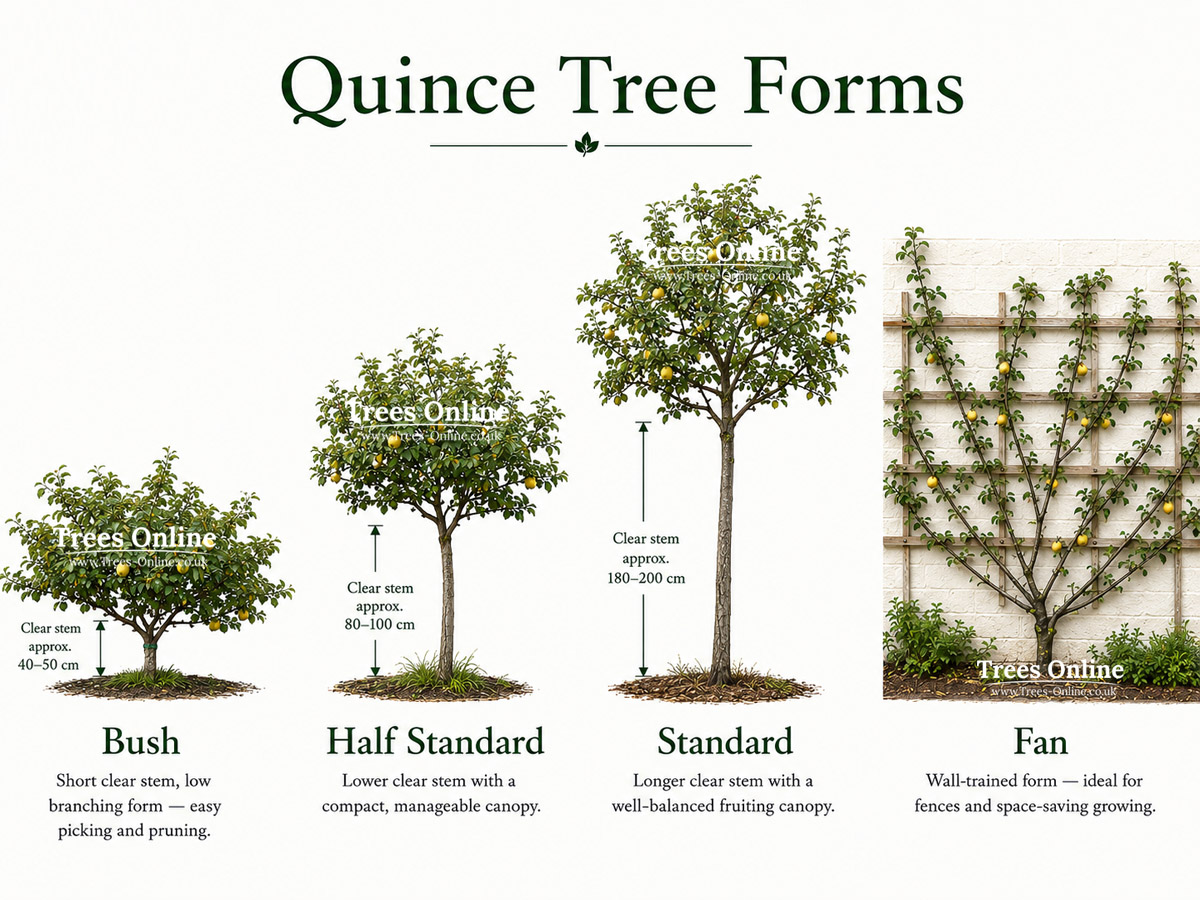
Quince plants are usually grown as:
- Bush: Allows more air and light into the canopy. Short, clear stem usually around 40-50cm
- Half-standard: Clear stem of around 80-100cm. Lollipop shape, considered ornamental and good for planting underneath or mowing.
- Fan-trained: Trained to grow in a fan shape against wires, trellis or a wall. Good for cooler gardens if grown against a south facing wall as the daytime heat creates a microclimate and keeps the plant slightly warmer. A space of around 2.5m tall and 4m wide or more is required to grow fan-trained quince.
Patio and Bare Root Quince Trees
Growing quince trees in pots
A patio quince tree is possible, but only with realistic expectations. RHS says compact quince varieties on Quince C or Quince Eline can be grown in large containers, using a pot at least 45–60cm wide and soil-based compost such as John Innes No. 3 [1]. Failing that, use the largest pot you can find, preferably 100L or more and fill it with soil that is fertile, moisture-retentive but well-drained. Although quince grows well in most soils, a pH of 6.5 to 7.5 should give optimal results.
As with all potted fruit, they require more maintenance. Drying out in the summer is a real concern, especially when fruiting and a general tree feed in spring is a good idea. [10]
Bare-root quince trees
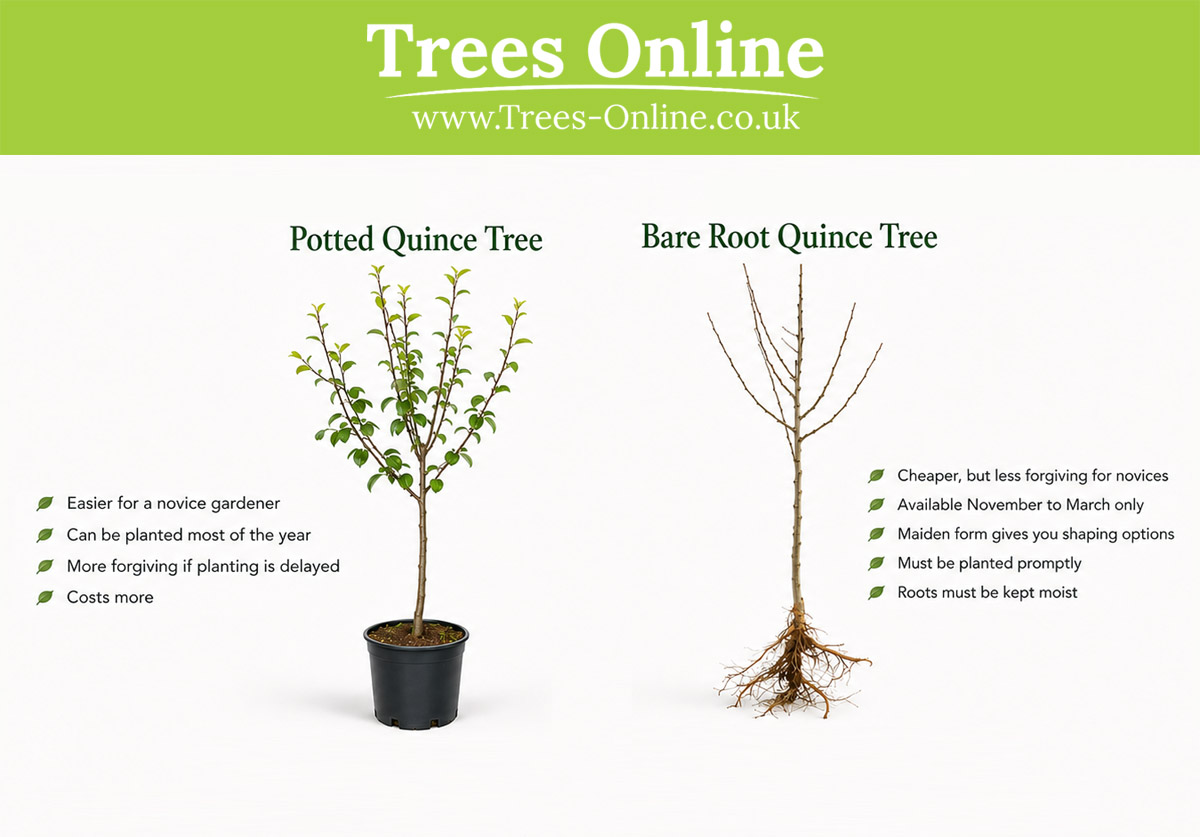
Bare-root quince trees are a dormant-season option, usually available from November to March and only planted while dormant. They have no soil around the roots and are usually cheaper. Other than maiden trees, bare-root quince trees generally come in the same forms as potted quince trees. Not as novice-friendly as potted versions but nothing major to worry about.
Maiden: A one-year-old tree that is the starting point for every other form of tree, e.g. bush, half-standard and fan-trained
Bush: 40-50cm of clear stem before branching. 2-3 years old.
Half-standard: 80-100cm of clear stem before branching. 2-3 years old.
Standard: Usually 180-200cm of clear stem before branching. 2-3 years old as a minimum.
Fan-trained: Very short stem of around 40-50cm.
Plant bare-root trees as soon as possible after delivery. If you cannot plant straight away, keep the roots damp and protected from frost, wind and drying out. For a short delay, store the tree somewhere cool and sheltered with the roots still wrapped and slightly moist. For a longer delay, heel it in by placing the roots temporarily in a shallow trench or large container, covering them with loose soil or compost, and firming it gently so the roots stay covered until planting. [11]
Where Do Quince Trees Grow Best?
Quince trees grow best in a warm, sunny, sheltered position. Sun helps the fruit ripen, and shelter helps protect spring blossom from cold winds and frost damage. [1] In practical terms, the prevailing wind comes from the west or south west so a wall or fence in the way helps with protection. For potted versions, moving under glass or a sunny spot helps. If you have a multi-level garden, move it away from the lowest point because that is where the cold collects.
In colder, northern or more exposed sites, RHS recommends planting against a south- or south-west-facing wall for extra warmth and shelter. [1]
Quinces tolerate a range of soils but prefer deep, fertile, moisture-retentive ground that has good drainage. They do not want soil that stays waterlogged for long periods. If soil is light or shallow, organic matter can help improve moisture retention. [1]
You may see old advice that quinces like growing near water. The safer buying rule is not “plant it wet”; it is to choose fertile, moisture-retentive soil that does not stay waterlogged.
How Long Before a Quince Tree Fruits?
The RHS says quince trees usually start cropping when they are five or six years old. [1] This means you will need to wait a minimum of 4+ years when buying a bare root maiden and 3+ years for options sold as 2-3 years old (most of them).
That timing can vary with tree age, variety, rootstock, pruning, site and weather.
When to Pick Quinces in the UK
In the UK, quinces are usually picked in October or November. The fruit should be yellow or golden, and strongly aromatic. Leave fruit on the tree as long as reasonably possible for flavour, but pick before hard frost. [1] If the fruit comes away easily with a gentle tug then this is a sign it is mature. If you are forced to pick them because of a frost, they will ripen indoors.
For storage, keep them cool, dry, airy and out of strong sun. Check the fruit daily and remove any that soften, bruise or start to rot. Other fruits may pick up their scent so keep other fruits separate.
To help picked quinces ripen indoors, keep them at room temperature near ripe bananas for a few days. Bananas release ethylene [22] [23], and quince is a climacteric fruit, so this can encourage ripening. Check the fruit daily and remove any that soften, bruise or start to rot.
RHS says quinces can keep for two or three months. [1][3] Use bruised or damaged fruit first, as it will not store well.
Eating and Cooking with Quince Fruit
Quince is most useful where you want flavour, fragrance and natural setting power. It makes the biggest difference in preserves, membrillo and apple or pear recipes, where even a small amount can add strong aroma and sharper, richer flavour.
It is also used in savoury cooking, especially tagines, stews and slow-cooked meat dishes, where its sharp, aromatic flavour cuts through rich meats such as lamb, pork, beef or game.
RHS says quince fruit is not edible raw and is cooked for jelly, desserts and membrillo [1] but this contradicts some quince trees being sold as dessert fruits such as Aromatnaya and Isfahan.
One of the best reasons to grow quince is its scent. Picked fruit can perfume a room as it ripens indoors, which is part of its appeal as an autumn fruit even before it reaches the kitchen. [7]
For buyers who make preserves, quince has a stronger case than many unusual fruit trees. A review of quince fruit notes that it is mainly consumed in processed form, and a pectin-extraction study tested pectin from quince peelings in jam production. [8][9]
Quince Tree Pruning and Common Problems
Pruning
For the first few years, pruning is mainly about building the shape, not chasing fruit.
In winter, remove damaged, dead or crossing growth, then choose a simple open framework of well-spaced branches. Do not hard-cut everything back each year, because quince is tip-bearing and will later fruit on the ends of previous year’s shoots.
For a bush tree, aim for a short clear stem and an open centre so light and air can get in. For a half-standard, keep the clear stem clean and build a balanced head above it. For a fan, tie young shoots into the fan shape while they are flexible and remove growth pointing out from the wall.
Once the shape is formed, pruning should stay light: remove problem wood, thin crowded growth, and avoid heavy shortening unless you are correcting shape. RHS says established quince trees usually only need light pruning where necessary, and that quince fruits mainly on shoot tips made the previous year.
Problems
Quince trees are usually fairly manageable, but the main problems to watch for are quince leaf blight, fireblight, brown rot, frost damage and poor cropping.
Good airflow, light pruning and clearing fallen infected leaves can help reduce leaf blight. Remove and destroy any fireblight-infected shoots promptly, cutting well below the affected area and disinfecting tools between cuts. Pick damaged or rotting fruit quickly to reduce brown rot, and avoid leaving ripe fruit hanging too long. Frost damage is best reduced by planting in a warm, sheltered position rather than a frost pocket. Poor cropping is often caused by youth, lack of sun, frost at blossom time, over-pruning or weak establishment, so site choice and patient aftercare matter more than heavy feeding or hard pruning.
Quince Tree FAQs
Are quince trees self-fertile?
Yes. Most quince trees are self-fertile, so one tree is usually enough for fruit.
Is quince worth growing?
Yes, if you want aromatic cooking fruit, spring blossom and an unusual crop that is not easy to buy fresh. It is less suitable if you only want sweet fruit to eat straight from the tree.
Are quince trees easy to grow?
They are usually manageable in the right site. The main requirements are sun, shelter, moisture-retentive but not waterlogged soil, and sensible pruning. [1] If you have penguins in your pagoda then quince is not for you.
How many years does it take for a quince tree to bear fruit?
RHS says quince trees usually start cropping after about five or six years. Tree age, variety, rootstock, pruning and site can all affect timing.
How tall do quince trees grow?
Expect a mature height and spread of around 3–4.5m for Quince A rootstock and 2.5 to 3.0m for Quince C. Local conditions and soil will also affect it.
Can quince trees grow in pots?
Yes, compact quince trees on dwarfing rootstocks can grow in large containers. RHS recommends a pot at least 45–60cm wide. As large as possible for the smallest possible problems.
Can quince grow in clay soil?
Quince can suit moisture-retentive soil, but it should not be planted where the ground stays waterlogged for long periods. Improve light or shallow soil with organic matter where needed. [1]
What does quince taste like?
Raw quince is usually hard and sharp, but cooking brings out its fragrance and flavour. It is normally grown as a cooking and preserving fruit rather than a dessert fruit. [1]
Why is my quince not fruiting?
Common reasons include the tree being too young. It needs to be a minimum of 5 years old. Cold or poor weather at flowering damaged the blossoms, lack of sun, poor establishment or over-pruning because quince fruits on last year’s new wood.
Are all quinces edible?
If by that, you mean can you pop one in your lunch box for a midday snack, then mostly no. A couple of varieties are listed as dessert and they are Aromatnaya and Isfahan but even then, it is suggested you REALLY let them ripen off before eating.
Fruiting quince trees produce edible fruit, but most quinces are cooked before eating rather than eaten raw.
Is quince the same as Japanese quince?
No. Fruiting quince is usually Cydonia oblonga. Japanese quince is usually Chaenomeles, an ornamental flowering shrub.
Are quince trees invasive?
Fruiting quince trees are not normally treated as invasive garden trees in the UK. The bigger issue is choosing the right site and allowing enough space. If your partner develops an unhealthy relationship with your potted quince and brings it into bed with them, then we would technically say yes, the quince has become invasive.
When should I prune a quince tree?
RHS says established quince trees only need light pruning if necessary, done in winter while dormant. Remove dead, damaged or diseased wood and thin congested or unproductive stems. Ideal conditions are when dry weather is forecast for a day or two.
Sources
1. RHS — How to grow quinces: https://www.rhs.org.uk/fruit/quince/grow-your-own
2. RHS — Quince leaf blight: https://www.rhs.org.uk/disease/quince-leaf-blight
3. RHS — Storing apples, pears and quinces: https://www.rhs.org.uk/fruit/fruit-trees/storing
4. RHS — Cydonia oblonga plant profile: https://www.rhs.org.uk/plants/5160/cydonia-oblonga-(f)/details
5. RHS — Cydonia oblonga Leskovac plant profile: https://www.rhs.org.uk/plants/163227/cydonia-oblonga-leskovac-(f)/details
6. RHS — Cydonia oblonga Reas Mammoth plant profile: https://www.rhs.org.uk/plants/131963/cydonia-oblonga-rea-s-mammoth-(f)/details
7. Country Life — There is only a handful of fruit trees I'd grow for their non-edible charms - quince is one: https://www.countrylife.co.uk/gardens/gardening-tips/there-is-only-a-handful-of-fruit-trees-id-grow-for-their-non-edible-charms-quince-is-one
8. International Journal of Development Research — Extraction of pectin from quince (Cydonia oblonga) fruit husk and using it in jam industry: https://www.connectjournals.com/file_full_text/3147701H_2163-2166.pdf
9. Food Chemistry — Quince fruit Cydonia oblonga Mill. nutritional composition, antioxidative properties, health benefits and consumers preferences towards some industrial quince products: a review: https://doi.org/10.1016/j.foodchem.2022.133362
10. RHS — Fruit in containers: https://www.rhs.org.uk/fruit/fruit-trees/containers
11. RHS — Trees and shrubs: establishment problems: https://www.rhs.org.uk/plants/types/trees/establishment-trees-shrubs
12. USDA-ARS / Joseph Postman — Curator’s Choice: Favorite Pears and Quince from the USDA-ARS Collection: https://www.homeorchardsociety.org/wp-content/uploads/2014/08/07-Joseph-Postman-Quince-Genetic-Resources.pdf
13. USDA-ARS — Relative Susceptibility of Quince, Pear, and Apple Cultivars to Fire Blight Following Greenhouse Inoculation: https://www.ars.usda.gov/research/publications/publication/?seqNo115=242446
14. Bayerische Landesanstalt für Weinbau und Gartenbau / Streuobst in Bayern — Sortenschilder 2025: Quitten: https://www.streuobst-in-bayern.de/fileadmin/pdf_upload_LWG_LfL/Sortenschilder_LWG_Quitte.pdf
15. Bayerische Landesanstalt für Weinbau und Gartenbau — Quitten – Sortiment, Anbau und Verwendung: https://www.lwg.bayern.de/gartenbau/obstbau/220879/index.php
16. Seed and Plant Journal — Abdollahi, Ghasemi and Mehrabipour, Evaluation of Fire Blight Resistance in some Quince (Cydonia oblonga Mill.) Genotypes. II. Resistance of Genotypes to the Disease: https://spj.areeo.ac.ir/article_110836.html?lang=en
17. Frank P Matthews — Cydora Robusta quince: https://www.frankpmatthews.com/catalogue/fruit-trees/quince/cydora-robusta/
18. Frank P Matthews — Serbian Gold quince: https://www.frankpmatthews.com/catalogue/fruit-trees/quince/serbian-gold/
19. Frank P Matthews — Vranja quince: https://www.frankpmatthews.com/catalogue/fruit-trees/quince/vranja/
20. Frank P Matthews — Aromatnaya quince: https://www.frankpmatthews.com/catalogue/fruit-trees/quince/aromatnaya/
21. Frank P Matthews — Isfahan quince: https://www.frankpmatthews.com/catalogue/fruit-trees/quince/isfahan/
22. https://postharvest.ucdavis.edu/produce-facts-sheets/quince
23. https://postharvest.ucdavis.edu/produce-facts-sheets/banana