How to Get More Fruit With Better Pollination
This fruit tree pollination guide helps novice gardeners improve their fruit tree harvest.
Fruit Pollination Guide Contents
How to Improve Fruit Pollination the Easy Way
If you don't want to read all of this article, then the best thing you can do is:
- Attract more bees and other buzzies to your garden. They move more pollen around, and your fruit crop should improve.
- Provide a pollination partner, which is another tree of the same type but a different variety that opens its flowers at the same time.......this is the reason why you might want to read further.
Back to top
Fruit Pollination Jargon Explained
Before we start, you need to know the following.
Pollination: Is when pollen is given to the female flower on your fruit tree to start the fruit-growing proces OR the transfer of pollen grains from a male anther to a female stigma, usually followed by fertilisation and seed production. [1] The donor tree is usually called a pollination partner.
Pollination partner: Another fruit tree that can provide pollen at the right time to start the pollination process OR a different compatible cultivar that flowers at the same time, or in an overlapping flowering group, and provides suitable pollen so your tree can set fruit properly. [1] [2] When the pollen comes from a different variety, this is called cross-pollination.
Fruit trees are generally grouped into three.
Non-self-fertile: A fruit tree that needs pollen from a different compatible tree to start the fruit-growing process. If it doesn't get the right pollen at the right time, you will get little to no fruit. In most cases, that means the same fruit type: an apple tree pollinates another apple tree, a pear tree pollinates another pear tree, and so on. [1] [3] They also usually need to be a different variety of apple tree e.g. you cannot plant two Katy apple trees with no other trees nearby and expect fruit.
Self-fertile: A fruit tree that can set fruit without another pollination partner nearby because it provides the pollen and the female flowers on the same tree i.e. provides its own pollen and starts the fruit growing process. However, self-fertile fruit trees can still crop better if there is another suitable cultivar nearby for pollination. [1]
Partially self-fertile: Follows the same rules as self-fertile but produces less fruit. [1] [4]
General rule: Fruit trees are usually pollinated by the same fruit type e.g. apples pollinate apples, but there are closely related exceptions that still fit the rule. For example, crab apples can pollinate apples, and compatible plums, gages and damsons can pollinate each other. [3] [4] Although they belong to a different type of fruit, they are closely related enough to pollinate each other.
Back to top
Flowering Times
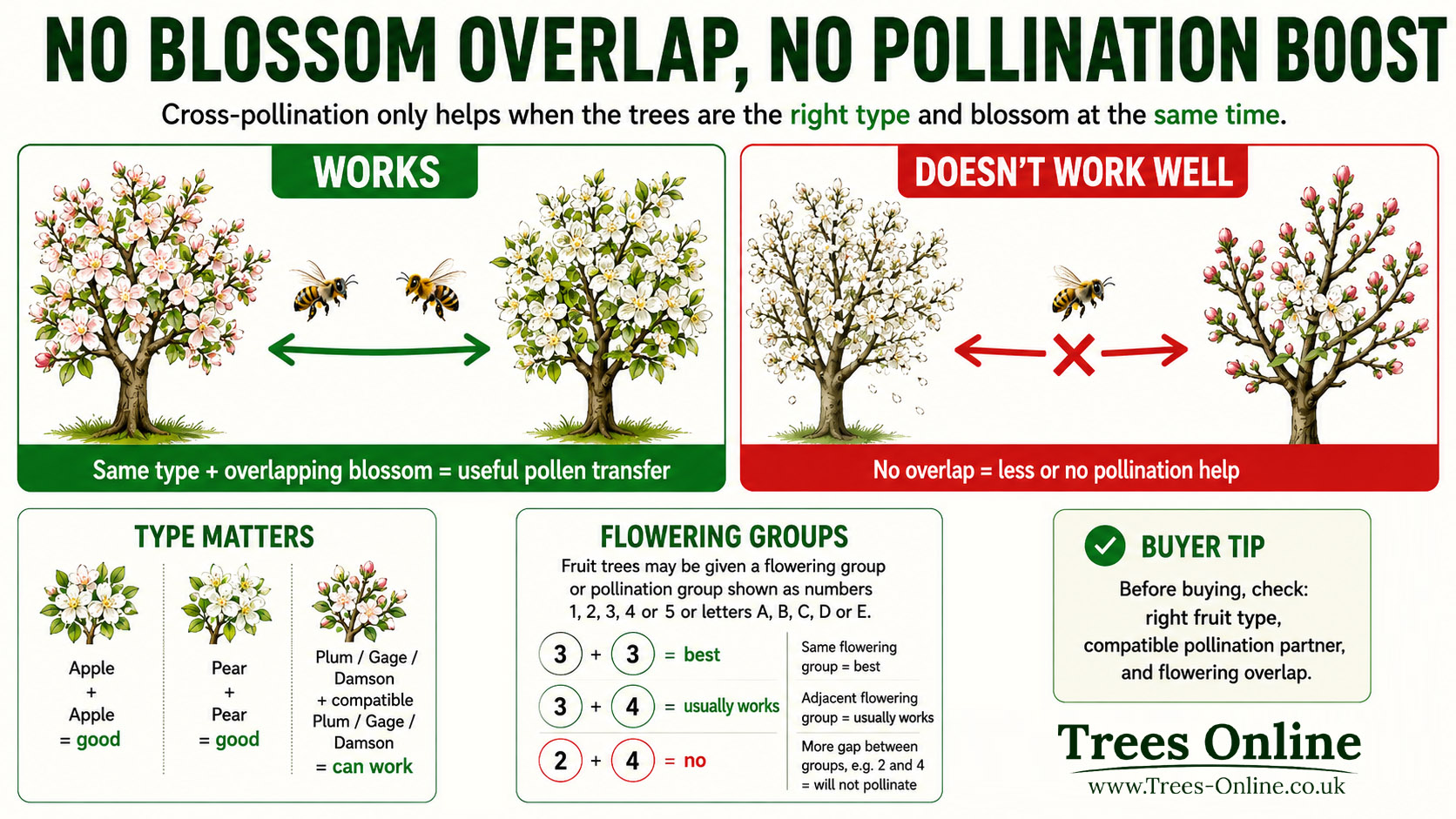
So now you know that an apple tree can only pollinate another apple tree*, another pear with a pear etc but there are further restrictions, especially with non self-fertile fruit trees. The flowers on both trees have to be open at the same time to allow pollen transfer.
Many fruit trees are given a number or letter to indicate a flowering window, e.g. 1, 2, 3, 4 and 5, or A, B, C and D. The best pollination partner match is usually one in the same flowering group, because the flowers open at the same time giving you maximum time for pollen transfer. [2] [4]
If you have adjacent numbers, e.g. you plant a 3 and a 4, then you can still have cross-pollination because group 4 will open its flowers shortly after group 3 i.e. flowering overlap. [2] [4]
If you have non-adjacent numbers, e.g. a 2 and a 4, then the 4 could open its flowers as the group 2 is losing fertility. [2] [4]
In summary, regardless of being self-fertile or not, buying trees in the same or adjacent flowering group is one of the best decisions you can make for better pollination and stronger cropping potential. [1] [2] [4]
*Very simplified for the purposes of explanation at this point.
Back to top
Compatible Pollination Partner
Now you know that your non self-fertile fruit tree needs another fruit tree of the same type (apples with apples etc) and in the same or adjacent flowering group (combinations include a 3 +4, 3 + 3 etc), for pollination to happen and fruit start to grow. This second tree is called a compatible pollination partner. A good example is a Discovery and Katy apple tree. Discovery and Katy are both listed as flowering group 3, so their blossom periods should be almost identical. [2] [3]
Self-fertile trees will produce fruit on their own so you only need to plant the one tree, ideal for smaller gardens. Crop yields can be improved by planting a compatible pollination partner nearby i.e. the same fruit type (apples with apples) but a different variety (Discovery and Katy) . This can be another self-fertile or non self-fertile tree, so long as the flowering groups are the same or adjacent. Both will share pollen and pollinate more flowers.
You can plant two identical self-fertile trees together, but the general consensus is that a greater harvest is had if the varieties are different.
Back to top
Triploid Varieties
Just when you thought you had all this sussed, wait for the Triploid trip. Apples and pears have triploid varieties and they are a real pain because their pollen is basically useless. It does nothing for itself or other fruit trees.
If you plant a triploid on its own and there are no pollination partners close by, it is unlikely to crop at all, let alone well. You need compatible pollination partners, but remember, the triploid is not a pollinator for the second tree. If the second tree is not self-fertile, it also needs a pollination partner to grow fruit. [2] [5] If you buy a triploid in flowering group 3 and a non self-fertile pollination partner, your triploid will have fruit, but your pollination partner will not. This is why buying a self-fertile pollination partner is a good idea.
If you want the second tree to crop better, you will need a third suitable pollination partner in the same or adjacent flowering group. [2] [5] This is why triploids are a pain. For a good fruit harvest you will need 2 trees, and for all trees to be cross-pollinated and give maximum crop, you need 3 trees.
Back to top
How Close Should Pollination Partners Be?
Closer is better. The easier you make it for bees and other buzzies to find food, the more they will do so.
Bees can travel a long way, and a neighbouring fruit tree may sometimes help. This is especially possible in built-up areas where lots of gardens have apples, pears, plums or cherries.
But relying on an unknown neighbour’s tree is less reliable than planting a known compatible partner yourself. RHS says that although bees can travel 3–4km, cross-pollinating fruit trees should generally be within 18m / 55ft to be really effective. [1]
Back to top
Can a Neighbour’s Fruit Tree Help?
Yes, it can, but it is not something to rely on blindly. If there is a compatible fruit tree nearby and its flower opening times overlap with yours, cross-pollination should happen. As you don't control that tree, it might be removed, pruned too heavily, die etc and you are left with no crop if your tree is not self-fertile. [1]
If space is tight and you can see compatible fruit trees nearby, you may be able to choose a self-fertile tree and treat the local trees as the extra help to improve your yield. [1] If they don't then you will still get a crop but not an improved one.
Summary
If you only have room for one tree, buy a self-fertile one. If you want the best chance of a heavier crop, buy a compatible pollination partner in the same flowering group or an adjacent flowering group. [1] [2]
Back to top
Some fruit trees that sound different are closely related enough to be compatible pollination partners. The usual rules still apply i.e. compatible type, overlapping flower times, close enough spacing and pollinators able to reach the blossom. [1] [3] [4] Examples include:
The Slight Exception
Sweet cherry trees will only pollinate other sweet cherry and not sour/cooking cherry trees. Sour cherry are usually self-fertile and can be cross-pollinated by another suitable sour cherry. [9]
Back to top
Make Your Garden Better for Pollinators
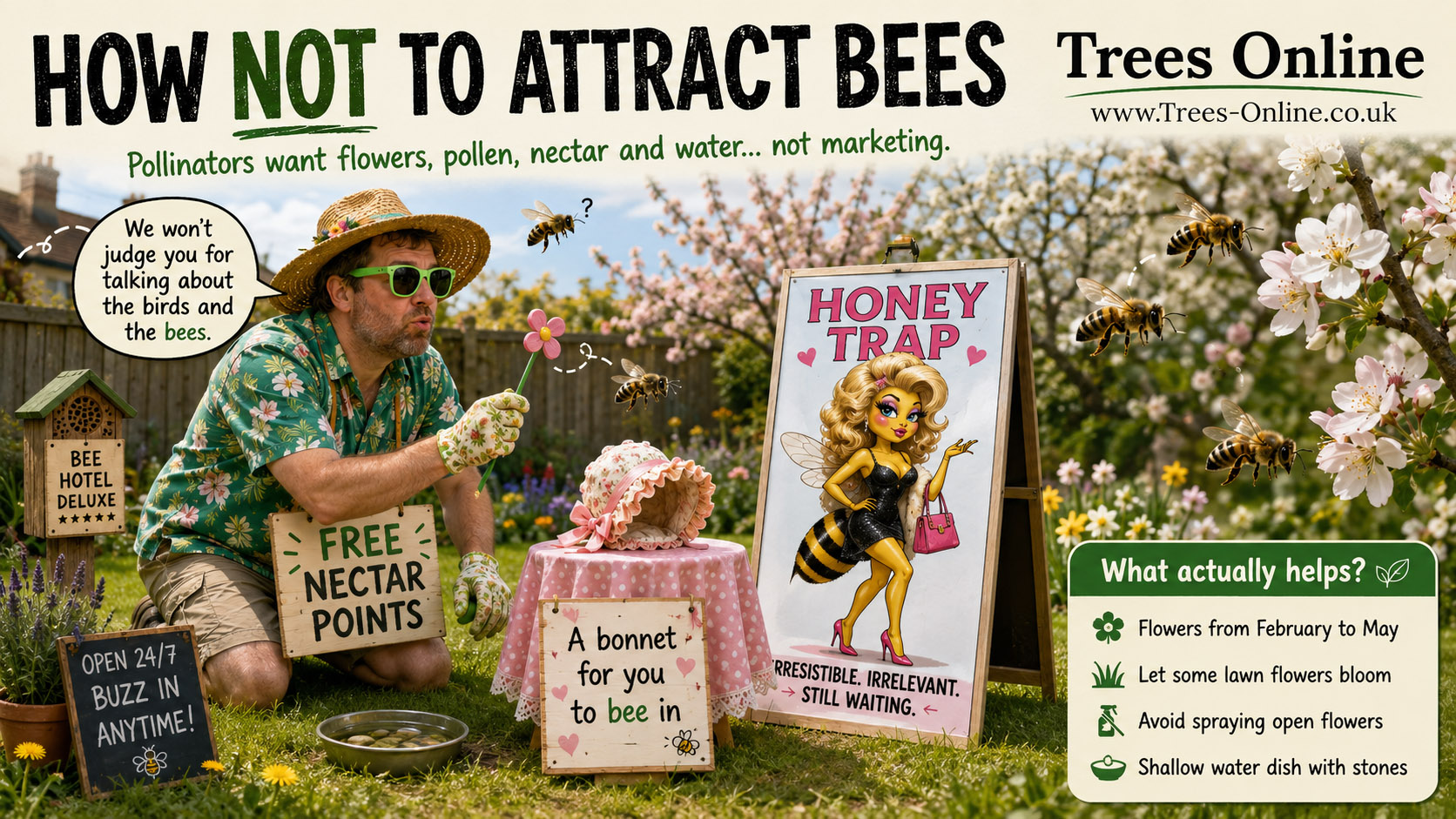
More pollinator activity can mean more pollen transfer and larger crops, so make the garden a useful pollinator feeding place during your fruit tree blossom time. [1] [10]
This table shows useful pollinator food sources for the main fruit blossom months. Timings are typical for the UK and can shift with variety, weather and location.
| Flowering time |
Fruit/nut trees usually flowering at this time |
Pollinator food sources |
| February |
Almond; hazelnut/filbert; very early apricot, peach or nectarine in mild/sheltered sites |
Snowdrop, crocus, winter aconite, hellebore, winter heather, mahonia, willow, hazel, sweet box, winter honeysuckle, winter-flowering clematis |
| March |
Almond, hazelnut/filbert, apricot, peach, nectarine, cherry plum, early plum, early gage, early damson, mirabelle |
Crocus, primrose, lungwort, hellebore, willow, hazel, flowering currant, blackthorn, cherry plum, dandelion, dead-nettle, cowslip, forget-me-not, grape hyacinth, lesser celandine, sweet violet |
| April |
Plum, gage, damson, mirabelle, cherry, pear, Asian pear, quince, medlar, crab apple, early apple |
Crab apple, hawthorn, bugle, comfrey, chives, thyme, rosemary, wallflower, aubretia, honesty, daisy, clover, bluebell, garlic mustard, ramsons, broom, barberry |
| May |
Apple, crab apple, pear, quince, medlar, late cherry, late plum, late gage, late damson, kiwi, mulberry, walnut |
Hawthorn, clover, daisy, bugle, comfrey, chives, thyme, rosemary, borage, hardy geranium, foxglove, allium, cotoneaster, blueberry, skimmia, holly, bellflower, cranesbill, columbine, wild strawberry |
Lawns can also help if they are allowed to flower. RHS recommends allowing lawn weeds to flower by mowing less often, and notes that dandelions are an important food source for many pollinators. Even a small unmown strip, wild corner or mixed flower border near the fruit trees can make the garden more useful to pollinating insects. [10] [12]
Avoid using insecticides while fruit blossom is open. Bees and other pollinators may also be feeding on flowering weeds, so do not spray open flowers of any kind. If frost protection is used, remove or open covers during mild daytime weather so insects can reach the blossom, then replace the covers before frost returns. [10] [13]
Bees and other pollinators sometimes need to drink, and RHS recommends a shallow dish with stones or marbles so they can land safely. It will not replace good nectar and pollen plants, but it can make the garden more useful to pollinators during warm, dry weather. [10]
Back to top
When Hand-Pollination Can Help Fruit Trees
Hand pollination is a backup method for fruit trees when there are too few natural pollinators or when cold, wet or windy weather limits insect activity. This is most likely needed with early-flowering fruit trees, especially peaches, nectarines and apricots. If you see no buzzies and the flowers are open, time to hand pollinate. [1] [14] [15] [16]
Honey bee flight is limited in cool weather: University of Maine Extension notes that honeybee flight can begin at about 10°C, but in spring usually begins at 12–14°C. To favour bumblebees and other pollinators, provide early spring flowers, include some tubular flowers such as lungwort, comfrey, dead-nettle and foxglove, leave a few rough nesting areas such as long grass or undisturbed borders, and avoid insecticides on open flowers. [11] [16] [17] [18] The takeaway point is if your fruit trees are flowering, you see no buzzies, and the temperature is at 10 or below then they are likely not coming until it warms up. If there is no sign of warmer weather while your flowers are open, then time to consider hand pollination.
Use a small soft paintbrush, cotton bud or feather. Gently brush inside an open flower to collect pollen, then dab it onto open flowers on the same tree if it is self-fertile or, better, onto a compatible pollination partner flowering at the same time. Repeat every few days because new flowers appear regularly. RHS specifically recommends hand-pollinating peaches and nectarines with a small paintbrush where poor pollination is a risk. [14] [15]
It can also help fan-trained trees under cover or trees protected with fleece, provided covers are opened or removed during the day so pollinators can still reach the blossom. [13] [14] [15]
Back to top
Common Mistakes That Reduce Fruit Yield
- Planting only one tree when it needs a pollination partner. [1] [2]
- Planting a triploid apple and expecting it to pollinate another apple. [2]
- Relying on bees when the weather is too cold, wet or windy during blossom. [11] [17]
- Covering blossom with fleece and not removing it during mild daytime weather. [13]
- Using insecticides while blossom or nearby lawn flowers are open. [10] [12]
- Planting in a cold, exposed or windy position. [13] [14] [15]
- Planting too deeply, which can cause grafted fruit trees to root above the graft union and lose the intended rootstock effect. [19]
- Overfeeding with high-nitrogen fertiliser, causing leafy growth instead of fruit. [20]
- Pruning at the wrong time or removing fruiting wood. [20]
- Letting the tree crop too heavily one year, which can contribute to poor cropping the next. Biennial bearing is a whole other subject. [21]
- Growing a tree in too much shade. [22]
- Growing patio or container trees in pots that are too small or dry out too quickly. [23]
For more buying help, see our fruit tree buying guides.
Back to top
Sources
- Royal Horticultural Society, Fruit pollination. Used for pollination basics, self-fertile cropping, nearby pollination, bees travelling 3–4km, and the 18m / 55ft effective cross-pollination guidance. https://www.rhs.org.uk/advice/beginners-guide/fruit-basics/fruit-pollination
- Royal Horticultural Society, Flowering times of apples: RHS Pollination Groups. Used for same/adjacent apple flowering group guidance, triploid apple sterile pollen guidance, Cox’s Orange Pippin, Katy, Scrumptious, Bramley’s Seedling and Blenheim Orange flowering/pollination references. https://www.rhs.org.uk/advice/pdfs/applepollinationgroups.pdf
- Royal Horticultural Society, Fruit trees: choosing the best. Used for general same-fruit-type pollination guidance and the note that plums, gages and damsons can pollinate each other if compatible. https://www.rhs.org.uk/fruit/fruit-trees/choosing-the-best
- Royal Horticultural Society, Plums, gages and damsons: choosing cultivars. Used for plum, gage and damson self-fertility, same/adjacent pollination group guidance, and cross-pollination benefit. https://www.rhs.org.uk/fruit/plums/choosing-cultivars
- Royal Horticultural Society, Best Pear Varieties for Your Garden. Used for pear triploid guidance and same/adjoining pollination group guidance. https://www.rhs.org.uk/fruit/pears/choosing-cultivars
- John Innes Centre, Heritage Orchard. Used for Merton Pride being triploid and ineffective as a pollination partner. https://www.jic.ac.uk/about-us/get-involved/public-engagement/find-out-more-about-church-farm/heritage-orchard/
- Washington State University Tree Fruit, Pear Pollination. Used for European and Asian pears cross-pollinating if they bloom at the same time. https://treefruit.wsu.edu/web-article/pear-pollination/
- Royal Horticultural Society, Cobnuts and Filberts: Growing Guide. Used for hazels/cobnuts/filberts being wind pollinated and needing compatible cultivars for good nut set. https://www.rhs.org.uk/nuts/cobnuts-filberts
- Royal Horticultural Society, How to grow cherries. Used for sweet and acid cherry pollination distinctions, self-fertility and compatible partner guidance. https://www.rhs.org.uk/fruit/cherries/grow-your-own
- Royal Horticultural Society, Plants for Pollinators. Used for pesticide avoidance, mowing less often, dandelions as pollinator food, water and nest-site guidance. https://www.rhs.org.uk/science/research/plants-for-pollinators
- Royal Horticultural Society, Plants for Pollinators: Garden plants. Used for pollinator-friendly plant examples including crocus, hellebore, wallflower, bugle, comfrey, hawthorn, lungwort, dead-nettle, willow, blueberry, skimmia and others. https://www.rhs.org.uk/science/pdf/conservation-and-biodiversity/wildlife/plants-for-pollinators-garden-plants.pdf
- Royal Horticultural Society, Lawn and mini-meadow habitats. Used for lawn flowers, pollen and nectar, dandelions as early food for pollinators, and reducing pesticide input. https://www.rhs.org.uk/wildlife/lawn-and-mini-meadow-habitats
- Royal Horticultural Society, Fruit: protecting from frost. Used for sunny/sheltered positions, frost pockets, fleece protection and opening/removing covers during the day for pollinator access. https://www.rhs.org.uk/fruit/fruit-trees/frost-protection
- Royal Horticultural Society, How to grow peaches. Used for peach fruiting problems, frost/poor pollination, hand-pollination with a small paintbrush and warm sheltered site guidance. https://www.rhs.org.uk/fruit/peaches/grow-your-own
- Royal Horticultural Society, How to grow nectarines. Used for nectarine fruiting problems, frost/poor pollination, hand-pollination with a small paintbrush and warm sheltered site guidance. https://www.rhs.org.uk/fruit/nectarines/grow-your-own
- Royal Horticultural Society, How to grow apricots. Used for early flowering, frost risk, wall/fan training and sheltered site guidance for apricots. https://www.rhs.org.uk/fruit/apricots/grow-your-own
- University of Maine Cooperative Extension, Background: Honeybee Flight Activity Index. Used for honeybee temperature/flight activity guidance. https://extension.umaine.edu/ipm/background-honeybee-flight-activity-index/
- Karbassioon et al., Responses in honeybee and bumblebee activity to changes in weather conditions, Oecologia. Used for honeybees being more weather-sensitive than bumblebees in orchard conditions. https://link.springer.com/article/10.1007/s00442-023-05332-x
- Royal Horticultural Society, Fruit rootstocks. Used for rootstock/graft-union guidance and why grafted fruit trees should not be planted with the graft union buried. https://www.rhs.org.uk/fruit/fruit-trees/rootstocks
- Royal Horticultural Society, Apple tree problems: frequently asked questions. Used for no/poor fruiting causes, including over-feeding, incorrect pruning and other cropping problems. https://www.rhs.org.uk/fruit/apples/tree-problems-faqs
- Royal Horticultural Society, Fruit: biennial bearing. Used for the heavy-crop/poor-crop cycle. https://www.rhs.org.uk/problems/fruit-biennial-bearing
- Royal Horticultural Society, How to grow apples. Used for sun/site guidance and general fruit-tree growing conditions. https://www.rhs.org.uk/fruit/apples/grow-your-own
- Royal Horticultural Society, Fruit in containers. Used for container fruit-tree watering and growing guidance. https://www.rhs.org.uk/fruit/fruit-trees/containers