Apricot Trees for Sale UK: Buying Guide
Buying an apricot tree is mostly about matching the tree to the right position. Apricots can grow and crop in the UK, but they are less forgiving than apples, pears or plums because their early blossom can be damaged by spring frost.
This guide helps you compare apricot trees for sale in the UK, including self-fertile apricots, potted apricot trees, bare root apricot trees, patio apricots and fan-trained apricots.
I Just Want to Buy a Good Apricot Tree — What Should I Choose?
Apricots that are regularly suggested by growers for taste are Tomcot, Golden Glow, Flavorcot / Bayoto, Moorpark and Goldcot.
If you have a smaller garden, then go for Aprigold, Compacta or Kioto.
For disease resistance and reliability go for Golden Glow.
If that answers your question then no need to keep reading this thesis so go buy your apricot from our website. Thanks for coming, adios amigo and see you again soon, if you have the room for another fruit tree.
Can You Grow Apricot Trees Successfully in the North of the UK?
Apricots can be grown in northern UK gardens, but they should be treated as a warm-wall or protected-site fruit rather than a guaranteed free-standing tree or bush planted in the middle of the lawn. As a rough rule, once you move north of the Midlands, the value of a warm, sheltered south-facing wall increases. In Scotland, outdoor cropping is much less reliable, so apricots are usually better treated as a greenhouse, conservatory or carefully fan-trained wall fruit.
Avoid frost pockets, shaded parts of the garden, exposed windy sites and wet ground.
Do Apricot Trees Need a Pollination Partner?
A pollination partner is another tree providing pollen to fertilise the first tree i.e. pollen on one tree getting to a flower on another. These trees are described as not self-fertile.
Most apricot trees sold for UK gardens are self-fertile, so it provides everything it needs on one tree for fruit production to occur.
Poor crops are more often caused by frost, cold weather or low insect activity during blossom than by lack of a second tree. If blossom opens during poor weather, hand pollination with a soft brush can help.
Apricot Hand Pollination
Use a small soft paintbrush, cotton bud or fingertip.
On a dry day while the apricot flowers are open, gently touch the centre of one flower to pick up pollen, then dab it onto the centre of other open flowers. Work around the tree, moving between flowers to spread pollen.
Repeat this every couple of days while the blossom is open, especially if the weather is cold, wet or there are few insects about. Avoid doing it in rain, as wet pollen moves poorly. You are repeating the process because not all flowers open at once.
A flower is ready when the petals are open, the flower is dry, the pollen looks loose or dusty, and the centre still looks fresh rather than brown or shrivelled.
Hand pollinating apricot blossom with a soft brush can help when cold weather reduces insect activity.
View larger imageApricot Tree Sizes and Rootstocks
A rootstock is the root system and lower stem that the apricot variety is grafted onto. It affects characteristics such as final height, strength of growth, soil tolerance and sometimes disease resistance. Most people want to know the rootstock to get an idea of the final height. The heights listed are expected under good conditions.
Pruning and training can keep a tree smaller, but this does not mean you can cut 50% of the height off and call it a patio tree.
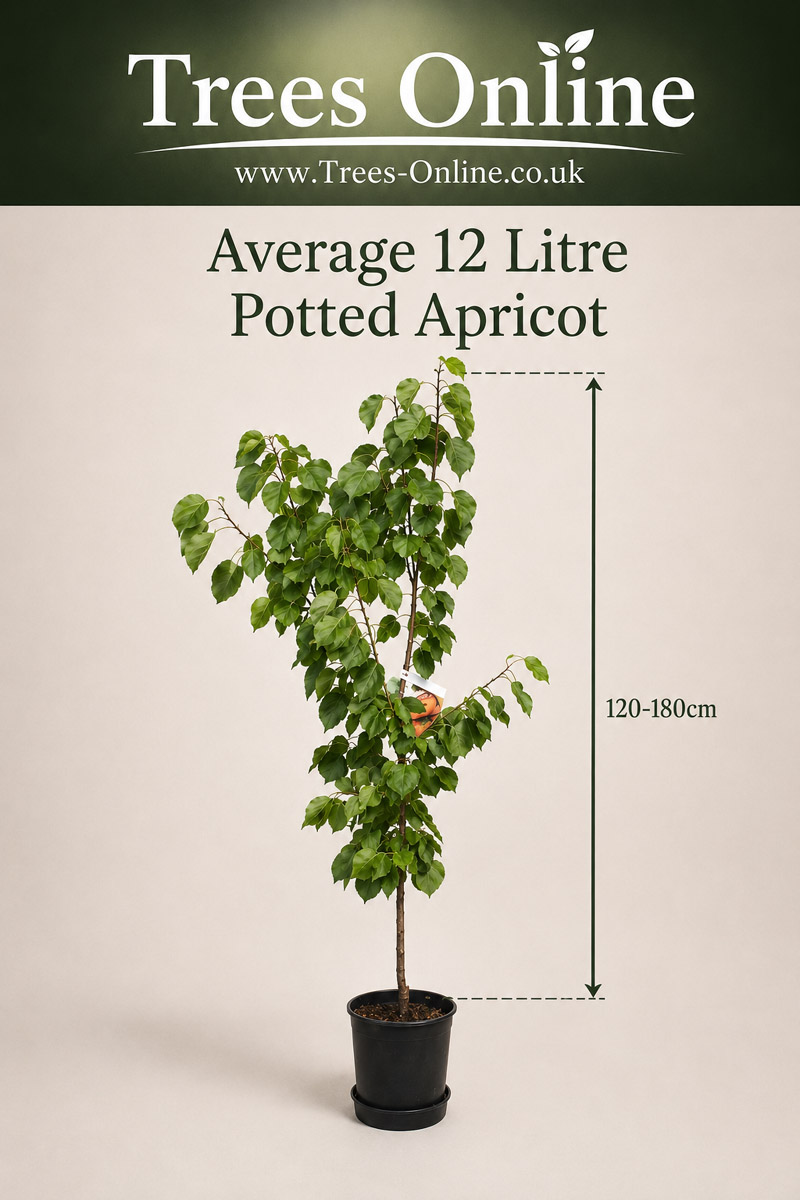
A typical 12 litre potted apricot bush gives a more established starting point than a smaller young plant.
View larger imageCommon Apricot rootstocks
St Julien A — best all-round strong grower; good for normal garden bush trees and fan-trained apricots; expected height 3.5–5m.
Torinel — best smaller-tree option; useful for smaller gardens, fans and large containers; expected height 2.4–3.6m.
Krymsk 86 — best for heavier or damper soils; strong-growing and useful where drainage is less ideal; expected height about 4m.
Wavit / WA-VIT — useful middle-ground rootstock; often smaller than St Julien A and can crop earlier; expected height around 3–5m, depending on supplier and form.
Myrobalan seedling — best for maximum vigour; suits larger spaces, but can be slower into cropping; expected height 4m+.
Peach seedling — strong-growing apricot rootstock; mainly relevant if a supplier specifically sells on it; expected height about 4m.
Montclair / Montclare — smaller apricot rootstock; useful where a full-size tree is not wanted; expected height 3–3.6m.
Pixy — smaller-growing and can crop earlier; needs good soil and watering; expected height 2.5–3m.
VVA-1 / Krymsk 1 — dwarfing option; useful for easier size control where available; expected height about 2.5–3m.
Adaptabil — best for tougher soil conditions; copes with poorer soils, drought and waterlogging better than many; expected height 3–4.5m.
Apricor — medium to large-growing apricot rootstock; expected height about 3–3.5m.
Bare Root vs Potted Apricot Trees
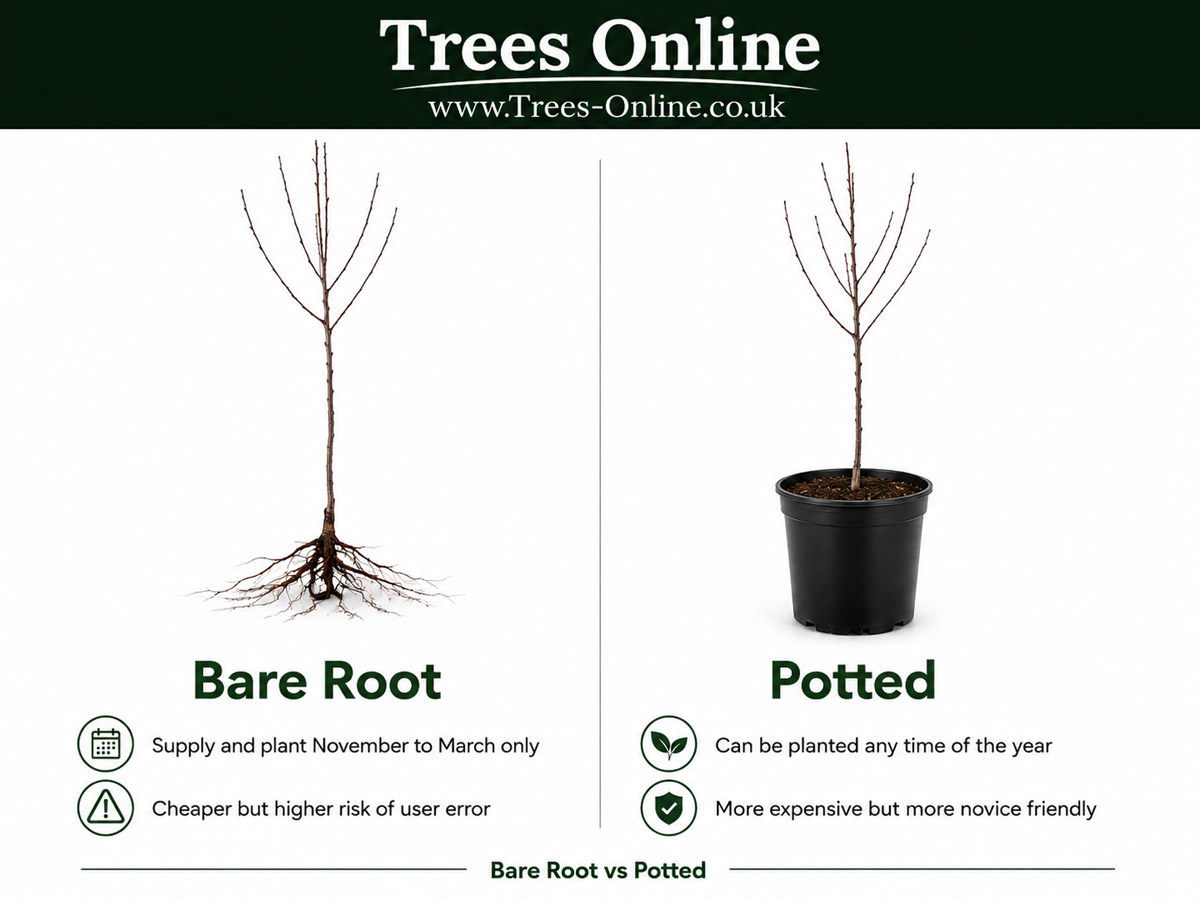
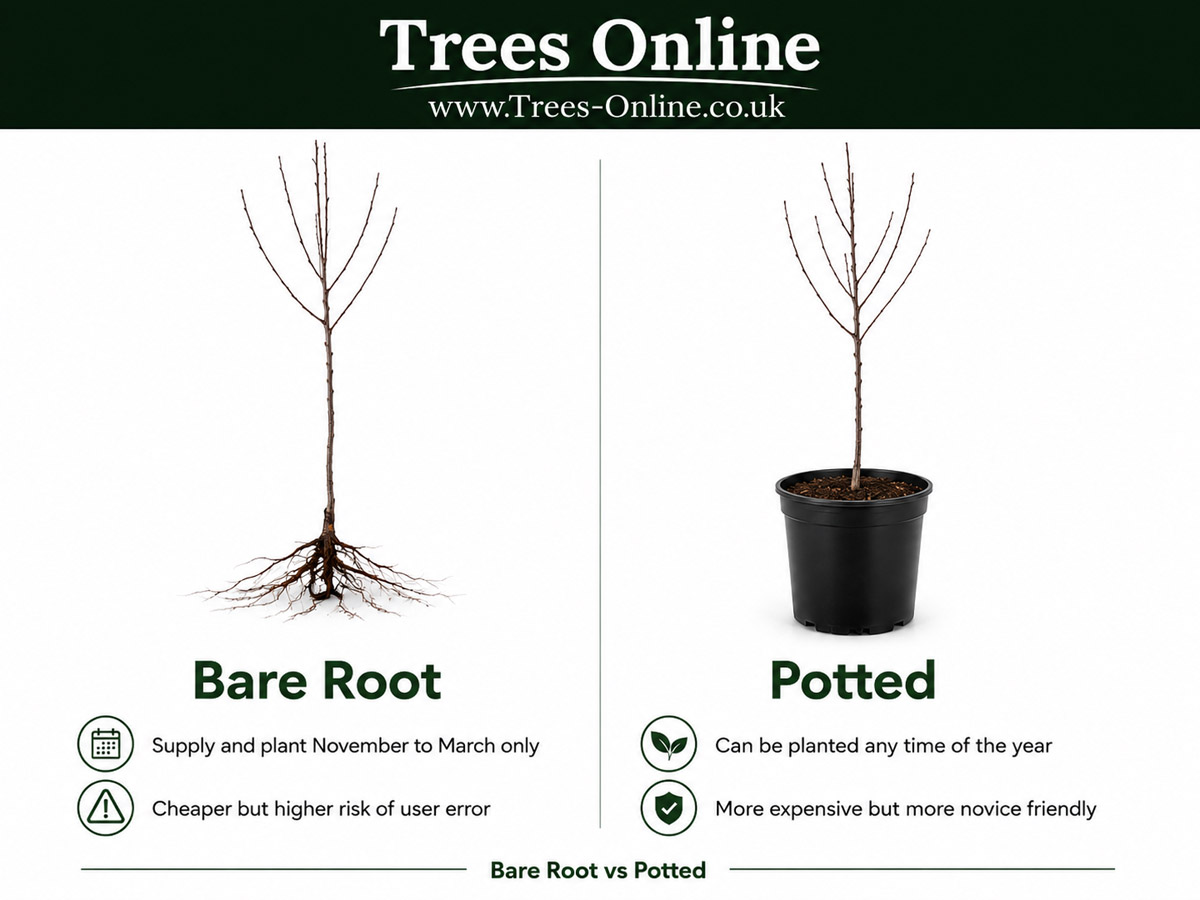
Bare root apricot trees are sold while dormant, usually between November and March, without a pot or compost around the roots. They are lifted from the field, packed to keep the roots from drying out, and planted while still dormant.
They are usually cheaper than potted trees, but they need more care at planting. The roots must not dry out, be bent sharply, or be crammed into too small a hole. If they are handled badly, the risk of failure is higher.
Bare root apricots may also be sold at different ages or stages. A one-year-old tree is often called a maiden. This is the option to choose if you want to train your own shape, such as a fan-trained tree, bush or half-standard. It gives you more control, but it also needs more pruning knowledge beyond the scope of this basic guide.
Potted apricot trees are supplied in containers. They cost more, but they give more flexibility because they can be planted for most of the year. Because the roots are already growing in compost, potted trees are usually easier for beginners to plant.
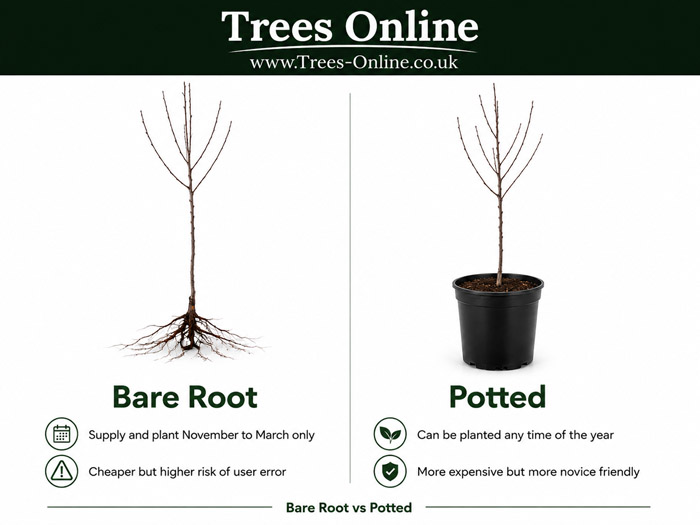
Bare root apricot trees are winter-planted, while potted apricot trees give a longer planting window.
View larger imagePlanting Apricot Trees
Apricots grow best in deep, moisture-retentive, well-drained soil. RHS says they prefer soil that is ideally slightly alkaline and struggle in poor, shallow soil. They do not like sitting wet, so drainage matters more than making the soil overly rich.
Good soils for apricot trees: fertile loam, improved sandy loam, and well-drained soil that holds some moisture without becoming waterlogged. If the soil dries out too fast, improve it with organic matter and mulch after planting. If it stays wet for long periods, fix the drainage or choose a better spot.
Soils to avoid: waterlogged soil, compacted clay, shallow poor soil, and any site where water sits around the roots after rain. Apricots are already fussy enough with blossom and frost; planting one into bad soil just adds another reason for failure.
Patio Apricot Trees
Patio apricot trees are for people who want apricots but do not have room for a larger bush or fan-trained tree. They can work well in a sunny courtyard, patio or small garden, but they are not the easy option. A tree in a pot has less root space, less stored water and less protection from drying out, heat and temperature swings and apricots are fussy enough.
The main advantage is size control. A compact apricot such as Garden Aprigold or Compacta is easier to fit into a small space than a standard apricot on a stronger rootstock. A patio tree can also be moved, positioned in a warmer spot, or placed where blossom protection is easier.
The disadvantages are mainly aftercare. Patio apricots dry out faster than trees planted in the ground, especially in warm weather. They also run out of nutrients more quickly and are more vulnerable to drought issues. The RHS says fruit in containers is usually more hassle than growing fruit in open ground, and container fruit needs full sun, regular watering and feeding.
Do not buy a patio apricot if you want a plant-and-forget fruit tree. Most failures are not because the tree was a bad tree. They are usually caused by the pot being too small, poor drainage, drying out, overwatering, lack of feeding, frost damage to blossom, or the tree being put in a shaded or exposed position.
A patio apricot is a good choice if you can give it a large container, full sun, shelter, free-draining soil-based compost, regular watering and feeding, and frost protection when it flowers. It is a poor choice if it will be left in a small pot, placed in shade, allowed to dry out, or watered randomly.
By “large container”, we mean properly large. At Trees Online, we see all sorts of containers being used. For an apricot, a large container is one that a single person would struggle to move, roughly 100 litres or more. The larger the container, the more root space and water reserve the tree has, and the fewer problems you are likely to have.
The form is the shape of the tree. Each has its own benefits.
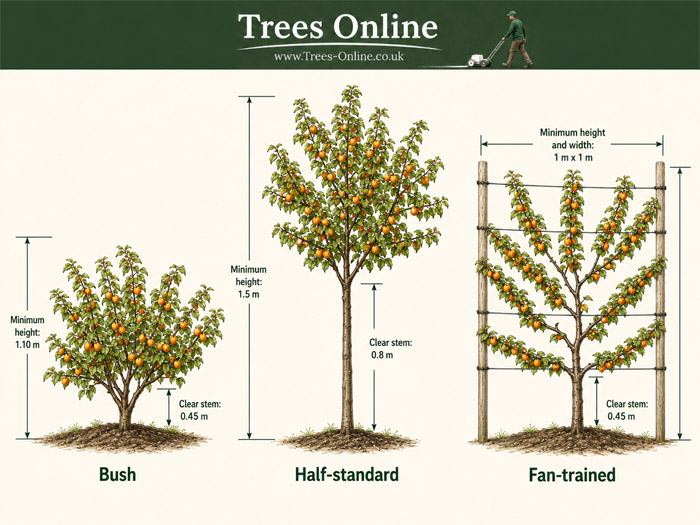
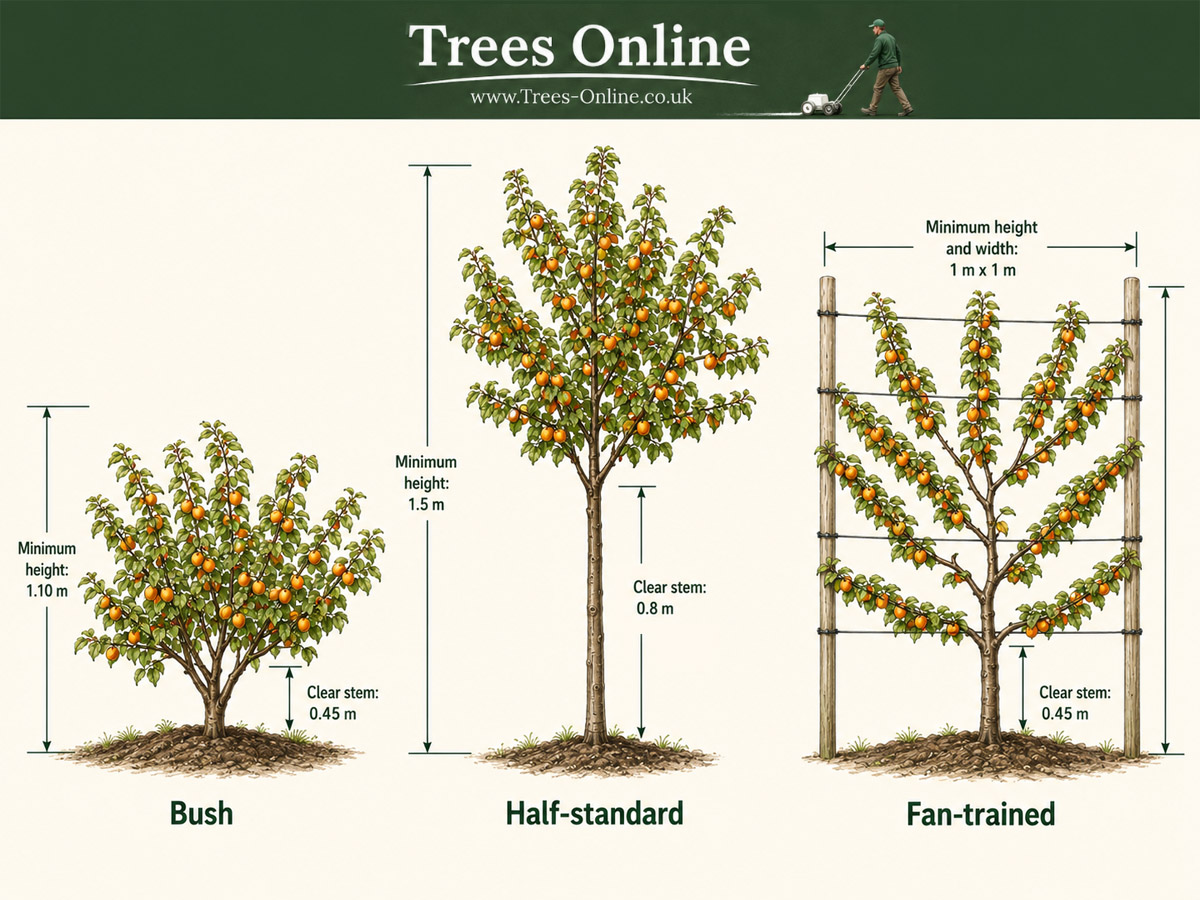
Bush, half-standard and fan-trained apricot trees suit different spaces and levels of frost protection.
View larger image
Bush
A free-standing fruit tree with a short clear stem, usually with the main framework of branches starting low down. This allows you to have a more open canopy allowing more air and light into it. Arguably more growing real estate too.
Fan-trained
A tree trained flat against a wall, fence or wire support, with the main branches spread out from a short stem in a fan shape. It is used because it gives warmth from the wall, saves space and makes pruning and frost protection easier.

A fan-trained apricot against a warm sunny wall is easier to protect and can suit smaller gardens.
View larger imageHalf-standard
A fruit tree with a clear trunk before the branches start, usually around 80-100cm clear stem, with the head of the tree formed above that.
How Soon Do Apricot Trees Fruit?
As a general fruit tree rule, smaller rootstocks fruit a little quicker than the taller ones. For St Julien A, the most popular of the apricot rootstocks, you should be looking at 3-4 years to produce fruit. Remember that a bare root maiden is 1-year-old and a 12 Litre potted bush is 2-3 years old.
Expect to harvest around late July to August and you know they are ripe when the fruits come away from the branch easily.
Popular Apricot Variety Comparison Table
This table is designed to make the main differences easy to spot. Where details are not strongly verified from public sources, the table avoids pretending otherwise.
| Tree |
General description |
Pros |
Cons / watch-outs |
| Bergeval / Aviclo [8] |
Modern French apricot with bright orange-red fruit, strong vigour and a semi-upright habit. |
Self-fertile; productive; late flowering; very good balanced aromatic flavour; attractive bicoloured fruit; resistant to plum pox/sharka. |
Limited storage; low temperatures can cause internal fruit damage; fruit may crack around the stalk cavity at full maturity. |
| Bergeron [9] |
Classic French apricot variety, widely recognised as a traditional French market apricot. |
Firm, fragrant fruit with good size; well-known established variety. |
|
| Compacta [10] |
Naturally compact/dwarf apricot aimed at patios, pots and smaller gardens. |
Self-fertile; compact frame; useful for patios and small spaces; orange freestone fruit suitable for eating or jam. |
Smaller harvests due to size of the tree. |
| Kioto [11,12] |
Modern self-fertile apricot with bright orange-red fruit and regular cropping potential. |
Very productive; regular high yield; attractive fruit colour; self-fertile; blossom has good frost resistance; fruits on one-year shoots. |
Needs regular pruning and fruit thinning to avoid overcropping; repeated excessive crops can exhaust the tree. Fruit can be firm and acidic straight from the tree, and CTIFL says it needs two or three days at room temperature before eating. |
| Pink Marry [13] |
Newer red-flushed apricot sold for garden and allotment use. |
Generous crop; attractive red-flushed fruit; succulent orange flesh. |
Borderline hardy; may need winter protection in colder areas. |
| Robada [14,15] |
Large-fruited USDA-bred apricot with red-blushed orange fruit and deep orange flesh. |
Very large fruit; strong flavour and aroma; bright red blush; firm, finely textured flesh; good fresh-market fruit. |
Fruit thinning is very important; excessive cropping can weaken the tree. |
| Golden Glow [16,17] |
UK-origin apricot found as a chance seedling in the Malvern Hills, Worcestershire. |
Self-fertile; reliable UK-climate reputation; hardy; robust; can crop as a free-standing tree in UK conditions; good resistance to bacterial canker reported by RHS Plants. |
|
| Tomcot [18,19] |
Modern self-fertile apricot with a strong UK garden reputation. |
Self-fertile; reliable in cooler climates; large orange fruit with crimson/red blush; early to mid-season cropping; good UK suitability in warmer regions. |
Best treated as stronger for southern and central UK rather than the safest choice for colder northern sites; best results need warmth and shelter. |
| Garden Aprigold / Aprigold [20] |
Naturally compact, self-fertile dwarf apricot for pots, patios and small gardens. |
Self-fertile; well suited to container cultivation; good small-space option; pale pink blossom followed by orange-gold fruit. |
Best sold as a patio/small-space apricot. |
| Goldcot [21,22] |
Modern self-fertile apricot bred for colder conditions, with golden-yellow fruit cropping in August. |
Self-fertile; crops well in colder and wetter climates; better suited to UK conditions than many apricots; good cooking apricot. |
Fresh-eating flavour is not its strongest point; better promoted for reliability and cookery than premium dessert flavour. |
| Flavorcot / Bayoto [23,24] |
Modern self-fertile apricot with yellow-orange, red-flushed fruit. |
Self-fertile; reliable; flavoursome fruit; fruits from a young age; some frost tolerance reported by RHS. |
|
| Moorpark / Moor Park [25,26] |
Old, well-known apricot and long-standing UK garden variety, grown for rich-flavoured fruit. |
Self-fertile; old favourite for UK gardens; large, rich, sweet, juicy fruit. |
Best on a warm south-facing wall; less suitable as an easy open-garden choice except in warmer UK areas. |
| Early Moorpark / Early Moor Park [27,28] |
Traditional early-ripening English apricot, described by RHS as popular and well suited to the UK climate. |
Self-fertile; popular UK variety; one of the better fresh-eating apricots; pale yellow fruit with orange blush; crops in August. |
Best planted on a wall or in a sheltered spot where spring frost is a risk. |
| Alfred [29,30] |
Hardy apricot variety with pale pink-white blossom and sweet orange fruit with a pink blush. |
Hardy enough for UK gardens; robust; dieback-resistant; good for eating fresh or jam; suitable as a bush or fan-trained tree. |
|
Common Apricot Tree Problems Buyers Should Know About
| Problem |
Why it matters |
How to reduce the risk |
| Spring frost damage |
The main reason a healthy apricot tree fails to crop. Blossom opens early and can be ruined by frost. |
Plant in the warmest sheltered spot available. Protect blossom when frost is forecast. (see Practical Frost Protection below) |
| Poor pollination in cold weather |
Apricots may flower when few insects are active. |
Choose a sheltered site. Hand pollinate with a soft brush if needed. |
| Wrong site / poor cropping |
Cold, shaded, wet or exposed sites can give weak crops even if the tree survives. |
Choose full sun, shelter and free-draining soil. Use a warm wall in colder areas. |
| Brown rot / blossom wilt |
Can damage blossom, shoots and ripening fruit. |
Keep airflow good. Remove affected blossom, shoots and fruit. |
| Bacterial canker |
Can cause dieback, sunken bark and amber gumming on Prunus trees. |
Avoid poor, wet or stressed sites. Prune in spring or summer, not winter. |
| Silver leaf / wrong pruning time |
Pruning stone fruit at the wrong time increases disease risk. |
Prune apricots in spring or summer during dry weather. |
| Peach leaf curl |
Can affect apricots, though it is more strongly associated with peaches and nectarines. |
Avoid wet, exposed sites. Use cover or a protected position if it becomes a repeated issue. |
| Dieback / gummosis |
Dead shoots or amber gum can signal stress, damage or disease. |
Avoid waterlogging and prune out dead or diseased wood at the right time. |
| Fruit splitting or cracking |
Fruit can split after rain or irregular watering. |
Keep watering even, especially in pots. Choose varieties with better cracking resistance where this is a concern. |
| Aphids |
Can distort young growth and leave sticky honeydew. |
Check soft new growth early and deal with small infestations before they build up. |
| Bird / wasp damage |
Ripe fruit can be damaged before harvest. |
Pick promptly when ripe and protect fruit if needed. |
| Poor establishment after planting |
Bad planting can kill or weaken the tree before it ever crops. |
Plant correctly, avoid bent or dry roots, water well and stake if needed. |
| Drought and pot stress |
Apricots in pots dry out quickly and can stop growing or drop fruit. |
Use a large container, water consistently and feed during the growing season. |
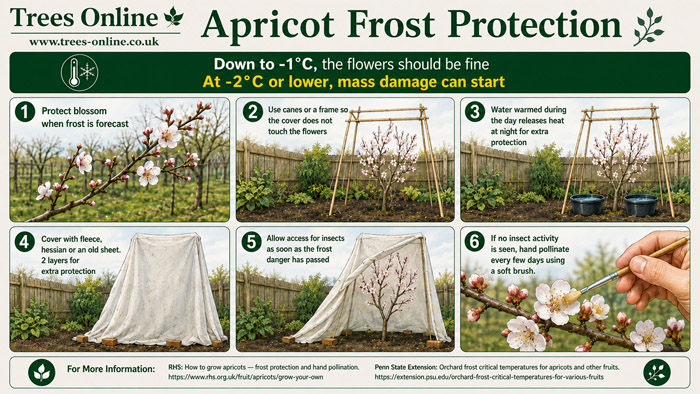
Practical Apricot Frost Protection
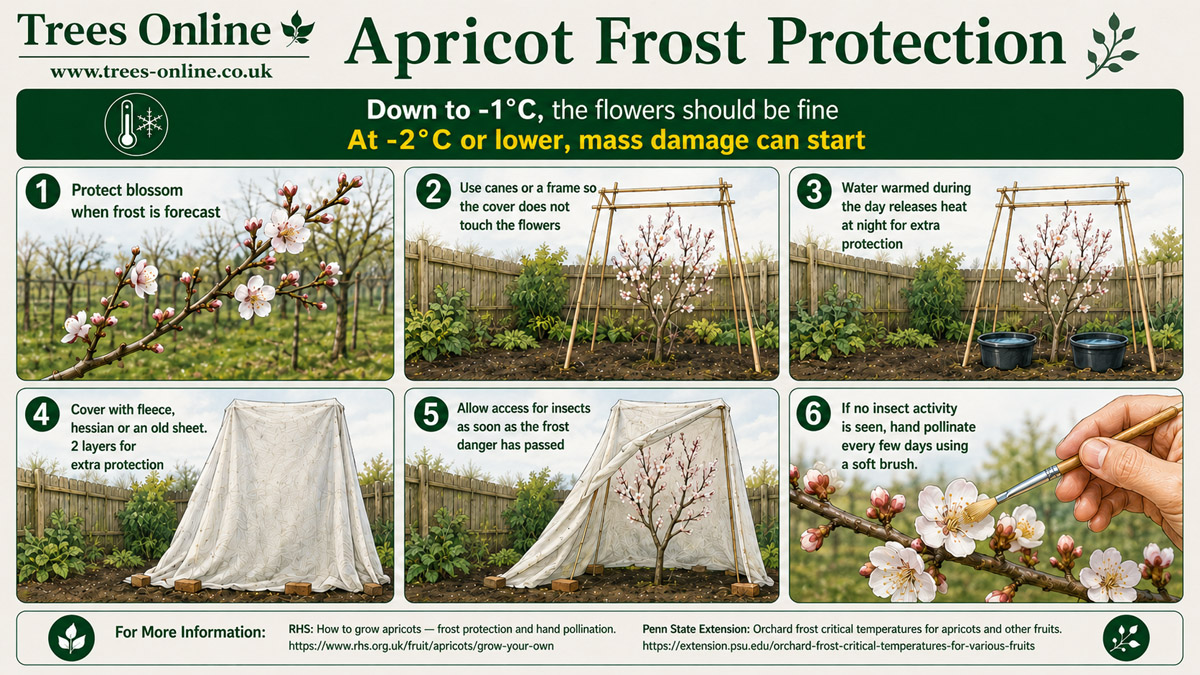
Some apricot blossom can open when the risk of frost is high in your area which means the flowers can be destroyed along with your hopes of a plentiful apricot harvest. [1]
The simplest method is to cover the tree overnight with horticultural fleece, hessian or an old bedsheet. Support the cover on canes so it does not touch the flowers. If fleece or polythene rests directly on blossom, cold can still pass through and damage the flowers. Remove the cover during the day so light and pollinating insects can reach the blossom. [1,31] A fan-trained tree is much easier to protect from frost.
Apricots are self-fertile, but they flower when few insects may be active. During cold or poor weather, hand-pollinate open flowers with a small soft brush over several days, ideally around the middle of the day in dry, sunny weather. [1]
Apricot Frost Risk by UK Region
RHS gives a rough UK guide for when late frost risk usually passes. The south coast and south-west tip of England are usually safest first, from early to mid May. Southern England and south Wales are usually around the second half of May. The Midlands, north-west England, Yorkshire and north Wales are closer to the end of May. North-east England, southern Scotland and Northern Ireland can still have frost into early June, while the Highlands and northern Scotland can remain at risk into mid June.
For apricot buyers, the important point is that apricots flower early, often before the normal last-frost period has passed. The colder or more exposed your area, the more important it is to choose the warmest sheltered position you have. In higher-risk areas, a fan-trained apricot against a sunny wall is usually more practical than a large free-standing tree because the blossom is easier to protect.[31]
Apricot Tree Buying FAQs
Are apricot trees self-fertile?
Most apricot trees sold for UK gardens are self-fertile, so one tree is normally enough. Cropping still depends on blossom survival, weather and pollination activity.
What is the best apricot tree for a small garden?
Look first at compact or patio types such as Garden Aprigold, Aprigold or Compacta.
Can apricot trees grow in pots?
Yes, but choose a compact variety or suitable patio form, use a large container and keep watering consistent.
Are bare root apricot trees better than potted apricot trees?
Not always. Bare root trees are good value for winter planting. Potted trees cost more but give a longer buying and planting season.
When should I plant an apricot tree?
Bare root apricots are planted while dormant in winter. Potted apricots can be planted across a longer season if the ground is workable and watering is managed.
Do apricot trees need a wall?
Not always, but a warm sunny wall is often the safest choice in the UK.
Why has my apricot tree not fruited?
The common causes are frost-damaged blossom, poor pollination during cold weather, a weak site, young tree age, poor establishment or incorrect pruning.
When are apricots ready to pick in the UK?
Apricots are usually picked from late July into August, depending on variety, site and weather.
Can I prune an apricot tree in winter?
No. Apricots are stone fruit and should be pruned in spring or summer during dry weather to reduce disease risk.
Should I buy a large apricot tree?
It depends on what you mean by large. If you want one to produce apricots asap then buy one that is at least 5 years old. If the age is not listed, then pot size should help. A minimum of 35L, preferably 50L.
Sources
1. https://www.rhs.org.uk/fruit/apricots/grow-your-own. Used for UK growing position, frost risk, self-fertility, hand pollination, pruning and harvest guidance.
2. https://www.rhs.org.uk/plants/196180/prunus-armeniaca-tomcot-%28f%29/details. Used for Tomcot self-fertility, cool-climate reliability and cropping season.
3. https://www.rhs.org.uk/plants/126770/prunus-armeniaca-golden-glow-%28f%29/details. Used for Golden Glow self-fertility and UK-climate suitability.
4. https://www.rhs.org.uk/plants/175410/prunus-armeniaca-garden-aprigold-%28f%29/details. Used for compact habit and container suitability.
5. https://www.rhs.org.uk/disease/brown-rot. Used for brown rot and blossom wilt risk.
6. https://www.rhs.org.uk/disease/bacterial-canker. Used for canker risk on Prunus trees.
7. https://www.rhs.org.uk/disease/silver-leaf. Used for pruning timing and disease-risk wording.
8. https://www.graeb.com/en/range/apricots/bergeval-tm-aviclo-s/. Used for Bergeval self-fertility, appearance, flavour, plum pox resistance and storage/transport watch-outs.
9. https://www.pepinieres-minier.fr/en/produit/prunus-armeniaca-bergeron. Used for Bergeron being a classic French apricot and for fruit quality/firmness wording.
10. https://www.rhsplants.co.uk/plants/_/apricot-compacta/classid.2000048925/. Used for compact size, self-fertility, patio/small-space suitability and fruit-use wording.
11. https://www.graeb.com/en/range/apricots/kioto-s/. Used for Kioto productivity, regular yield, fruit colour, self-fertility, frost-resistant blossom, one-year-shoot fruiting and overcropping/pruning/thinning warnings.
12. https://varietes_abricot.ctifl.fr/fiche/varietes/kioto-cov. Used for Kioto firmness/acidity and the note that fruit benefits from two or three days at room temperature before eating.
13. https://www.rhsplants.co.uk/plants/_/apricot-pink-marry/classid.2000036816/. Used for Pink Marry fruit, cropping, soil/site and hardiness wording.
14. https://www.ars.usda.gov/news-events/news/research-news/1997/superb-apricot-offered-to-growers/. Used for Robada size, flavour, aroma, fresh-market value, firmness and shipping/handling quality.
15. https://www.graeb.com/en/range/apricots/robada-s/. Used for Robada crop load, fruit thinning and overcropping warning.
16. https://www.rhs.org.uk/plants/126770/prunus-armeniaca-golden-glow-%28f%29/details. Used for Golden Glow self-fertility, UK-climate suitability, origin and cropping season.
17. https://www.rhsplants.co.uk/plants/_/apricot-golden-glow/classid.2000047674/. Used for bacterial canker resistance and damp-region suitability wording.
18. https://www.rhs.org.uk/plants/196180/prunus-armeniaca-tomcot-%28f%29/details. Used for Tomcot self-fertility, cool-climate reliability, southern/central UK suitability, fruit description and cropping season.
19. https://www.rhsplants.co.uk/plants/_/apricot-tomcot/classid.2000036817/. Used for Tomcot larger-than-average fruit, red blush, UK hardiness wording and warm/sunny site watch-out.
20. https://www.rhs.org.uk/plants/175410/prunus-armeniaca-garden-aprigold-%28f%29/details. Used for Garden Aprigold compact habit, self-fertility, container suitability, blossom, fruit colour and cropping season.
21. https://www.rhs.org.uk/plants/82523/prunus-armeniaca-goldcot-%28f%29/details. Used for Goldcot self-fertility, colder/wetter-climate cropping and culinary-use wording.
22. https://www.orangepippin.com/varieties/apricots/goldcot. Used for Goldcot flavour-quality and food-use wording.
23. https://www.rhs.org.uk/plants/219279/prunus-armeniaca-flavorcot-%28-bayoto-pbr%29-%28f%29/details. Used for Flavorcot / Bayoto self-fertility, reliability, flavour, young-age fruiting and late-July ripening.
24. https://rhs.crocdn.co.uk/plants/_/apricot-flavorcot-bayoto-pbr/classid.2000047673/. Used for Flavorcot / Bayoto fruit description and sunny/sheltered/south-facing-wall watch-out.
25. https://www.rhs.org.uk/plants/126376/prunus-armeniaca-moorpark-%28f%29/details. Used for Moorpark self-fertility, reliability, flavour, fruit colour and ripening season.
26. https://www.keepers-nursery.co.uk/fruit-trees/apricot/moorpark. Used for Moorpark warm-wall/open-garden suitability wording.
27. https://www.rhs.org.uk/plants/140063/prunus-armeniaca-early-moorpark-%28f%29/details. Used for Early Moorpark UK suitability, self-fertility, fresh-eating quality and August cropping.
28. https://www.frankpmatthews.com/catalogue/fruit-trees/apricot/early-moorpark/. Used for Early Moorpark wall/shelter and spring-frost protection wording.
29. https://www.rhs.org.uk/plants/51228/prunus-armeniaca-alfred-%28f%29/details. Used for Alfred hardiness, blossom and fruit description.
30. https://www.rhsplants.co.uk/plants/_/apricot-alfred/classid.2000047671/. Used for Alfred robustness, dieback resistance and eating/jam/bush/fan wording.
31. https://www.rhs.org.uk/advice/beginners-guide/fruit-basics/positioning-fruit. Used for fleece-tent frost-protection guidance, including keeping fleece or polythene away from blossom and only covering when frost is forecast.