UK Fruit Trees for Sale Online: A Beginner’s Guide
This buyer’s guide helps novice gardeners choose the right fruit tree to buy online.
Fruit Tree Buyer’s Guide Contents
How to Choose Fruit Trees for Your Garden
If you know nothing of fruit trees and just want to buy a fruit tree online, choose a potted, self-fertile variety on a rootstock that keeps your tree to around 3–4m high. Good luck with your online tree purchase, thanks for reading this far.
If you are still confuddled, keep reading. Below are the options explained.
Potted: comes in a pot and can be planted all year round. Usually 10–15 litres for a 2–3 year old tree, as long as the ground is not frozen or waterlogged. [4] [5]
Self-fertile: will produce fruit without another fruit tree nearby. [6]
Rootstock: most fruit trees are two parts joined together, the roots, called the rootstock, and the rest of the tree. Choose a rootstock that gives you the height you want. Most people go for the 3–4m range. [7] [8]
Back to top
Rootstocks Most People Buy for an Average UK Garden
This assumes you have an average to large sized garden for your fruit tree, so buy rootstocks from the medium and semi-vigorous columns. Although you can prune it to whatever height you wish, 3–4m makes fruit picking and pruning straightforward compared to 5m+ trees. [7] [8]
| Fruit tree |
Very Dwarf |
Dwarf |
Semi-Dwarf |
Medium |
Semi-Vigorous |
Vigorous |
Very Vigorous |
| Apple |
M27 (1.2–1.8m) |
M9 (1.8–2.4m) |
M26 (2.4–3m) |
M116 (3m) |
MM106 (3–4m) |
MM111 (4–4.5m) |
M25 (4.5m+) |
| Pear |
— |
Quince C / Quince Adams / Elinée (2.5–3m) |
— |
— |
Quince A (3–4.5m) |
Pyrodwarf (4m) |
Pyrus Communis / Kirchensaller (5m) |
| Cherry |
— |
Gisela 5 (2.4–3m) |
— |
— |
Colt (3.5m) |
— |
F.12/1 (5m) |
| Plum / Gage / Damson |
— |
— |
VVA-1 (2.5m) |
— |
St Julien A / Wavit (3.5m+) |
— |
Brompton (5m) |
| Peach / Nectarine |
— |
— |
— |
St Julien A (3.5m+) |
— |
— |
— |
| Apricot |
— |
— |
— |
St Julien A / Wavit (3.5m+) |
— |
— |
— |
Back to top
Best Fruit Trees for Beginners to Grow in UK Gardens
The easiest are usually plums, damsons, self-fertile cherries and self-fertile apples. Pears are quite easy but their sun requirements can be high, so that technically makes them not as easy as the easiest. At the other end are apricots, peaches and nectarines, which can be a bit needy.
Easy fruit trees to grow for UK gardens.
The Easiest Fruit Tree Options to Grow
These are the easiest options to buy for each fruit tree. Half standard means a lollipop shape, usually with 80–100cm of clear stem. A bush has much less clear stem and starts to branch out closer to the ground like a conventional bush shape. [9]
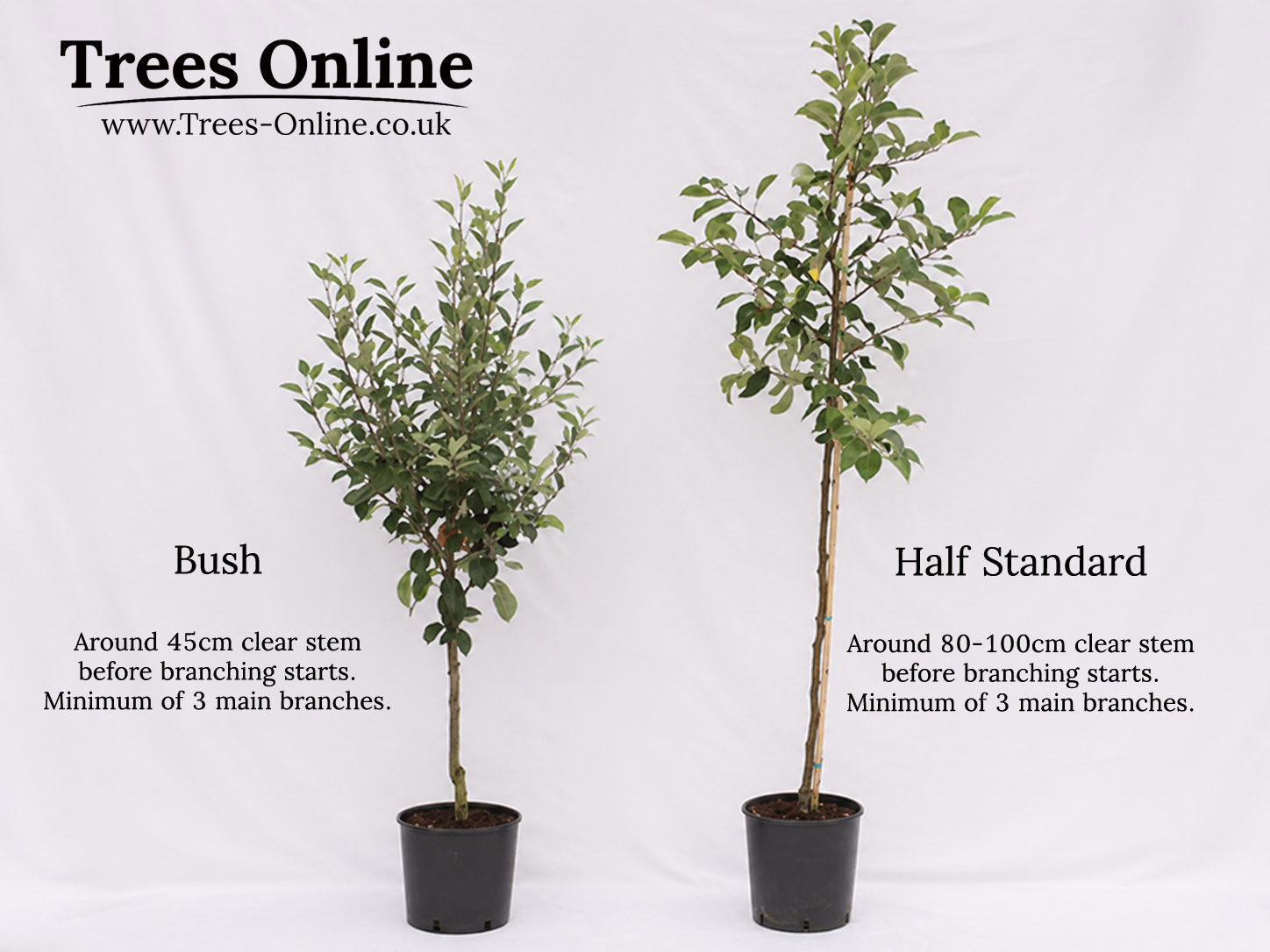
Bush fruit tree versus half standard fruit tree.
- Apple: M26 or MM106, potted, bush or half standard and self-fertile.
- Pear: Quince A, potted, bush or half standard, and self-fertile.
- Cherry: Colt, potted, bush or half standard, and self-fertile.
- Plum: St Julien A or Wavit, potted, bush or half standard, and self-fertile.
- Gage: St Julien A or Wavit, potted, bush or half standard, and self-fertile.
- Damson: St Julien A or Wavit, potted, bush or half standard.
- Peach: St Julien A, potted, bush or half standard, and self-fertile.
- Nectarine: St Julien A, potted, bush or half standard, and self-fertile.
- Apricot: St Julien A or Wavit, potted, bush or half standard, and self-fertile.
Back to top
Patio Fruit Trees for Small Gardens and Pots
A patio fruit tree is usually a fruit tree grown on a dwarfing or very dwarfing rootstock and at maturity will be in the 1.5 to 2.5m height range. [7] [10]
For a smaller tree at maturity, look for:
- Apple — M27, around 1.5m
- Pear — Quince C, around 2.5m
- Cherry — Gisela 5, around 2.5m
- Plum — Pixy, around 2.5m
- Gage — Pixy, around 2.5m
- Damson — Pixy or VVA-1, around 2.5m
Their smaller size makes them very suitable for container growing. Use the largest pot you can find because it means they need feeding and watering less often. [5] [10]
Back to top
Bare Root, Potted and Mature Fruit Trees
Fruit trees are usually sold in three main ways: bare root, potted or mature.
Bare Root Fruit Trees
These are usually 1–3 years old, are sold and can only be planted after leaf fall in November and before new leaves appear in April, also known as the dormant season. The supplied height range can be from less than a metre to over 2m. [11]
Advantages of Bare Root Fruit Trees
- Cheaper than potted versions.
- The one year maiden option means you can prune them into any shape you wish, such as half standard, bush or fan.
Disadvantages of Bare Root
- Shorter planting window.
- Less forgiving for beginners, with a potentially higher failure rate.
Potted Fruit Trees
These are usually 2–4 years old, in a 9–15 litre pot and 150–240cm tall on average.
Advantages of Potted Fruit Trees
- Can be planted all year round except in frozen and waterlogged conditions. [4] [5]
- Better suited for the novice as there are fewer complications.
- No rush to plant them.
Disadvantages of Potted Fruit Trees
- More expensive than bare root.
Buying Mature Fruit Trees Online
If you are looking to buy a mature fruit tree online then be prepared for the extra price. Not only do you pay more for the tree, anything over 200cm cannot go through the cheaper courier network.
Back to top
Choosing the Right Fruit Tree for Your Garden Conditions
Make sure your site is not working against you. If you have any of these conditions, this is our advice.
Fruit Trees and Frost Pockets
Frost pockets are particularly bad for apricots, peaches and nectarines. The main frost risk usually tails off through May. Frost generally passes early May in London and the south west, mid-May in the south of England, late May in much of England and Wales, and June in Scotland. [1] [2]
Fruit Trees and Exposed Windy Sites
For example, coastal sites and hilltops. Wind can reduce fruit yield, even with self-fertile trees. If it is too windy for bees and other pollinators at flowering time, it is not a good site. [3] [6]
Fruit Trees for Wet Soil or Poorly Drained Ground
Worst for apricot, peach, nectarine and cherry. Better options for less-than-ideal sites are plum, gage, damson, then pear. [12]
Fruit Trees for Shade
Most fruit trees crop best in sun. Sour cherries and some early cooking apples cope better with shade, but less sun usually means weaker cropping and poorer fruit quality. [3]
Fruit Trees and Very Acid Soil
Most fruit trees prefer slightly acid to neutral soil, around pH 6 to 6.5. Apples and pears are among the least happy on very acid soil. [13]
Fruit Trees and Shallow Chalk Soil
Not great for apples and pears. Plum, gage and damson are usually better choices. [13]
Back to top
When to Plant Fruit Trees
Bare root fruit trees are planted from November to April while dormant. Potted fruit trees can usually be planted all year round, but autumn to early spring is still the easiest time because the tree is under less stress and needs less watering. Avoid planting when the ground is frozen or waterlogged. [4] [11]
Growers usually release new-season stock around August and September, so availability is often highest from late summer into autumn. [14]
Ready to Buy Fruit Trees Online?
Hopefully you now have a decent understanding of the basics from our thesis so you can buy a fruit tree online from us and have it thrive on your land.
If you don’t, please feel free to contact us.
Fruit trees for sale online.
Back to top
Sources
- Royal Horticultural Society, Fruit: protecting from frost. Used for frost-pocket warnings and sheltered-site advice for early flowering crops such as apricots, peaches and nectarines. https://www.rhs.org.uk/fruit/fruit-trees/frost-protection
- GardenFocused, Guide to UK, Ireland and France last frost dates for gardeners. Used for practical regional last-frost timing guidance. https://gardenfocused.co.uk/adjust-dates-uk.php
- Royal Horticultural Society, Fruit basics: positioning your fruit trees and bushes. Used for site guidance covering sun, shade, exposure, airflow, pollinators and frost pockets. https://www.rhs.org.uk/advice/beginners-guide/fruit-basics/positioning-fruit
- Royal Horticultural Society, Trees and shrubs: planting. Used for advice that container-grown plants can be planted any time of year, with frozen or waterlogged ground avoided. https://www.rhs.org.uk/plants/types/trees/planting-trees-shrubs
- Royal Horticultural Society, How to plant a tree. Used for the advice that autumn to spring is usually the best planting period, while containerised trees can be planted at other times with extra care. https://www.rhs.org.uk/plants/types/trees/how-to-plant-a-tree
- Royal Horticultural Society, Fruit pollination. Used for self-fertile fruit-tree advice and the note that even self-fertile trees can crop better with another suitable cultivar nearby. https://www.rhs.org.uk/advice/beginners-guide/fruit-basics/fruit-pollination
- Royal Horticultural Society, Rootstocks for fruit. Used for the explanation that rootstocks restrict vigour and help determine eventual tree size. https://www.rhs.org.uk/fruit/fruit-trees/rootstocks
- Frank P. Matthews, Rootstocks for Fruit Trees. Used for UK nursery rootstock guidance, including common apple, pear, cherry and plum-family rootstocks. https://www.frankpmatthews.com/advice/fruit_rootstocks/
- Royal Horticultural Society, Fruit trees: choosing the best. Used for tree form guidance, including bush, half-standard and standard fruit-tree forms. https://www.rhs.org.uk/fruit/fruit-trees/choosing-the-best
- Royal Horticultural Society, Fruit in containers. Used for container-growing advice, including full sun, watering and the extra care needed for fruit grown in pots. https://www.rhs.org.uk/fruit/fruit-trees/containers
- Frank P. Matthews, Fruit trees and bushes. Used for the nursery description of bare-root availability during dormancy and container trees being plantable through the year. https://www.frankpmatthews.com/catalogue/type/fruit-trees/
- Royal Horticultural Society, Fruit trees: feeding and mulching. Used for the explanation of waterlogging on poorly drained or compacted heavy soil and the risk to plant roots. https://www.rhs.org.uk/fruit/fruit-trees/feeding-and-mulching
- Royal Horticultural Society, Soil: understanding pH and testing soil. Used for general pH guidance and the point that pH 6.5 is a good general-purpose garden pH. https://www.rhs.org.uk/soil-composts-mulches/ph-and-testing-soil
- Frank P. Matthews, Online shop / seasonal availability. Used for the note that container-tree ordering may open ahead of autumn and bare-root delivery starts in the dormant season. https://www.frankpmatthews.com/online-shop/