Click image to enlarge
Close ×
Press Esc to close
Lord Napier Nectarine Tree
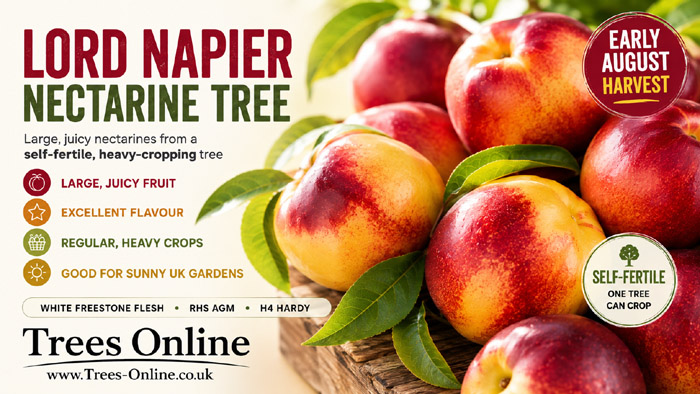
Lord Napier is a self-fertile nectarine tree producing regular, heavy crops of large fruit in early August without the need of another nectarine tree nearby, although another could improve crop sizes. The nectarines have pale yellow skin with a deep crimson cheek in full sun, very white, melting, juicy flesh and a freestone, which means it comes away from the flesh readily, not a free gift from us. The flavour is excellent and the fruit is best eaten fresh. Lord Napier is also one of the better-established nectarine varieties for growing outdoors in sunny UK gardens and holds the RHS Award of Garden Merit. [1] [2] [3]
Nectarines flower early, when there may be few pollinating insects active, so hand-pollinating the open flowers with a small soft brush can improve fruit set. Protect the blossom if frost is forecast with agricultural fleece or other suitable material. [1] [4]
If the tree sets a very heavy crop, thin the young fruit when they are around walnut size, leaving roughly 15cm between fruitlets. This gives the remaining nectarines more room to develop. [4] If when you come to thin the crop you find actual walnuts, you purchased the wrong tree.
Pick Lord Napier when the fruit is fully coloured, slightly soft near the stalk and comes away easily when gently lifted or pulled. Fruit ripened fully on the tree has the best flavour. [4]
Nectarines can continue to ripen after picking, provided they are mature enough when harvested. They are climacteric fruit, so mature fruit picked while still firm will soften and develop its eating quality. Fruit picked too early may soften but will not develop the same flavour as properly mature fruit. [8] [9] If they still have flower petals on them, then no amount of home ripening will make a difference.
To ripen Lord Napier nectarines at home, leave them at room temperature until they soften and become fragrant. Ripening can be speeded up by placing the fruit in a paper bag; adding a ripe apple or banana will increase the amount of ethylene around the fruit and speed the process further. Once ripe, move the nectarines to the refrigerator if they are not being eaten immediately. [9]
Planting Lord Napier Nectarine Tree
Plant in full sun in fertile, moisture-retentive but well-drained soil. Choose a warm, sheltered position, ideally south- or west-facing, and avoid frost pockets, exposed sites and waterlogged ground. [1] [4]
A sunny south- or south-west-facing wall or fence is ideal as it creates a slightly warmer micro-climate. In warmer sheltered gardens Lord Napier can also be grown as a free-standing tree. In cooler areas, a warm wall, greenhouse or polytunnel improves the chances of the fruit ripening well. [4]
Final tree size depends heavily on rootstock. VVA-1 is semi-dwarfing, and gives an eventual height of around 3m. St Julien A is more vigorous and can reach around 5m if allowed to grow to its full size. Soil, pruning and training will also affect final height and spread. [5] [6]
Water well after planting and during dry spells while the tree establishes. Keep the soil evenly moist while the fruit is swelling. Mulching the root area helps retain moisture, but keep mulch clear of the trunk. [4]
RHS rates Lord Napier H4, equivalent to around -10°C to -5°C. The tree itself is therefore hardy through much of the UK, but the early blossom is much more vulnerable to frost. [1]
Is your site suitable to grow a nectarine tree? That is the big question. A lot of commercial advice about growing stone fruits in a UK garden mention the Midlands as the point where cold weather issues could start however we have seen several examples of people growing free standing peach trees in the North West. Granted, they took all precautions e.g cleared all weeds, mulched heavily, watered well, fed and pruned the tree but they were getting good crops after a few years.
Pruning Lord Napier Nectarine Tree
Nectarines fruit mainly on shoots produced the previous year, so pruning should encourage a steady supply of young growth. Prune in spring or summer rather than winter to reduce the risk of silver leaf and bacterial canker. [4]
Free-standing trees are usually pruned after fruiting in summer. Remove dead, damaged, crossing and badly placed growth while retaining enough young shoots for the following year's crop. [4]
Peach leaf curl is the main disease risk. Infection occurs when emerging leaves are wet, so rain protection is the most useful preventative measure. RHS recommends covering wall-trained peaches and nectarines from after leaf fall until around mid-May, while leaving the sides open for ventilation and pollinating insects. There are currently no fungicides available to amateur gardeners for controlling peach leaf curl. [7]
Interesting Information About Lord Napier Nectarine Tree
Lord Napier originated at Sawbridgeworth in 1860 and remains widely grown more than 160 years later.
Click image to enlarge
Show sources
[1] RHS — Prunus persica ‘Lord Napier’
https://www.rhs.org.uk/plants/131863/prunus-persica-lord-napier/details
[2] RHS — Fruit Trees: Choosing the Best
https://www.rhs.org.uk/fruit/fruit-trees/choosing-the-best
[3] Frank P Matthews — Lord Napier Nectarine
https://www.frankpmatthews.com/catalogue/fruit-trees/nectarine/lord-napier/
[4] RHS — How to Grow Nectarines
https://www.rhs.org.uk/fruit/nectarines/grow-your-own
[5] Frank P Matthews — Rootstocks for Fruit Trees
https://www.frankpmatthews.com/advice/fruit_rootstocks/
[6] RHS — Rootstocks for Fruit
https://www.rhs.org.uk/fruit/fruit-trees/rootstocks
[7] RHS — Peach Leaf Curl
https://www.rhs.org.uk/disease/peach-leaf-curl
[8] University of Florida IFAS Extension — Harvesting and Postharvest Handling of Stonefruits
https://ask.ifas.ufl.edu/publication/HS1459
[9] UC Davis Postharvest Research and Extension Center — Storing Fresh Fruits and Vegetables for Better Taste
https://postharvest.ucdavis.edu/sites/g/files/dgvnsk12711/files/inline-files/230110.pdf
×
Press Esc or click outside the image to close