|
Click image to enlarge
× 
Conifer Hedging – Comparing Seven Popular Varieties
You could be forgiven for thinking that one evergreen conifer hedging plant is much the same as another but not so. There is a broad range of growth rates from 15-100 cm a year, pruning rates from 1 to 3 a year and some trees won't grow back if you cut back too much.
This guide compares seven popular conifer hedging varieties to help you choose the best evergreen hedge for your garden. We compare Green and Golden Leylandii, Western Red Cedar, Common Yew, Hicksii Yew, Lawson Cypress and Monterey Cypress, covering growth rates, privacy, maintenance, planting distances and suitability for different growing conditions.
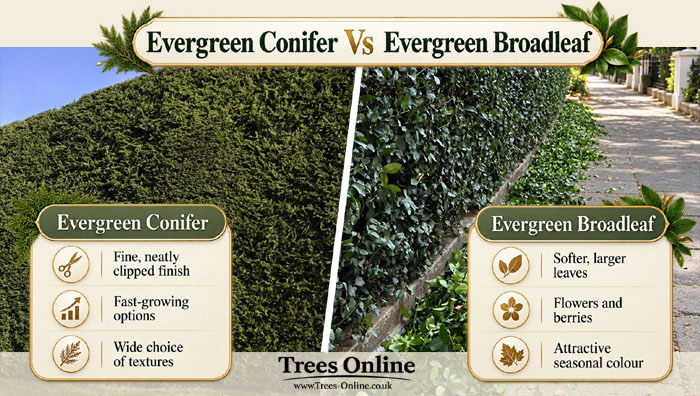
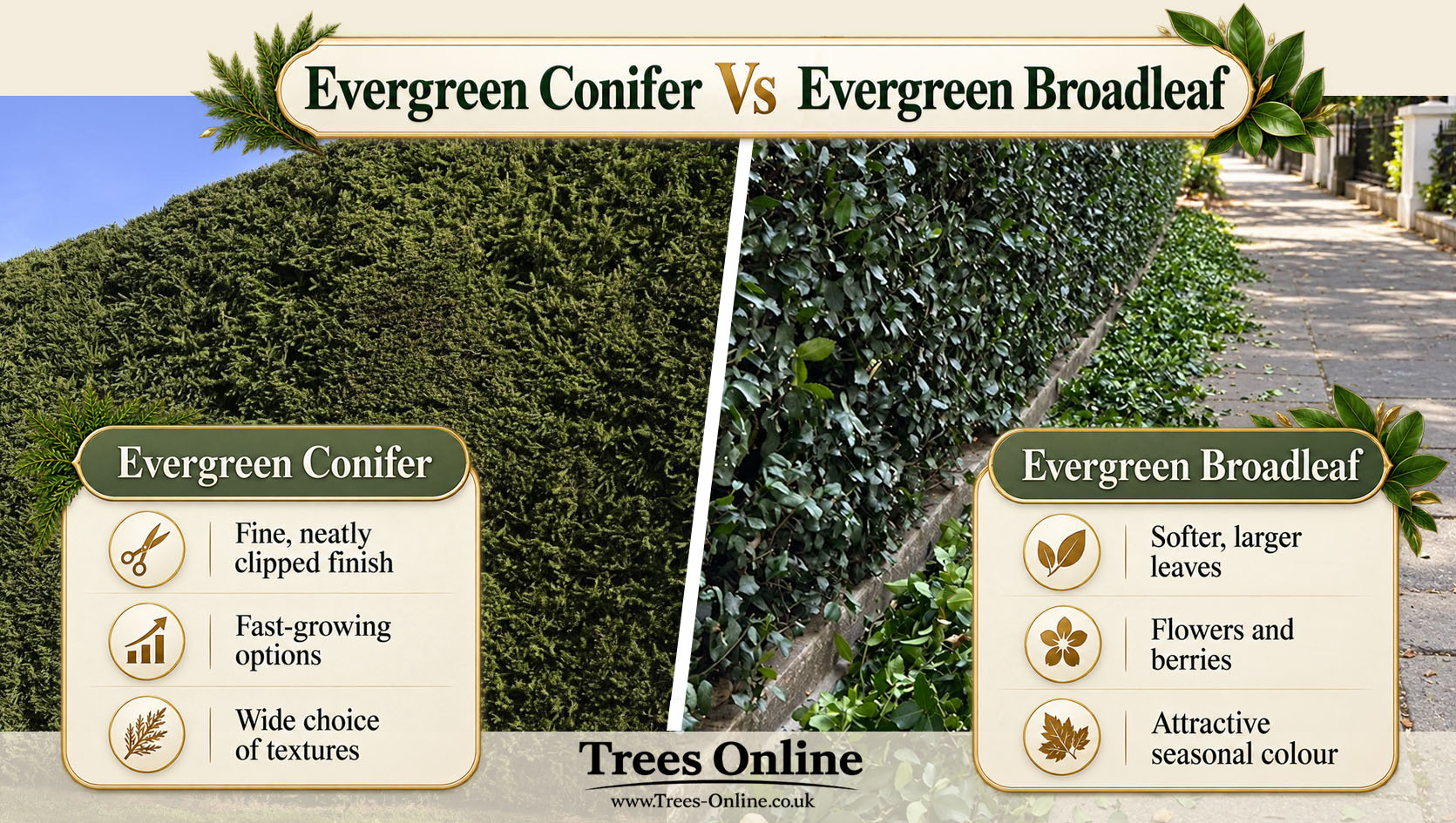
Why Choose Conifer Hedging Over Broadleaf Evergreen Hedging?
Broadleaf hedging such as Cherry Laurel, Portuguese Laurel, Photinia and Griselinia can all make attractive evergreen hedges, but sometimes a conifer hedge can have the advantage.
- A finer, neater clipped finish. Conifer hedging such as Yew, many cypresses and Western Red Cedar allow a crisp, even surface. Crisp as in flat, tidy etc and not tastes of cheese and onion. Trees Online accepts no liability for any hedge-licking injuries. Large-leaved evergreens such as Cherry Laurel can show obvious cut edges when trimmed mechanically. [2]
- A different range of colours and textures. Green Leylandii gives solid deep-green screening, Golden Leylandii adds yellow-gold colour, Western Red Cedar has glossy aromatic sprays, and Yew offers a darker, finely textured formal finish.
- Offers faster growth. Fast-growing conifers can deliver tall privacy sooner.
- More hardy. Conifer hedges that survive below minus 20°C include Common Yew and Hicksii Yew. Conifers that survive down to -20 °C are Green Leylandii, Golden Leylandii ‘Castlewellan Gold’, Western Red Cedar and Lawson Cypress.
Broadleaf evergreen hedges such as Cherry Laurel, Portuguese Laurel, Photinia ‘Red Robin’, Griselinia littoralis all go down to -15 degrees C.
- Cost. Although costs can be comparable generally, Western Red Cedar seems to be the cheapest evergreen hedge option regardless of size.
Where broadleaf evergreens can be better: if you want flowers, ornamental berries, bright red new leaves or a softer, leafy appearance, Laurel, Photinia and other broadleaf hedges may be more appealing.
Conifer Hedge Comparison – How Do the Seven Varieties Differ?
Compare seven popular conifers for hedging by annual growth, maintenance, pruning tolerance and planting distance. Growth rates are approximate and depend on growing conditions.
| Conifer hedge |
Annual growth |
Trims per year |
Regrows after pruning back to brown wood? |
Plant spacing[1] |
Main advantage |
| Green Leylandii |
Up to 100cm [13] |
2–3 |
No |
75cm |
Fastest-growing of these seven hedges. |
| Golden Leylandii 'Castlewellan Gold' |
Up to 60cm [14][15] |
2–3 |
No |
75cm |
Fast-growing screening with golden foliage. |
| Western Red Cedar |
Up to 75cm [13] |
2 |
Yes (most of the time) |
60cm |
Fast growth, aromatic evergreen foliage, and often the cheapest. |
| Common Yew |
Up to 30cm [8] |
1–2 |
Yes |
50cm |
Formal hedging that tolerates severe pruning. |
| Hicksii Yew |
Up to 15cm [17] |
1 |
Yes |
50cm |
Slow-growing and low maintenance for smaller hedges. |
| Lawson Cypress |
Up to 60cm [13] |
2 |
No |
60cm |
Dense, finely textured formal hedging. |
| Monterey Cypress |
Up to 60cm [16] |
1–2 |
No |
60cm |
Informal coastal screening in mild gardens. |
Plant spacing is a suggestion and can be reduced or increased based on your patience, local conditions and budget. If you have poor soil, they will grow slower so you can tighten them up. We have seen Leylandii hedges planted at 30cm spacings and they grew fine. If you are happy to wait until they bush out and knit together, you can plant wider but be aware the gap at the bottom may not completely fill in if you go too wide.
Which Conifer Hedge Is Best for Your Garden?
Choosing the right conifer hedge depends on more than appearance and growth rate. Some varieties are better suited to shade, dry ground, coastal gardens or exposed boundaries. The following guide will help you choose the most suitable option for your garden.
| Garden conditions |
Best choices |
Why choose them? |
| Shady gardens |
Common Yew, Hicksii Yew |
Both grow in full shade, making them particularly useful for north-facing gardens and boundaries shaded by buildings or mature trees. [8][9] |
| Dry or drought-prone ground |
Common Yew, Monterey Cypress |
Established Yew tolerates drought. Monterey Cypress also handles dry conditions, provided the garden has a sufficiently mild climate. [8][12] |
| Moist or damp soil |
Western Red Cedar, Lawson Cypress |
Western Red Cedar and Lawson Cypress grow well in soil that stays damp but allows excess rainwater to drain away. Avoid boggy ground that squelches underfoot or where puddles remain long after rain, as neither is a reliable choice for permanently waterlogged soil. [6][7][10][11] |
| Cold, windy and exposed gardens |
Common Yew, Hicksii Yew, Leylandii |
Both Yews tolerate exposed positions. Leylandii is suitable for moderately exposed sites and establishes quickly, but is less suitable for severe exposure. [1][9][20] |
| Coastal gardens |
Monterey Cypress, Leylandii |
Monterey Cypress is particularly suited to mild seaside gardens. Leylandii tolerates salt spray and is another option for coastal boundaries, although severely exposed sites can be problematic. [1][12][20] |
| Roadside gardens and air pollution |
Common Yew, Western Red Cedar |
A dense hedge can help trap some of the pollution generated by passing traffic. [19] but these two are particularly noted for it. |
What About Clay and Chalk Soil?
Clay soil: All seven conifers can grow in clay, provided it drains adequately. The main problem is heavy clay that remains waterlogged after rain. Yew is particularly vulnerable to root rot in these conditions, although planting on a raised ridge can help. Western Red Cedar and Lawson Cypress are suitable options for moisture-retentive clay that allows excess water to drain away. [6][8][10]
Chalk soil: All seven are listed by the RHS as suitable for chalk, but shallow, dry chalk can limit your choice. Established Common Yew tolerates drought, while Monterey Cypress tolerates dry conditions but needs a relatively mild, sheltered location. Western Red Cedar is less suited to very dry, poor soil and benefits from light shelter on chalk. Lawson Cypress tolerates chalk but prefers slightly acidic soil. [7][8][10][12]
Which Conifer Hedge Is Best for Wildlife?
Dense evergreen conifer hedges provide year-round shelter and nesting cover for birds. Common Yew offers an additional benefit: female plants produce red, berry-like fruits eaten by birds and small mammals. If attracting a wide range of wildlife is your main priority, a mixed hedge containing flowering and fruiting species will provide a greater variety of food throughout the year. [8][19]
Important: Common Yew and Hicksii Yew are highly poisonous if eaten and should never be planted within reach of grazing livestock. [8][9]
Show sources
- RHS – Hedges: selection. Species comparisons, maintained-hedge suitability, planting distances and special sites.
- RHS – How to trim a hedge. Trimming tools and the effect of mechanical cutting on large-leaved evergreens.
- RHS – How to grow conifers. Old-wood pruning limitations, Yew and Thuja exceptions.
- RHS – Green Leylandii. Growth, sun, soil, clipping, pests and disease.
- RHS – Leylandii ‘Castlewellan Gold’. Appearance, vigour and growing conditions.
- RHS – Western Red Cedar ‘Atrovirens’. Appearance, growing conditions, pruning and toxicity.
- Forest Research – Western Red Cedar. Growth, shade, moisture, drought and exposure tolerances.
- RHS – How to grow Yew. Annual growth, shade, pruning, moisture and toxicity.
- RHS – Yew ‘Hicksii’. Habit, shade, soil and toxicity.
- RHS – Lawson Cypress ‘Green Hedger’. Hedging characteristics, trimming and diseases.
- Forest Research – Lawson Cypress. Growth and site limitations.
- RHS – Monterey Cypress. Coastal suitability, hardiness and screening role.
- House of Commons Library – High Hedges Bill, Research Paper 01/20 (2001), page 7. Lists estimated annual growth of Leylandii (100cm), Western Red Cedar (75cm) and Lawson Cypress (60cm), citing a government consultation.
- Forestry Commission – Champion Trees in the British Isles (1990), page 26. Records a 14m Golden Leylandii ‘Castlewellan’ specimen; not a measured annual growth rate.
- Irish Garden Plant Society – A Heritage of Beauty, page 45. Cultivar history and propagation date used when estimating long-term growth of ‘Castlewellan Gold’.
- Forestry Commission – Exotic Forest Trees in Great Britain (1957), page 55, Table 16. Monterey Cypress stand recorded at 45ft after 22 years, approximately 62cm/year averaged over that period.
- American Conifer Society – Taxus × media ‘Hicksii’. Gives a ten-year average of 10–12.5cm growth per year.
- RHS – Pruning Hedges. Trimming frequency for conifer hedges.
- RHS – Hedges with Environmental Benefits. Airborne particulate capture by Common Yew and Western Red Cedar, wildlife shelter, food sources and benefits of mixed hedges.
- Forest Research – Leyland Cypress. Salt spray tolerance, moderate wind exposure tolerance and limitations on severely exposed sites.
Growth rates and planting suitability depend on soil, weather, location and management. Plant spacings are guidelines for an average single-row hedge, not guarantees of finished density or height.
|
|