Click image to enlarge
Mix and Match Castlewellan Golden Leylandii
If you want to mix and match your Leylandii hedging between gold and green, and keep the quantity price break, then purchase the total amount you need in gold or green and specify at checkout how you want them split e.g. 50:50 green and gold.
Golden Castlewellan Leylandii Hedge Plants
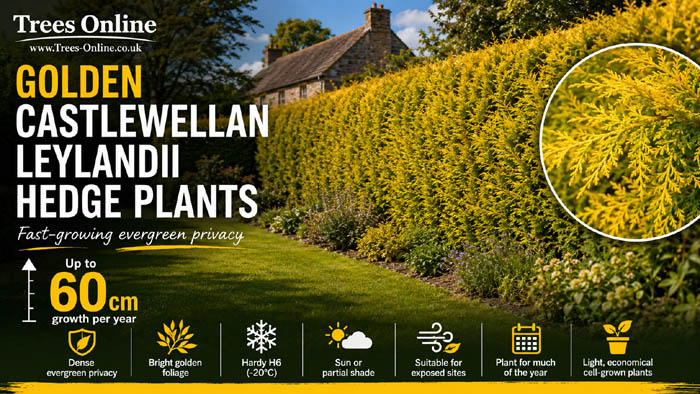
Golden Leylandii is a fast-growing evergreen hedge plant that gives you dense year-round privacy, shelter and bright golden-yellow foliage instead of the darker green of standard Leylandii. Golden Leylandii hedging is very hardy, rated H6 (minus 20 degrees centigrade) by the RHS, grows in full sun or partial shade, accepts most well-drained soils and can be used in exposed as well as sheltered positions. Once it forms a thick, continuous hedge, it can provide useful wind protection, help soften surrounding noise and give evergreen cover for garden wildlife. [2] [4] [5]
Our young cell-grown Golden Leylandii plants for sale are light, inexpensive and easy to handle. They can be planted almost all of the year compared to the bare-root planting period of November to March[7] and the longer your hedge the more you will notice the cost savings.
Gold Leylandii or Green Leylandii – What Is the Difference?
The main reason to choose Gold Leylandii is colour and growth speed. Golden forms produce yellow to golden-yellow foliage, giving a much brighter hedge than standard Green Leylandii, and the RHS list it as a slower-growing variety.[1]
You don't have to choose if you don't want to, you can have both and mix them into the same hedge. The green Leylandii will grow slightly faster, but trimming that back to the height of the yellow is no problem.
If maximum speed and a traditional dark-green hedge are your priorities, see our Green Leylandii hedge plants. If you prefer a brighter golden hedge, choose Gold Leylandii.
How Fast Does Golden Castlewellan Leylandii Grow?
Golden Castlewellan Leylandii is a fast-growing evergreen and can realistically grow around 60cm a year in good UK conditions, making it an excellent choice for fast privacy and screening. Forestry Commission records show a ‘Castlewellan’ specimen at Heaselands, Sussex had reached 14m high by 1990.[12] Historical records show the cultivar was first propagated in 1968, so that tree could have been no more than 22 years old; 14m over 22 years equates to a crude average of about 64cm of height per year.[13] We mention this because some retail sites quote growth rates as high as 90cm a year for Golden Leylandii, whereas the documented UK evidence supports a figure of around 60cm a year as much more defensible.
Will Leylandii Reduce Noise?
Once Golden Leylandii has formed a tall, wide and dense hedge, it can help reduce some surrounding noise up to 8 dB by absorbing and scattering sound, particularly higher-frequency sounds such as:
- voices
- barking dogs
- sirens
- Some machinery and power-tool noise
- Lawnmowers, hedge trimmers and strimmers
- General neighbour/garden activity
The effect is much smaller for lower-frequency noise such as road traffic, where a solid fence or wall is more effective. [4] To put this into perspective, an 8dB drop is roughly around a 40% noise reduction. We emphasise "roughly" because our brains froze up at the perceived volume and actual volume explanation. If you really want to know 84% of energy is reduced, but it only sounds like 40% quieter....yeagh....the PC was walked away from and a coffee made.
Where Can Golden Leylandii Be Planted?
Golden Leylandii grows in full sun or partial shade. The RHS profile for ‘Castlewellan Gold’ lists chalk, clay, loam and sandy soils, acid, neutral or alkaline conditions, and both exposed and sheltered positions, provided the soil is well drained. It is rated H6, corresponding to roughly -20°C. [2]
For strong establishment and growth, use fertile, well-drained ground with reliable moisture while the hedge is young. Research on Leyland Cypress has found growth responds to fertility and soil conditions, but permanently waterlogged ground should be avoided. [8] [9]
How Far Apart Should You Plant Golden Leylandii?
For a normal single-row Leylandii hedge, the RHS gives a suggested planting distance of approximately 60–75cm apart in average conditions. Use the closer end where earlier joining is important; the wider end uses fewer plants and gives each plant slightly more room. In difficult conditions, the RHS notes that planting distances may need to be reduced slightly. [1]
This author had a green Leylandii hedge planted 3 per metre, which was dense enough to stop 4 Great Danes getting out of the garden despite their best efforts.
How and When Should You Cut or Trim a Golden Leylandii Hedge?
The RHS Leyland Cypress pruning guide applies to all cultivars. Prune between April and the end of August, with up to three cuts during the growing season. Start shaping the sides while the plants are young and keep the hedge slightly wider at the base than at the top so light reaches the lower foliage. [3] Don't cut the main leader until your hedge has reached the desired height.
Keep cuts within young leafy growth. Do not allow the hedge to become much wider or taller than required and then expect to cut it hard back later. This is because Leylandii will not grow from back if you cut into the brown wood.
Before trimming, check carefully for active bird nests; it is an offence to damage or destroy a wild bird’s nest while it is being used or built. [3] [6]
Can You Cut Golden Leylandii Back Hard?
Not into bare brown wood. Golden Leylandii has the same important pruning limitation as Green Leylandii: if you cut the sides back beyond the leafy growth into old leafless wood, new growth will not normally appear from that bare area. This is why regular light trimming from an early age is much safer than allowing the hedge to become overgrown and trying to reduce its width drastically later. [3] One trick landscapers use is to direct lower branches into a bare patch and secure them with soft rubber ties.
How Tall Does Golden Leylandii Grow?
Golden Leylandii should be treated as a potentially very large tree rather than a naturally small hedge. The RHS describes ‘Castlewellan Gold’ as a vigorous columnar evergreen capable of reaching 25m or more if allowed to grow as a tree.[2]
Decide your required hedge height before planting and begin controlling the hedge as it approaches that height. Leylandii is far easier to keep at the required size than to recover after years of neglected growth.
Golden Leylandii Browning, Winter Colour, Pests and Diseases
Do not confuse normal seasonal colour with dead foliage. The RHS describes ‘Castlewellan Gold’ as golden-yellow and notes that the foliage can sometimes become bronze-tinged. A general bronze or gold-bronze cast in cold weather is therefore different from sharply defined dead brown patches. [2]
Where individual sections actually turn brown and die, check whether the hedge has dried out, remained waterlogged or been cut into old leafless growth. Cypress aphid can also cause extensive brown areas in Leyland Cypress. [3]
The RHS lists conifer aphid and scale insects as possible pests and bacterial canker and honey fungus as possible diseases of ‘Castlewellan Gold’. Leyland Cypress foliage can also irritate the skin, so gloves and covering clothing are sensible when planting or trimming. [2] [3]
See What Our Customers Are Saying About Our Gold Leylandii Hedging
Hi, got my "Leylandii Gold" trees today, Many thanks, they look really healthy Kind regards Julie 0215
Click image to enlarge
Show sources
[1] Royal Horticultural Society: Hedges – selection. Used for Leyland Cypress as a tall evergreen hedge, suggested 60–75cm planting spacing, and the RHS description of ‘Castlewellan’ as yellow-shooted and less vigorous than the standard form.
[2] Royal Horticultural Society: × Cupressocyparis leylandii ‘Castlewellan Gold’. Used for golden-yellow foliage, possible bronze colouring, evergreen habit, ultimate natural size, soil, light, exposure, H6 hardiness, pruning response, skin irritation, pests and diseases.
[3] Royal Horticultural Society: Leyland cypress – pruning. Used for April–August pruning, up to three cuts in the growing season, hedge shape, old-wood limitations, browning and cypress aphid.
[4] Royal Horticultural Society: Hedges with environmental benefits. Used for the ability of dense hedges to provide privacy, reduce some noise and support wildlife, with dense evergreen canopies particularly useful where noise reduction is wanted.
[5] Royal Horticultural Society: Hedge and woodland-edge habitats. Used for wildlife cover and the value of hedges as living windbreaks.
[6] GOV.UK: Wild birds – protection and licences. Used for the legal protection of active wild-bird nests.
[7] Forest Research: Establishment & management. Used for cell-grown planting stock being suitable for lifting and planting outside the normal bare-root planting period and its potential establishment advantages.
[8] University of Georgia Cooperative Extension: Leyland Cypress Trees Often Planted Incorrectly. Used for the general Leyland Cypress preference for fertile, well-drained soil and the importance of adequate soil moisture.
[9] Journal of Environmental Horticulture: Soil pH and Fertility Affect Growth of Leyland Cypress Christmas Trees. Used for evidence that Leyland Cypress growth responds to soil pH and fertility.
[10] North Carolina State University / International Plant Propagators’ Society: Ted Bilderback – Leyland Cypress Propagation. The paper lists ‘Castlewellan’ among the principal Leyland Cypress clones and reports that 3–5ft of annual growth is possible in full sun and well-drained soils. Used for the approximately 90–150cm potential annual growth figure and its limitations.
[11] Oregon State University: Hesperotropsis × leylandii. Used for confirmation that ‘Castlewellan’ is synonymous with ‘Castlewellan Gold’ and is a vigorous grower, although slower than ordinary Leyland Cypress.
[12]
Forestry Commission: Champion Trees in the British Isles, Field Book 10 (1990). Records a × Cupressocyparis leylandii ‘Castlewellan’ specimen at Heaselands, Sussex at 14m high in 1990.
[13]
Irish Garden Plant Society: A Heritage of Beauty. Records that ‘Castlewellan’ was first propagated on 29 February 1968. Used with the Forestry Commission measurement to calculate that the Heaselands specimen averaged at least approximately 64cm of height per year.