Click image to enlarge
Liquidambar styraciflua – Sweet Gum Tree Saplings for Spectacular Autumn Colour
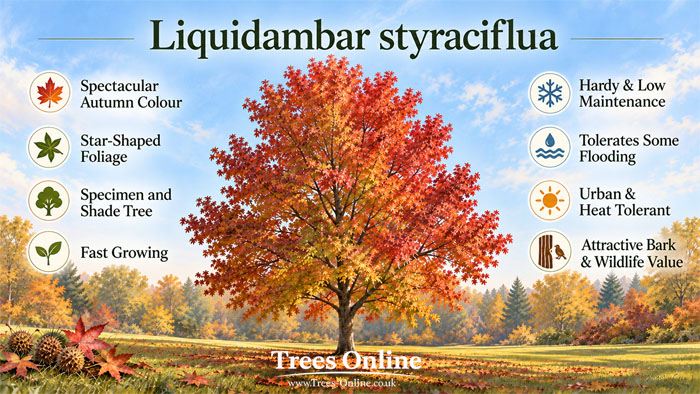
Create avenues, parkland and ornamental woodland with spectacular autumn colour using the Sweet Gum tree (Liquidambar styraciflua). Also known as the American sweetgum tree or liquid amber tree, this deciduous species produces outstanding displays of yellow, orange, crimson and purple foliage, often retaining its colour well into late autumn, sometimes into December.[1][2][21]
Individual trees can develop different autumn shades, creating a varied display across larger plantings.[2] Supplied as young, 20–60 cm cell-grown trees, these saplings provide an economical way to establish a larger planting scheme.
Young Sweet Gum trees develop an attractive, upright, broadly conical shape, gradually forming substantial crowns as they mature. Their natural form makes them suitable for avenues and informal groups of woodland trees.[2]
We have not listed these trees in our hedges section as the characteristics of the tree do not lend themselves very well to a conventional clipped hedge.
Ideal for: Avenues, estate drives, parkland, ornamental woodland, substantial gardens and larger planting schemes where exceptional autumn colour is the main objective.
Liquidambar Tree Sapling – Distinctive Foliage and Bark
The Liquidambar tree has glossy, rich green leaves with five to seven pointed lobes, producing a distinctive star-shaped appearance. Although often mistaken for maple foliage, Sweet Gum leaves grow alternately along the branches rather than in opposite pairs. When crushed, the leaves release a pleasant fragrance from their natural aromatic oils.[2][3]
Young branches can develop unusual corky ridges or wings, while the older trunk gradually develops deeply furrowed grey-brown bark. These features provide additional interest when the branches are bare in winter.[2]
The bark also produces a separate aromatic substance: a fragrant, sticky resin known as American storax, which has traditionally been used in perfumes and cosmetics.[2]
Sweet Gum Woodland Trees – Mature Height, Spread and Growth Rate
Our Sweet Gum tree saplings reach a mature height of 20–25 metres, with a spread of up to 12 metres in favourable UK conditions.[1][4] Exceptional British specimens can grow taller, including a tree recorded at 28.5 metres at Syon, London, in 2017.[2]
Sweet Gum has a good growth rate in Britain, typically adding around 30–60 cm in height annually under suitable conditions. Growth is generally slower in cooler northern and western regions, while warm summers encourage stronger development.[2][4][22][23]
Cell-grown Liquidambar styraciflua – Best Soil, Sun and Growing Conditions
Liquidambar styraciflua grows in clay, loam and sandy soils, performing best in moderately fertile, moist but well-drained ground. For the strongest growth and autumn colour, choose acidic to neutral soil with a pH of 7.0 or below.[1][11]
Avoid chalky or alkaline soils. Although Sweet Gum can survive in moderately alkaline conditions, its autumn colours are often disappointing. Alkaline soil can also cause iron chlorosis, resulting in yellowing leaves and poorer growth.[2][3][11]
Full sun encourages the strongest autumn display, although partial shade is tolerated.[1] Autumn colour is also influenced by the weather. Sunny autumn days followed by cool, frost-free nights encourage stronger red and purple colouring, while drought or early frosts can reduce the display.[8][20]
The species benefits from summer warmth but dry, shallow soils can cause drought stress during a British summer.[2]
Sweet Gum is well suited to damp ground, including moist clay soils and riverside locations. It tolerates seasonal flooding, making it useful where soils are periodically wet. However, it grows best in deep, moist soil rather than ground that remains permanently waterlogged.[1][6][9]
The species has an RHS hardiness rating of H6, indicating tolerance of approximately −20°C to −15°C. It is sufficiently cold-hardy for most UK locations, although cooler summers can restrict growth even where winter temperatures are suitable.[1][2]
Liquidambar Young Trees for Sale – Low-Maintenance Growth, Pruning and Exposure
Once established, Liquidambar trees require little routine pruning. Occasional removal of damaged, diseased or crossing branches is normally sufficient, preferably in late winter or early spring. Heavy pruning is best avoided because it can spoil the natural shape.[1][5]
One important consideration is the relatively brittle wood. Branches and leading shoots can break during storms, particularly in areas lacking prolonged summer warmth. Significant breakages may also allow wood-decaying fungi to enter.[2]
Although it is listed as suitable for both sheltered and exposed positions, consider the consequences of possible branch failure before planting near roads, buildings or frequently used areas.[1][2]
Sweet Gum Sapling Tree – Fruits, Roots and Other Considerations
Flowers and fruits: Small, inconspicuous spring flowers can develop into distinctive, round, woody seed heads covered in short, sharp projections. Fruiting is generally less prolific in Britain than in warmer American climates, but the hard, spiky fruits can create a maintenance nuisance around paths, lawns and paved surfaces.[2][3] The spiky fruits develop green, turn brown in autumn and can remain hanging from bare branches through winter.[21]
Roots: Sweet Gum develops deep roots in well-drained ground, but its root system becomes shallower and more widespread in wet soils.[6] As the tree matures, large surface roots can lift nearby paths, driveways and paving. UK research into tree roots generally finds that most pavement damage occurs within 2 metres of the trunk, although some damage may occur farther away.[11][12] The species is classed as having low water demand, reducing its relative risk of clay-shrinkage subsidence compared with high-water-demand trees.[10]
Coastal conditions: Sweet Gum is suitable for coastal planting and tolerates salty winds, moderately saline soils and some airborne salt.[7][11][13][14][15] Established trees are documented in coastal towns including Hastings, St Leonards-on-Sea and Bournemouth, where a tree planted in 1977 was still present in 2008.[2][17] The species is also recommended for planting beside brackish tidal shorelines where salt spray, salt accumulation and occasional tidal flooding occur.[16]
Livestock and pets: Sweet Gum is listed among trees suitable for horse pastures and providing shade.[18] However, grazing livestock can damage young saplings through browsing, bark stripping, trampling or pulling out newly planted trees, so protect them.[19]
Pests and diseases: Sweet Gum is generally free from serious pest problems in British cultivation, although honey fungus is a recognised potential disease. Occasional caterpillar damage, scale insects and leaf diseases are recorded overseas but should not be regarded as common UK problems.[1][3]
Click image to enlarge
[10]
RHS – Trees Near Buildings. Used for: Classification of Liquidambar as a low-water-demand tree and its relative risk of clay-shrinkage subsidence.