Need Help Finding the Right Hedge? Use our HEDGE FINDER
Want but to buy a lot of hedge plants? Trade Price Details or straight to Contact Us
Why Buy Our Cheap Hedging Trees?
- 1+ year old, all between 10cm - 60+ cm
- FREE TREE WARRANTY and delivery.
- Plant all year, easy to plant, high success rates and early growth
- Hardy North UK grown plants, contains mycorrhizae and fertilizer.
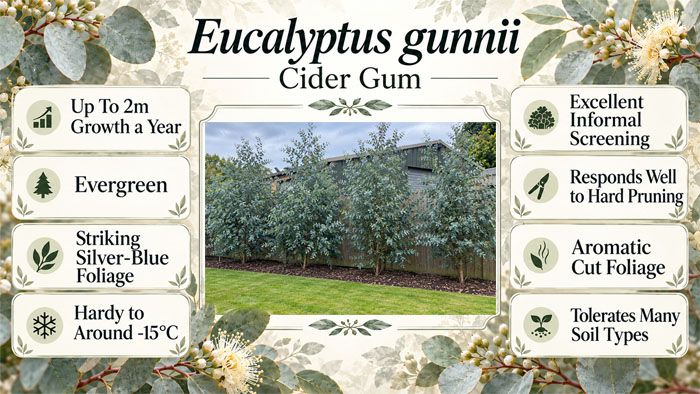
Fast Growing Eucalyptus gunnii Screening Trees.
For larger and older trees go to Mature Eucalyptus Gunni, Standard And Shrubs
Our Eucalyptus gunnii cell-grown plants can be used as cheap, evergreen, and fast-growing screening trees even under British conditions.[5] With a growth rate of up to 2m a year [8], you won’t have to wait long for anything to be screened out.
The distinctive blue-grey foliage contrasts well in the garden and provides year-round colour. Cider Gum establishes quickly, can be grown as a large specimen, and repeatedly coppiced for fresh foliage.[1][2] Easy to understand how it got the RHS Award of Garden Merit (AGM).
Young Cider Gum carries rounded, glaucous blue-grey leaves on pale stems. As the tree matures, these gradually change to longer grey-green adult leaves, while older trunks develop attractive peeling cream and brown bark.[1] The juvenile foliage is also valued for decorative cutting and floristry.[2]
Native to Tasmania, Cider Gum has a naturally columnar, upright habit.[1] Its foliage is mildly fragrant, with the characteristic eucalyptus aroma becoming more noticeable when the leaves are crushed.[15]
Ordinary Eucalyptus gunnii naturally develops a relatively open crown, so it is better suited to a loose screen or repeated multi-stem planting than to a dense, tightly clipped formal hedge.[3]
For informal screening, around 1.75m between plants is a sensible starting point. A seven-year Eucalyptus gunnii trial used 1.75m spacing and found that well-grown plants filled their allotted space.[16]
Ideal for: Year round colour and architectural planting, coppiced eucalyptus displays and quick growing evergreen trees for informal screening.
Eucalyptus gunnii Screening – How to Get a Thick Screen as Quickly as Possible
If you want the plants to gain height and thicken up at the same time, leave the main leader alone until it reaches the height you want. While it is growing, trim back long or straggly side shoots to encourage them to branch and become bushier. Once the main leader reaches the final screen height, cut the top out and continue trimming the sides to maintain a thick screen.[4][17]
If you only need screening above a fence or wall, you can keep a clear stem below it. Once the main stem reaches the height where you want the screen to start, cut it across at that height. Eucalyptus gunnii will then produce multiple new branches from around the cut. Remove any new shoots from lower down if you want to keep the stem clear.[4]
Late winter to early spring, around February to March, is the normal time for formative pruning.[4]
Best Soil, Sun and Shelter for Eucalyptus gunnii
Choose full sun and a reasonably sheltered position e.g. no hilltops, because its rapid young growth can be damaged on exposed and windy sites.[2]. Cider Gum is very light-demanding and should not be planted in permanent shade.
The species is hardy through most of the UK, with an H5 rating equivalent to approximately −15°C to −10°C.[1] Young shoots are more vulnerable to badly timed frost, so frost hollows should be avoided.[2]
Best growth is achieved on reasonably fertile and moist soils. Slightly acidic conditions are preferred, although some alkaline tolerance is recorded, and the species can grow on clay, loam, sand and chalk.[1][2]
Some imperfect drainage can be tolerated, but very wet sites, peat and permanent waterlogging are unsuitable.[2] Drought tolerance is only moderate, so ground that retains reasonable moisture is preferable to very dry soil.[3]
Cider Gum can be suitable for coastal planting in Britain, but it is best where there is some shelter from strong winds.[2]
How Large Does a Cider Gum Tree Grow?
An unrestricted Cider Gum tree can become a substantial tree, with a potential height of around 34m and a crown exceeding 8m across.[3]
The root system may become extensive, and eucalyptus is classed among high-water-demand trees.[3][6] Large trees can therefore compete strongly with nearby planting for moisture.
Most trees near buildings cause no structural damage, but high-water-demand trees need extra consideration on shrinkable clay, where drying of the soil can contribute to subsidence. Roots can also exploit drains that are already leaking.[6]
Wildlife, Browsing, Toxicity and Other Limitations
Mature Cider Gum produces small white flowers and can provide some value to bees and other pollinating insects.[1][3] The flowers are produced in summer.[15] Frequently coppiced plants may flower little because the stems are continually pruned back.
Young plants may be palatable to deer and other browsing mammals if other food sources are low, so protection may be necessary where browsing pressure is high.[2] This does not apply to your nearest and dearest, they are a different sort of deer so no need to tell your partner to stop eating the hedge.
Eucalyptus foliage is toxic if eaten by dogs, cats and horses.[7] Small amounts are more likely to cause digestive upset, while larger amounts or concentrated eucalyptus oils can cause more serious issues.[14]
Eucalyptus gunnii is generally a trouble-free tree, although several pests and diseases can occasionally occur. Eucalyptus gall wasp produces small raised swellings on the leaves and can sometimes cause heavy leaf fall, but it does not normally affect the long-term health of the tree.[9] Eucalyptus sucker (an insect) feeds on young shoots and can leave them sticky with honeydew, although the damage is usually minor and does not normally reduce the vigour of the plant.[10]
Oedema is not an infection but a reaction to excessively wet conditions, causing water-soaked areas and corky swellings on the leaves.[11] More serious problems include silver leaf, which can cause branch dieback and may eventually kill affected trees, and honey fungus or Phytophthora root rot, both of which attack the roots and can lead to decline or death.[2][12][13] Good drainage helps reduce the conditions associated with oedema and root problems.
Delivery
Due to courier unpredictability, we advise having your trees delivered AT LEAST 3 days before you actually need them.
Returning Cell-Grown Trees
For phytosanitary reasons, cell-grown trees cannot be returned to the nursery.
Delaying Planting Cell-Grown Trees
If you cannot plant straight away, take the trees out of the packaging and stand upright next to each other in a sheltered location outside. November to March, no need to water unless they start to dry out and these would be ok for up to 6 weeks. During Spring and Summer, you can do this for up to 3 weeks.
Site Conditions and Evergreen Tree List
Our Tree Chart details which site conditions suit which trees and also which are evergreen or semi-evergreen.
Feeding or Fertilising Hedges
Any nitrogen-based fertiliser will do such as 20:20:10 but the longer-lasting ones which take 18/24 months are better as they are regulated by the weather and moisture, therefore release slowly.
Second Line of Hedging or Staggered Row
We recommend planting the second line of trees 25 cm or 10 inches away from the first if using the staggered hedging approach. Consider buying 10% more than you need and plant the spares elsewhere so you have immediate replacements for damaged or diseased trees.
Hedge Protection
For all hedging protection please view the Tree Extras Section.
You would think that thorny plants would put rabbits off from eating them however this is not the case. They are happy to take the pain regardless of the cost (sounds like rabbits would be suited to marriage).
Using Bark or Wood Chip Mulch for Hedging Trees
Mice like to use this as a nest/home/holiday retreat and they eat the bark (especially Beech). Periodically check for damage below the mulch or bark layer. Alternatively use gravel or plastic sheeting as a method of reducing weeds.
Adding Fragrance and Colour to Your Hedge
Honeysuckle (Lonicera periclymenum) is a very popular addition to any garden due to the strong fragrance, splash of colours and interest it generates from other wildlife. Click the link to find out more.
Plants Suitable for Coastal Planting
Native: Hawthorn, Blackthorn, Sea Buckthorn, Holly, Juniper, Rowan, Whitebeam, Willow, Field Maple.
Evergreen/Semi-Evergreen: Griselinia, Olearia, Escallonia, Elaeagnus, Berberis, Privet, Cotoneaster.
Ground Cover: Hebe, Gorse, Sea Buckthorn (low form), Tamarisk, Pyracantha.
Factors Detrimental to Cell-Grown/Young Hedging Trees
Too much/little water, animal urine, excessive wind exposure (will slow growth), salt spray, frost on new growth, herbicide drift and over-application of fertiliser.
Planting in the Corner of a Garden
Air and light are reduced in this location which could promote fungal and bacterial issues. If the corner is of the house and a fence then you also have leeching issues to contend with from cement and wood preservatives. Also when it rains, that area would experience higher water levels so we advise against it unless the plant is very hardy.