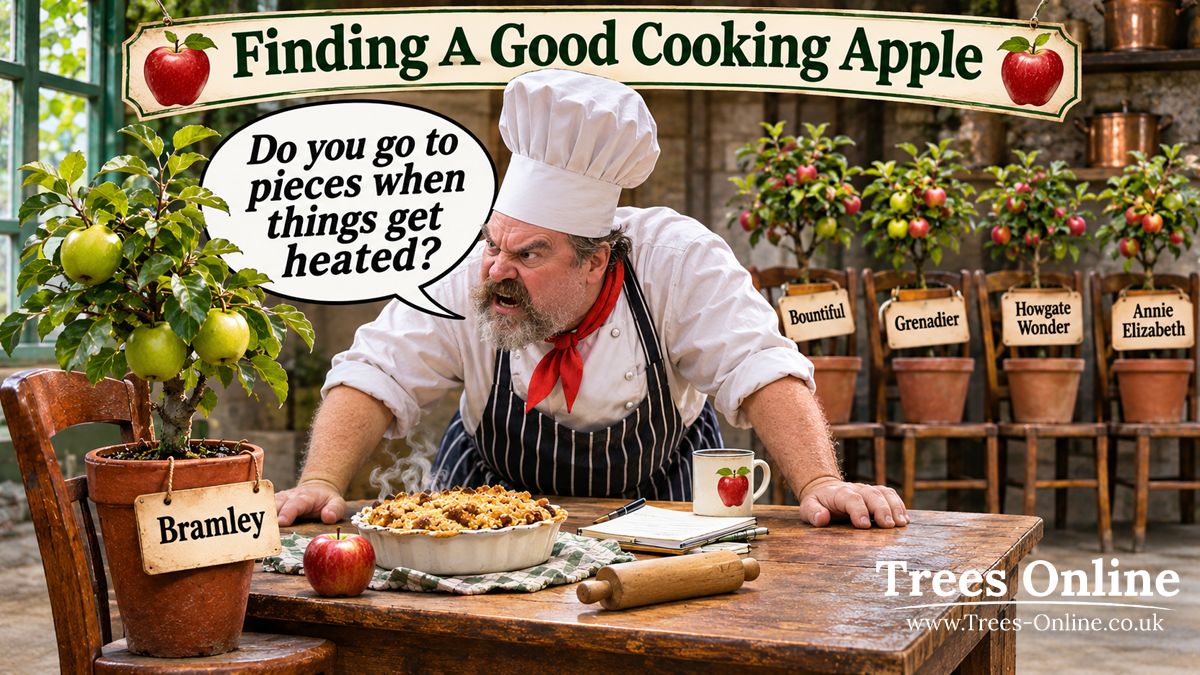
Growing your own cooking apple tree gives you far more choice than your local supermarket because their priority is profit and long-term storage, not taste or texture. Bramley may be Britain's most famous cooking apple, but there are sweeter varieties that require less added sugar, and other cooking apples that retain their shape when heated. There are even apples that sit somewhere between eating and cooking apples.
Choose the right varieties, and you could have free homegrown cooking apples from July through to April, whether you have a small patio or enough space for several mature apple trees. Process them, and you have apple products all year. White Transparent, for example, is recorded as a late-July culinary and dessert apple at the National Fruit Collection, although it is not included in the selector below.[103]
If you just want a good cooker, then here are our top 5 selections.
A good cooking apple retains plenty of flavour when heated and has the right balance of sweetness, acidity and texture for the dish you are preparing. For sauces and crumbles, you may want an apple that breaks down readily, whereas for tarts and whole baked apples, you may prefer one that softens but retains its shape. You don't want to be offering an apple sauce that hasn't broken down from the slices you made earlier; that is just a jug of apple chunks.
Cooking apples, also known as culinary apples, are generally more acidic and often larger than eating apples. High acidity helps the apple flavour cut through, balances added sugar and complements rich foods such as buttery pastry and pork. It also helps pectin form a gel when making jams and jellies and can slow the browning of freshly cut apples.
You can eat cooking apples raw, assuming your facial muscles can cope with some major spasm and your eyes feeling like they have been welded shut. Equally, you can cook with eating apples. Dual-purpose varieties offer the best of both worlds, with some becoming sweeter and more suitable for eating as they mature in storage.
Some of the best cooking apples are those given to you free because the owner has more than they know what to do with. We had a neighbour that gave away 2-3 carrier bags each to all his neighbours and still was overwhelmed.
Why Do Some Cooking Apples Turn to Mush?
It depends on the structure of the apple's flesh and how it responds to heat. Pectin acts like a natural glue holding the apple's cells together. During cooking, pectin and other structural components change and break down. The extent of this breakdown varies between apple varieties.
Research published in 2026 confirmed these differences in cellular breakdown and found that the firmness of a raw apple is not necessarily a reliable indication of how well it will retain its shape when cooked.[1][2][3]
Choose the qualities you want. We show the best matches first.
1. Choose what matters to you
Cooking qualities
Choose apples that retain their shape when cooked, are recommended for baking whole or are described as firm bakers. The results explain the particular benefit.
Apples that soften and break down when heated, useful for apple sauce, purées and soft fillings.
Apples with a sweet or milder cooking flavour, which may need less added sugar.
Apples with a pronounced acidic flavour, ideal if you enjoy traditional tangy cooking apples.
Apples suitable for both cooking and eating fresh. Some are better for eating when fully ripe.
Growing qualities
Varieties with documented resistance to one or more diseases. Results identify the diseases; resistance does not mean immunity.
Trees known for heavy crops, regular cropping or producing fruit from a young age. Results explain which applies.
Varieties recommended for cold, wet, northern or coastal conditions. Check the results for the specific conditions.
Varieties recommended for frost-prone locations, including late-flowering apples that may avoid earlier spring frosts.
Self-fertile or partially self-fertile varieties that can produce fruit without another apple tree nearby. Compatible pollen may improve cropping.
Garden requirements
Varieties suited to smaller gardens or with relatively compact growth. Choose an appropriate rootstock to control eventual size.
Varieties recommended for growing in containers on a suitable rootstock. Regular watering and feeding are needed.
Varieties suitable for trained forms such as espalier or cordon. The results explain the documented suitability.
Varieties noted for particularly attractive spring flowers.
Apples with distinctive skin or flesh colour, such as red flesh.
Harvesting and recognition
Apples with a documented early harvesting season, including August. Picking dates vary with growing conditions.
Apples that can potentially be kept or used into spring under suitable storage conditions.
Varieties awarded the Royal Horticultural Society Award of Garden Merit, recognising garden performance.
No options selected
2. Find your matches
Choose an option above to see recommended varieties.
Annie Elizabeth
Partially self-fertile: some fruit may set alone; a compatible pollination partner usually improves cropping.
View more details and sources
Retains shape when cooked or suitable for whole baking
Hold their shape when cooked: White flesh retains its shape in cooking. [22]
Sweet or mild cooking flavour / less added sugar
Sweeter, milder or need less sugar: Its light flavour suits stewing with very little added sugar. [34]
Large individual apples
Large individual apples: Produces large, round-oblong fruit. [34]
Disease resistance and documented susceptibility
Some apple canker resistance: Listed by the RHS among apples showing some resistance to canker. [15]
Powdery mildew resistance: The cultivar specification from Frank P. Matthews explicitly reports resistance to powdery mildew. Qualification: Nursery evidence. The RHS disease list does not name this cultivar for this disease. [34][14]
Apple scab resistance: The cultivar specification from Frank P. Matthews explicitly reports resistance to apple scab. Qualification: Nursery evidence. The RHS disease list does not name this cultivar for this disease. [34][13]
Heavy, regular, early or alternate-year cropping
Heavy crops: The RHS describes it as a heavy cropper. [22]
Cold, wet, northern or coastal sites
Cold, wet or northern sites: Tolerates cold and wet conditions. [22]
Self-fertile or partially self-fertile
Partially self-fertile: Partly self-fertile. [22]
Attractive blossom or unusual fruit or flesh colour
Attractive blossom: Deep pink spring blossom. [22]
Picking season (not season of use)
Picking season: Early October. The RHS gives mid-autumn. [34]
Potential storage or season of use as stated in source
Long storage into spring: Stores to mid-spring in the RHS profile. Qualification: Frank P. Matthews gives February and the Agroforestry Research Trust gives a season of use to June. Use the RHS profile’s mid-spring estimate. [22][34][28]
Requires compatible pollen from another apple variety. Cannot reliably pollinate other apple trees. [96]Pollination guide
View more details and sources
Retains shape when cooked or suitable for whole baking
Hold their shape when cooked: Recommended for tarts because it stays intact during cooking. [38]
Suitable for sauces and purées
Sauces and purées: The Big Apple’s variety guide describes a stiff purée or shape retention depending on the preparation. It is used for apple charlotte. Qualification: Both cooking outcomes are documented. Expect a firmer purée when cooking it down. [39][38]
Dual-purpose cooking and fresh eating
For cooking and fresh eating: Use for cooking from late September and for eating later in autumn and winter. [40]
Cold, wet, northern or coastal sites
Cold, wet or northern sites: Suitable for northern, colder and higher-rainfall areas. [40]
Picking season (not season of use)
Picking season: Early October. [41]
RHS Award of Garden Merit
RHS Award of Garden Merit: The current RHS apple register records an Award of Garden Merit dated 1993. [7]
Requires compatible pollen from another apple variety. Cannot reliably pollinate other apple trees. [8]Pollination guide
View more details and sources
Suitable for sauces and purées
Sauces and purées: Cooks to a cream-coloured purée. [42]
Traditional sharp cooking flavour
Traditional sharp flavour: Identified as a sharp cooking apple. [42]
Large individual apples
Large individual apples: The RHS describes the apples as large. [42]
Disease resistance and documented susceptibility
Canker resistance reported by nursery: Keepers rates it resistant to canker. The RHS canker list gives no clone-specific classification. [43]
Powdery mildew resistance: Keepers rates its mildew response as resistant. [43]
Heavy, regular, early or alternate-year cropping
Heavy crops: Reported to crop more heavily than Bramley’s Seedling. [44]
Cold, wet, northern or coastal sites
Cold, wet or northern sites: Keepers recommends it for northern Britain. The RHS profile specifies a sheltered position. [43]
Late blossom or other documented suitability for frost-prone sites
Other choices for frost-prone sites: Keepers lists it for late-frost sites. The source does not give a blossom mechanism. [43]
Smaller gardens, pots and patios; appropriate rootstock required
Smaller gardens: About 20% less vigorous than Bramley’s Seedling. The RHS still describes it as vigorous, so choose a suitable size-controlling rootstock. Qualification: The nursery recommends it as a smaller-garden alternative on a suitable rootstock. [42][44]
Picking season (not season of use)
Picking season: Early October in the directory. The RHS profile gives mid-autumn. [28]
Potential storage or season of use as stated in source
Long storage into spring: Stores to early spring. The Agroforestry Research Trust gives use to March. [42]
Requires compatible pollen from another apple variety. Cannot reliably pollinate other apple trees. [49][97]Pollination guide
View more details and sources
Retains shape when cooked or suitable for whole baking
Bake whole: A whole baked-apple recipe names Bramley-type apples and keeps the scored, softened fruit intact in the dish. [45]
Suitable for sauces and purées
Sauces and purées: The research documents rapid loss of tissue structure when heated. It softens to a purée-like texture. [1]
Traditional sharp cooking flavour
Traditional sharp flavour: Strong acidic flavour and creamy purée. [46]
Large individual apples
Large individual apples: The Armagh Bramley specification says most fruit is harvested at a minimum average diameter of 75 mm. This is an indication of market fruit size in Armagh. [47]
Disease resistance and documented susceptibility
Good blossom wilt resistance: Named by the RHS among cultivars with good blossom-wilt resistance. [48]
Heavy, regular, early or alternate-year cropping
Heavy crops: The trees crop heavily through October. [3]
Espaliers, cordons and other trained forms
Espalier with extra pruning: This partial tip-bearer can be trained as an espalier but the RHS says management can be difficult. [23]
Picking season (not season of use)
Picking season: Early October is the typical nursery picking time. Commercial regional timing varies. [46]
Potential storage or season of use as stated in source
Long storage into spring: RHS fruit specialist gives March or April in suitable storage. Qualification: The profile gives November to February as its ordinary season of use. [10][49]
RHS Award of Garden Merit
RHS Award of Garden Merit: The current RHS apple register records an Award of Garden Merit dated 1993. [7]
Sweeter, milder or need less sugar: The purée can be made without adding sugar. [54]
Dual-purpose cooking and fresh eating
For cooking and fresh eating: Suitable for fresh eating and cooking. [54]
Attractive blossom or unusual fruit or flesh colour
Unusual flesh or fruit colour: The cut flesh resists browning and cooks to a white purée. Qualification: The horticultural paper corroborates the slow-browning trait and identifies Eden as SJCA38R6A74. The RHS has a separate cultivar called Eden. [54][55][56]
Picking season (not season of use)
Picking season: Early October according to the nursery catalogue. [54]
Partially self-fertile: some fruit may set alone; a compatible pollination partner usually improves cropping.
Things to consider
May produce a larger crop every other year. [58]
View more details and sources
Suitable for sauces and purées
Sauces and purées: Cooks down to a fluffy purée. [58]
Sweet or mild cooking flavour / less added sugar
Sweeter, milder or need less sugar: The RHS says the cooked fruit needs very little sugar. [58]
Disease resistance and documented susceptibility
Some apple canker resistance: Listed by the RHS among apples showing some resistance to canker. [15]
Powdery mildew resistance: The cultivar specification from Frank P. Matthews explicitly reports resistance to powdery mildew. Qualification: Nursery evidence. The RHS disease list does not name this cultivar for this disease. [59][14]
Apple scab resistance: Listed by the RHS among apples resistant to scab. [13]
Heavy, regular, early or alternate-year cropping
Tendency to crop in alternate years: The RHS calls the heavy crop typically biennial. [58]
Heavy crops: Heavy crops, typically borne in alternate years. [58]
Cold, wet, northern or coastal sites
Cold, wet or northern sites: Very suitable for colder, wetter conditions in northern areas. [58]
Self-fertile or partially self-fertile
Partially self-fertile: Frank P. Matthews lists partial self-fertility. [59]
Picking season (not season of use)
Early picking: Normally picked in early August in the nursery catalogue. [59]
RHS Award of Garden Merit
RHS Award of Garden Merit: The current RHS apple register records an Award of Garden Merit dated 1993. [7]
Partially self-fertile: some fruit may set alone; a compatible pollination partner usually improves cropping.
View more details and sources
Retains shape when cooked or suitable for whole baking
Hold their shape in the oven: The cultivar description explicitly records shape retention in the oven. [61]
Hold their shape when cooked: Keeps its shape during baking. [61]
Sweet or mild cooking flavour / less added sugar
Sweeter, milder or need less sugar: The RHS describes the culinary flavour as very mild. Qualification: The nursery describes the flesh as sweet and juicy when eaten. The RHS assessment gives the mild culinary variety descriptor. [5][61]
Dual-purpose cooking and fresh eating
For cooking and fresh eating: A cooking apple sweet and juicy enough to eat fresh. [3]
Large individual apples
Large individual apples: The RHS describes very large fruit. The National Fruit Collection records a width of 95 mm for its characterisation. [5][19]
Heavy, regular, early or alternate-year cropping
Regular cropping: The orchard nursery describes regular heavy crops. [62]
Heavy crops: The RHS describes heavy cropping. [5]
Cold, wet, northern or coastal sites
Cold, wet or northern sites: The orchard nursery describes it as suited to colder areas. [62]
Self-fertile or partially self-fertile
Partially self-fertile: Classified as partially self-fertile. [5]
Smaller gardens, pots and patios; appropriate rootstock required
Pots and patios: Named by the RHS in its list of culinary apples for containers. [18]
Espaliers, cordons and other trained forms
Espaliers: Named by the RHS among cooking apples to consider for espalier. [23]
Picking season (not season of use)
Picking season: Ripens in October. Frank P. Matthews lists early October on the cultivar page. [3]
Potential storage or season of use as stated in source
Long storage into spring: RHS fruit specialist gives March or April under suitable conditions. Qualification: The nursery guide gives March. [10][3]
RHS Award of Garden Merit
RHS Award of Garden Merit: The current RHS apple register records an Award of Garden Merit dated 2014. [7]
Partially self-fertile: some fruit may set alone; a compatible pollination partner usually improves cropping.
Things to consider
More prone to apple canker. [15]
View more details and sources
Retains shape when cooked or suitable for whole baking
Hold their shape when cooked: RHS records shape retention and a delicate, juicy cooked result. Pick before full ripeness for cooking. [63]
Dual-purpose cooking and fresh eating
For cooking and fresh eating: Dessert variety that can also be used for cooking when picked early. [63]
Disease resistance and documented susceptibility
More prone to apple canker: The RHS lists it among cultivars particularly susceptible to apple canker. [15]
Heavy, regular, early or alternate-year cropping
Regular cropping: The RHS reports good, regular crops. [63]
Cold, wet, northern or coastal sites
Cold, wet or northern sites: The RHS identifies it for colder northern areas. [63]
Self-fertile or partially self-fertile
Partially self-fertile: Keepers and Frome Town Council record partial self-fertility. Allow for improved cropping with a pollination partner. Qualification: Frank P. Matthews labels it self-fertile. RHS groups both grades together. Use the more cautious grade supported by the other two sources. [64][65][66][23]
Espaliers, cordons and other trained forms
Espaliers: Named by the RHS in its one-tree espalier guidance. [23]
Picking season (not season of use)
Picking season: RHS fruit specialist gives early September to early October for ripeness. [10]
RHS Award of Garden Merit
RHS Award of Garden Merit: The current RHS apple register records an Award of Garden Merit dated 1993. Its register classification is dessert. See its separate culinary evidence. [7]
Partially self-fertile: some fruit may set alone; a compatible pollination partner usually improves cropping.
View more details and sources
Suitable for sauces and purées
Sauces and purées: Cooks down into a light froth. [22]
Sweet or mild cooking flavour / less added sugar
Sweeter, milder or need less sugar: The creamy purée needs little added sugar. [67]
Large individual apples
Large individual apples: The RHS describes medium to large fruit. [22]
Disease resistance and documented susceptibility
Powdery mildew resistance: The cultivar specification from Frank P. Matthews explicitly reports resistance to powdery mildew. Qualification: Nursery evidence. The RHS disease list does not name this cultivar for this disease. [67][14]
Apple scab resistance: The cultivar specification from Frank P. Matthews explicitly reports resistance to apple scab. Qualification: Nursery evidence. The RHS disease list does not name this cultivar for this disease. [67][13]
Heavy, regular, early or alternate-year cropping
Regular cropping: The RHS specifically describes the late-summer crop as reliable. [22]
Heavy crops: RHS records a reliably heavy crop in late summer. [22]
Cold, wet, northern or coastal sites
Cold, wet or northern sites: The nursery reports it as popular in northern UK growing conditions. [67]
Self-fertile or partially self-fertile
Partially self-fertile: The RHS says partly self-fertile, with better cropping when cross-pollinated. Qualification: The nursery labels it fully self-fertile. The RHS classification takes precedence. [22][67]
Smaller gardens, pots and patios; appropriate rootstock required
Smaller gardens: The RHS describes a neat, upright tree. Choose a size-controlling rootstock. [22]
Picking season (not season of use)
Early picking: Directory gives August to September. Select it for an August crop alongside earlier options. [28]
Potential storage or season of use as stated in source
Shorter storage: The RHS describes storage of up to a month. [22]
Partially self-fertile: some fruit may set alone; a compatible pollination partner usually improves cropping.
View more details and sources
Retains shape when cooked or suitable for whole baking
Hold their shape when cooked: Well-ripened fruit remains shapely and flavoursome after cooking. [68]
Dual-purpose cooking and fresh eating
For cooking and fresh eating: Specifically suitable for cooking, tarts, cider and fresh eating. [69]
Disease resistance and documented susceptibility
Apple scab resistance: Listed by the RHS among apples resistant to scab. [13]
Heavy, regular, early or alternate-year cropping
Regular cropping: RHS reports regular crops. [68]
Heavy crops: RHS reports heavy crops. [68]
Cold, wet, northern or coastal sites
Cold, wet or northern sites: The RHS recommends it for northern, colder and higher-rainfall areas. [68]
Self-fertile or partially self-fertile
Partially self-fertile: Frank P. Matthews lists partial self-fertility. RHS profile gives a flowering group with no fertility grade. [69]
Espaliers, cordons and other trained forms
Cordons, fans and other trained forms: The RHS profile says it is suitable for all forms of training. [68]
Picking season (not season of use)
Picking season: Early October. [69]
RHS Award of Garden Merit
RHS Award of Garden Merit: The current RHS apple register records an Award of Garden Merit dated 1993. Its register classification is dessert. See its separate culinary evidence. [7]
Sauces and purées: Especially suited to a lemon-flavoured purée. [70]
Traditional sharp cooking flavour
Traditional sharp flavour: Historic cultivar accounts describe strongly acidic flesh and recommend it as a kitchen apple. Frank P. Matthews describes its lemon-flavoured purée. [71][70]
Large individual apples
Large individual apples: The historic pomological description describes large fruit. [71]
Disease resistance and documented susceptibility
Some apple canker resistance: Listed by the RHS among apples showing some resistance to canker. [15]
More prone to powdery mildew: RHS mildew guidance lists it among cultivars commonly affected. [14]
Apple scab resistance: Listed by the RHS among apples resistant to scab. [13]
Heavy, regular, early or alternate-year cropping
Regular cropping: The grower’s assessment reports that the variety regularly produces a large crop. [72]
Heavy crops: The grower’s assessment describes a regularly large crop. [72]
Crops from a young age: A historic trial at the New York Agricultural Experiment Station corroborated its reputation for bearing young. [71]
Late blossom or other documented suitability for frost-prone sites
Other choices for frost-prone sites: The RHS recommends it for frost-prone gardens under long flowering or frost-resistant blossom. It does not assign which mechanism applies. [26]
Smaller gardens, pots and patios; appropriate rootstock required
Smaller gardens: The RHS selection guide describes a small tree suitable for gardens. Choice of rootstock still applies. [4]
Espaliers, cordons and other trained forms
Cordons, fans and other trained forms: The cultivar profile says it is suitable for all training forms. [22]
Picking season (not season of use)
Picking season: The directory gives September to October. The nursery gives early October. [28]
Potential storage or season of use as stated in source
Long storage into spring: The RHS selection guide gives use to March. [4]
RHS Award of Garden Merit
RHS Award of Garden Merit: The current RHS apple register records an Award of Garden Merit dated 1993. [7]
Partially self-fertile: some fruit may set alone; a compatible pollination partner usually improves cropping.
Things to consider
May produce a larger crop every other year. [21]
View more details and sources
Suitable for sauces and purées
Sauces and purées: The cultivar description records a juicy, mild purée. [74]
Sweet or mild cooking flavour / less added sugar
Sweeter, milder or need less sugar: Mild when cooked to a purée. [74]
Dual-purpose cooking and fresh eating
For cooking and fresh eating: Suitable for cooking and eating. Develops as an eater in storage. [21]
Large individual apples
Large individual apples: The cultivar description specifies large fruit. [74]
Disease resistance and documented susceptibility
Some apple canker resistance: Listed by the RHS among apples showing some resistance to canker. [15]
Powdery mildew resistance: Listed by the RHS among cultivars resistant to apple powdery mildew. [14]
Apple scab resistance: Listed by the RHS among apples resistant to scab. [13]
Heavy, regular, early or alternate-year cropping
Tendency to crop in alternate years: The RHS documents a typically larger crop every other year. [21]
Heavy crops: Crops heavily, typically with larger crops in alternate years. [21]
Self-fertile or partially self-fertile
Partially self-fertile: Frank P. Matthews lists partial self-fertility. RHS espalier advice groups it with self-fertile and partly self-fertile cultivars. [74][23]
Espaliers, cordons and other trained forms
Espaliers: The RHS names it as a cooking apple suitable for espalier. [23]
Cordons, fans and other trained forms: The RHS cultivar profile says it is suitable for all forms of training. [21]
Picking season (not season of use)
Mid-October or later picking: The Agroforestry Research Trust lists mid-October. [28]
Potential storage or season of use as stated in source
Long storage into spring: Stores for use to March and sometimes longer. [21]
Partially self-fertile: Keepers gives partial self-fertility. The RHS espalier guide includes it in a grouped list for planting a single tree. [80][23]
Espaliers, cordons and other trained forms
Espaliers: Named for espalier by the RHS. [23]
Cordons, fans and other trained forms: The RHS profile describes it as suitable for all training forms. [79]
Picking season (not season of use)
Picking season: Late September in the nursery catalogue. [81]
RHS Award of Garden Merit
RHS Award of Garden Merit: The current RHS apple register records an Award of Garden Merit dated 1993. [7]
Self-fertile: compatible pollen may improve cropping.
Things to consider
May produce a larger crop every other year. [83]
View more details and sources
Retains shape when cooked or suitable for whole baking
Baking generally: Large fruit recommended for baking generally. [82]
Suitable for sauces and purées
Sauces and purées: Cooks down to a light, pale-yellow purée. [83]
Sweet or mild cooking flavour / less added sugar
Sweeter, milder or need less sugar: The RHS says the cooked purée is quite sweet. [83]
Large individual apples
Large individual apples: The nursery describes very large apples. [82]
Disease resistance and documented susceptibility
Some apple canker resistance: Listed by the RHS among apples showing some resistance to canker. [15]
Apple scab resistance: Listed by the RHS among apples resistant to scab. [13]
Heavy, regular, early or alternate-year cropping
Tendency to crop in alternate years: The RHS says the compact trees tend towards biennial bearing. [83]
Self-fertile or partially self-fertile
Self-fertile: Keepers classifies it as self-fertile. The RHS espalier guide groups it with self-fertile and partially self-fertile apples without assigning a grade. [84][23]
Smaller gardens, pots and patios; appropriate rootstock required
Pots and patios: The RHS cultivar profile lists patio and container use. [83]
Smaller gardens: The RHS explicitly describes the tree as compact. [83]
Espaliers, cordons and other trained forms
Espaliers: The RHS recommends it for espalier. [23]
Picking season (not season of use)
Early picking: The directory specifies August to September. The RHS profile places the crop in late summer. [28]
Requires compatible pollen from another apple variety. Cannot reliably pollinate other apple trees. [89][96]Pollination guide
View more details and sources
Sweet or mild cooking flavour / less added sugar
Sweeter, milder or need less sugar: The specialist description describes a light, sweet cooked result even though the raw flesh is sharp. [89]
Large individual apples
Large individual apples: Medium to large fruit. [90]
Disease resistance and documented susceptibility
Apple scab resistance: Listed by the RHS among apples resistant to scab. [13]
Heavy, regular, early or alternate-year cropping
Heavy crops: A North Cumbria Orchard Group trial account reports good crops from the fourth year with occasional excessive yields. Qualification: CiderHQ also reports a heavy crop on an established standard. These are growing observations, not a measured UK average. [91][92]
Requires compatible pollen from another apple variety. Cannot reliably pollinate other apple trees. [96]Pollination guide
View more details and sources
Suitable for sauces and purées
Sauces and purées: Cooks to a well-flavoured purée. [94]
Sweet or mild cooking flavour / less added sugar
Sweeter, milder or need less sugar: The RHS reports a purée less acidic than Bramley’s Seedling. Qualification: Frank P. Matthews calls the purée sharp. Retain the RHS relative comparison. [94][95]
Large individual apples
Large individual apples: The RHS explicitly says individual fruits can be very large. [94]
Heavy, regular, early or alternate-year cropping
Regular cropping: The RHS also says the crops are regular. [94]
Heavy crops: The RHS documents heavy crops. [94]
Espaliers, cordons and other trained forms
Cordons, fans and other trained forms: The RHS says it can be grown in all training forms, using the appropriate rootstock. [94]
Attractive blossom or unusual fruit or flesh colour
Attractive blossom: The RHS describes attractive deep pink flowers. [94]
Picking season (not season of use)
Picking season: Late September in the nursery specification. [95]
RHS Award of Garden Merit
RHS Award of Garden Merit: The current RHS apple register records an Award of Garden Merit dated 1993. [7]
Tickled Pink (Baya Marisa) produces red-fleshed apples that retain their colour and shape when cooked, allowing you to make unusually colourful apple desserts. Its deep pink spring blossom is an additional attraction, although the fruit only stores for a few weeks.[6]
Blenheim Orange has a distinctive nutty flavour and is useful for both cooking and eating. Charles Ross is suitable for baking and eating fresh, whilst James Grieve can be used for cooking before becoming sweeter as it ripens.[4][7]
These varieties are particularly useful if you only have room for one apple tree but want fruit for more than one purpose, provided their pollination requirements are met. Blenheim Orange is triploid and requires a compatible apple flowering nearby.[40][97]
Harvesting and Storing Cooking Apples
Early-season cooking apples have a short storage life, mid-season apples generally keep for four to eight weeks and late-season varieties can last several months.[10][30]
Select undamaged, medium-sized, slightly underripe apples with their stalks intact. Store them at a consistent temperature of 4–7°C somewhere dark, frost-free, slightly humid, well-ventilated and protected from rodents. Keep apples away from strong-smelling substances.[10][30]
Arrange apples on shallow, ventilated trays without them touching each other. Store varieties separately because they ripen and deteriorate at different rates. Remove apples showing signs of excessive softening, rot or mould, but leave sound, ripe apples in storage until needed. Smaller quantities can be refrigerated in perforated plastic bags.[10][30]
Picking season and season of use can be different. Some late-season apples benefit from 4-5 weeks in storage because their flavour develops and may become sweeter.[29][30]
Preserving Cooking Apples
Garden Organic recommends stewing apples before freezing. Alternatively, peel, core and slice them, treating the slices with ascorbic acid (vitamin C) to prevent browning. Freeze the slices separately on a tray before transferring them into airtight containers.[98][99]
Frozen fruit generally retains its best quality for eight to twelve months at -18°C or colder. Freezing without added sugar is possible, allowing you to adjust the sweetness when cooking. Other preservation methods include dehydration, bottling and making apple butter, jams and chutneys.[100][101][102]
Choosing the Right Cooking Apple Tree for Your Garden
Best Cooking Apple Trees for Small Gardens and Patios
For a smaller garden, consider Lane's Prince Albert or Bramley 20 on a suitable dwarfing rootstock. If you want to grow a cooking apple tree in a container, the RHS specifically recommends Arthur Turner, Bountiful and Howgate Wonder.
M9 and M26 are useful rootstock options for smaller gardens and containers.
If you have more wall or fence space than garden space, consider an espalier. Howgate Wonder, Newton Wonder, Peasgood's Nonsuch and Reverend W. Wilks are recommended by the RHS for espalier training.
Read our fruit tree rootstock guide to compare eventual tree sizes and growing requirements.[8][18][23][31]
Triploid Pollination
Cooking apples have more than their fair share of Triploid varieties so you need to know this.
The best option is to always buy a self-fertile option for ease and space saving. It flowers, it fruits, and everyone is happy. If the self-fertile options don't have the qualities you want, you may choose a variety that is NOT self-fertile, i.e. it requires another compatible apple tree nearby for pollination. If you have two compatible trees in the same or adjacent flowering groups, they swap pollen and both produce apples.
Triploid apple varieties, such as Bramley's Seedling and Bramley 20 are selfish lovers. They need pollen to produce apples but what they give in return will not pollinate other apple trees.[97] The easiest option if you have a triploid is to buy a self-fertile apple tree in the same or adjacent flowering group so both trees fruit. [104]
Whether you prefer traditional Bramley apples, sweeter cooking varieties, early-cropping apples or a versatile cooking and eating apple, choose the variety that suits your kitchen and the rootstock that suits your garden.