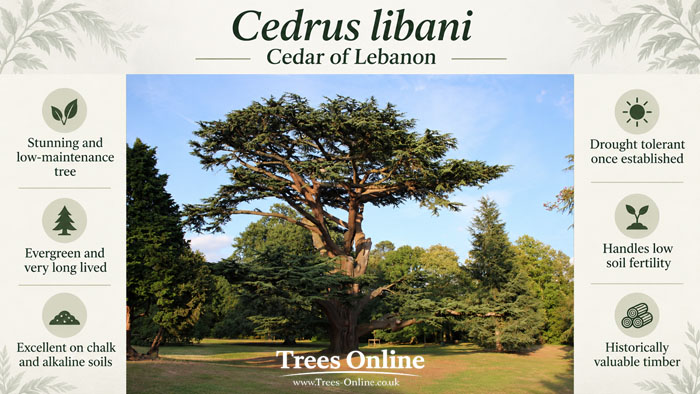
Cedar of Lebanon Tree – Cedrus libani Cell Grown Saplings
Cedar of Lebanon (Cedrus libani) is a magnificent long-lived evergreen for large gardens, estates and land, combining year-round foliage with exceptional hardiness, drought tolerance once established and an ability to grow on chalk and alkaline soils. Young trees are upright and conical, but with age they develop the enormous spreading branches and distinctive tiered crown that make a mature Cedar of Lebanon one of Britain's most recognisable specimen trees. Cedrus libani also holds the RHS Award of Garden Merit.[1][2][3]
For landowners, Cedrus libani has another attraction: this is not purely an ornamental conifer. Its timber has been valued for thousands of years and Cedar of Lebanon is being trialled as a potential forestry species for a warmer British climate, particularly on suitable lowland soils that are neutral, chalky or limestone-based.[1]
The species has been grown successfully as a specimen tree in Britain for more than three centuries and can exceed 25m in height and 1m trunk diameter.[1]
Ideal for: large gardens, open lawns, estates, parkland, mixed woodland, small woodland plots and experimental timber planting on sunny, well-drained ground.
Cedar of Lebanon for Dry Ground and Summer Drought
Once established, Cedar of Lebanon is tolerant of periods of drought,[1] which is particularly useful on free-draining ground that can become dry in summer. At the opposite extreme, high rainfall can be a problem. For forestry planting, warmer sites receiving less than about 1,500mm annual rainfall are currently preferred.[1]
Cedar of Lebanon Growth Rate and Mature Size
Cedar of Lebanon can become a fast-growing tree once established. Early growth may be slower, but after the first few years it can grow very quickly and develop into a substantial tree.[1][2]
Mature trees in Britain can exceed 25m in height and 1m in trunk diameter.[1]
As the tree matures, its shape changes from a more upright young form into the broad, spreading structure for which Cedar of Lebanon is famous. Older trees develop large horizontal branches and a wide, often flattened crown.[2]
Where a Cedar of Lebanon Plant Grows Best
A Cedar of Lebanon plant is straightforward in its basic requirements:
- Full sun is best.[1][2]
- Soil should be well-drained.[2]
- Chalk, clay, loam and sandy soils can all be suitable if drainage is adequate.[2]
- Acid, neutral and alkaline soils are tolerated.[2]
- Established trees tolerate periods of drought.[1]
- Peat and persistently wet soils should be avoided.[1]
- Very high-rainfall locations are less suitable.[1]
- Highly exposed forestry sites are not recommended.[1]
Cedar of Lebanon can grow in an open position, but avoid sites that are regularly battered by strong, unrestricted winds, such as exposed hilltops, open ridges or very windswept coastal ground.[1][2]
Cedar of Lebanon Hardiness in Britain
Despite originating in the eastern Mediterranean, Cedar of Lebanon is extremely hardy in the UK and will tolerate temperatures around -20°C.[1][2]
Cedar of Lebanon Needles, Leaves and Cones
The evergreen Cedar of Lebanon needles are dark green and reach approximately 3cm long. They occur spirally on young shoots and in dense whorls on the shorter side shoots.[2] As the tree develops, these dense evergreen shoots cover increasingly broad horizontal branches, producing the layered appearance associated with mature trees.
Cedar of Lebanon cones are upright rather than hanging beneath the branches.[2]
Cedar of Lebanon Compared with Atlas Cedar and Deodar Cedar
Cedar of Lebanon, Atlas Cedar and Deodar Cedar are all large evergreen trees that need plenty of room, full sun and well-drained soil. The main difference for most buyers is the shape and appearance they develop as they mature.[2][4][5]
Cedar of Lebanon develops the broad, horizontally layered crown associated with old parkland specimens. Deodar Cedar is more pendulous, with a noticeably drooping leading shoot when young, while Atlas Cedar starts more conical and broadens with age, carrying dull green to grey-green foliage.[2][4][5]
Choose Cedar of Lebanon where the aim is the classic wide, tiered cedar shape seen in historic British parks and estates rather than the more drooping appearance of Deodar Cedar.
Cedar of Lebanon Maintenance and Pruning
Once planted in a suitable position, Cedar of Lebanon requires relatively little intervention.
No routine pruning is required,[2] which is particularly appropriate for a specimen tree because its naturally spreading branches are one of its main attractions.
Cedrus libani – Proven in Britain for Centuries
Although it is not a native British tree, Cedrus libani has an exceptionally long history of cultivation here.
The earliest known introduction to Britain was 1638, and the original tree near Wantage associated with that introduction is recorded as still thriving. Numerous specimen trees planted in British parks and gardens during the eighteenth century also survive.[1]
This exceptional lifespan is another reason it works particularly well as an estate, parkland or family legacy tree.
[1] Forest Research – Cedar of Lebanon
Used for: British cultivation, forestry trials, growth, mature size, drought, rainfall, soils and exposure.
[2] Royal Horticultural Society – Cedrus libani
Used for: mature form, evergreen foliage, soil, drainage, sun, hardiness, needles, cones and pruning.
[3] Royal Horticultural Society – Award of Garden Merit ornamental plants
Used for: confirmation that Cedrus libani holds the RHS Award of Garden Merit.
[4] Royal Horticultural Society – Cedrus deodara
Used for: comparison with Deodar Cedar.
[5] Royal Horticultural Society – Cedrus atlantica
Used for: comparison with Atlas Cedar.