Looking to Buy a Lot of Trees? Trade Price Details or straight to Contact Us
Why Buy Our 10-60cm Cell Grown Trees?
- Our trees are covered by our FREE TREE WARRANTY. (first 15% not covered)
- Very easy to plant all year, little cultivation required and very high success rate.
- Root plug contains both naturally occurring mycorrhizae and fertilser.
- Cell grown i.e. 1 year old and 10-60cm. Establish quickly.
- Plants do not "check" when planted so rapid early growth.
- Grown in Scotland with fertilizer and mycorrhizae.
Hybrid Larch Cell-Grown Saplings for Fast Woodland Establishment – Larix × eurolepis
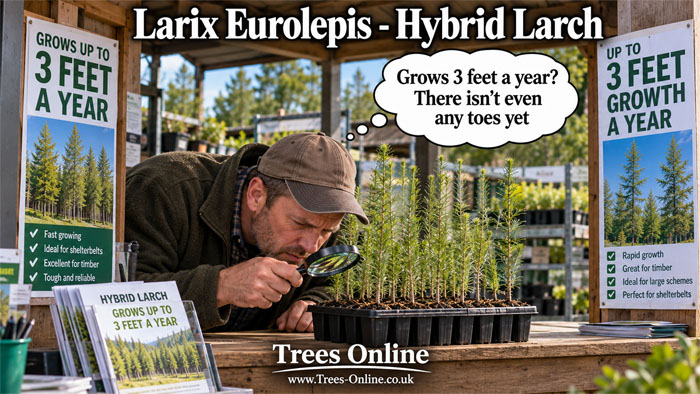
Hybrid Larch (Larix × eurolepis) is a very fast-growing deciduous conifer for establishing new woodland, as it is a pioneer species and is great for productive forestry and large-scale estate planting. Young trees on suitable sites can grow around 50–100cm a year, with some plantings exceeding that.[15][16] Larch can be grown alongside broadleaf trees to encourage taller, straighter stems (nurse tree)[12][13], while its golden autumn foliage gives larger woodland and estate schemes strong seasonal colour.[3]It can even help improve the soil.
Hybrid Larch as a Nurse Tree and Soil Improver
One particularly useful role is as a nurse tree alongside oak. They restrict the light and force surrounding trees to grow up instead of out, which creates longer and straighter stems.[12]The effect has been demonstrated in long-term forestry trials. Sessile oak grown with Japanese Larch reached around 4.0 metres at 15 years compared with 2.1 metres in a pure oak stand and subsequently developed substantially better stem form. Beech and sweet chestnut also benefited, although silver birch did not, so the effect should not be assumed for every broadleaf species.[13]Those particular trials used other larch species, but Hybrid Larch itself is recognised as a good nurse species.
Hybrid Larch can also improve the availability of phosphorus already present in the soil.[1] Research on other larch species has shown that this is not simply phosphorus being returned in fallen needles: larch roots can help convert less-available soil phosphorus into forms plants can absorb.[9][10] In mixed larch and Manchurian ash stands, neighbouring ash had substantially more plant-available phosphorus around its roots and higher phosphorus levels in its foliage than ash grown without larch.[11] This provides direct evidence that larch can improve phosphorus availability for a neighbouring tree, although the same benefit has not been directly demonstrated for every companion species.
Hybrid Larch Forestry Plants for Timber Production
Hybrid Larch combines rapid growth with good stem form and can out-yield European and Japanese Larch on comparable sites.[1] This makes these forestry plants useful for buyers looking for productive trees for timber as well as for multipurpose woodland where timber is only one objective.
Its timber is strong, durable and flexible and is used for construction, exterior cladding, fencing, gates and other applications where durable timber is valuable.[3]
When Hybrid Larch is grown fairly closely with other trees, it can naturally shed its lower branches, helping produce a cleaner, straighter trunk for timber.
Where Hybrid Larch Grows Best – Soil, Moisture, Light and Exposure
Hybrid Larch grows best in an open position on deep, moist, well-drained acidic soil. It is particularly well suited to relatively poor mineral soils and does not need highly fertile ground to grow strongly.[1][17]
Newly planted saplings need plenty of light, so tall weeds, bramble and other competing vegetation should be kept under control until the trees are established. Once growing strongly, Hybrid Larch's rapid height growth allows it to rise above most low vegetation.[1]
Sites receiving around 700–1,500mm of annual rainfall are particularly suitable. Dry spring weather and very free-draining slopes can cause establishment losses, so the best sites retain adequate moisture without becoming waterlogged.[1][17]
Hybrid Larch tolerates moderate exposure and is extremely cold hardy, with an H7 rating equivalent to winter temperatures below approximately -20°C.[1][5][6] It comes into growth early in spring, however, so fresh shoots can still be damaged by late frost.[1]
Hybrid Larch Tree Size, Autumn Colour and Landscape Value
A mature Hybrid Larch tree is a large forest tree, typically reaching around 30 metres in height,[3] while documented UK and Irish specimens have exceeded 38 metres.[5] These tree saplings are therefore suited to woodland, forestry, estates, parks and other substantial sites rather than confined gardens.
Unlike most familiar conifers, Hybrid Larch is deciduous. Its soft green needles turn a strong golden-yellow before falling in autumn, and this seasonal contrast has been widely used in forest landscape design.[3]
The cones also provide seed used by Common Crossbills, giving Hybrid Larch some wildlife value alongside its forestry and landscape uses.[19]
[1] Forest Research – Hybrid Larch
Used for: hybrid vigour, growth, mixed planting, nurse-tree use, phosphorus status, timber production, rainfall, site requirements, exposure, frost, pruning, thinning, pests and diseases.
[2] Royal Horticultural Society – Larix × marschlinsii
Used for: accepted botanical name and Larix × eurolepis synonym.
[3] Forestry England – Hybrid Larch
Used for: mature height, autumn colour, landscape use and timber uses.
[5] Trees and Shrubs Online – Larix × marschlinsi
Used for: H7 hardiness, documented mature heights and British early-growth records.
[6] Royal Horticultural Society – RHS Hardiness Ratings
Used for: interpretation of the H7 hardiness rating.
[7] Forest Research – Ramorum Disease
Used for: Hybrid Larch susceptibility and the impact of Phytophthora ramorum in Britain.
[8] Forestry Commission – Operations Note 23
Used for: current England guidance concerning larch and P. ramorum risk zones.
[9] Research on Phosphorus Availability in the Larch Rhizosphere
Used for: evidence that larch roots can increase plant-available phosphorus without increasing total soil phosphorus.
[10] Research on Available Phosphorus in Larch–Ash Mixed Stands
Used for: evidence that increased phosphorus availability is associated with larch root activity rather than simply fallen-needle decomposition.
[11] Research on Nutrients in Larch and Ash Mixed Stands
Used for: increased plant-available phosphorus around ash grown with larch.
[12] Forest Research – Pedunculate Oak
Used for: weak apical dominance in oak and larch nurse trees encouraging straighter growth.
[13] Forestry Commission – Managing Mixed Stands of Conifers and Broadleaves in Upland Forests in Britain
Used for: measured effects of larch nurse crops on broadleaf height growth and stem form.
[15] Forestry – Growth Heterosis in Hybrid Larch Larix × eurolepis
Used for: annual Hybrid Larch height growth averaging 91.6cm, with a measured range of 43–133.5cm.
[16] Potential of Hybrid Larch in Forest Regeneration in Latvia
Used for: annual height increments of 48–79cm and the effect of site conditions on growth.
[17] Forest Research – Wood Properties and Uses of Larch in Great Britain
Used for: Hybrid Larch soil acidity, nutrient regime, moisture, drainage and soil-depth requirements.
[18] Forestry Commission – Alternative Coniferous Species
Used for: susceptibility of young Hybrid Larch to deer browsing.
[19] Bird Study – Non-native Conifers and Common Crossbills in Britain
Used for: Common Crossbills feeding on Hybrid Larch seed.
Delivery
Due to courier unpredictability, we advise having your trees delivered AT LEAST 3 days before you actually need them.
Returning Cell Grown Trees
For Phytosanitary reasons, cell grown trees cannot be returned to the nursery.
Delaying Planting Cell Grown Trees
If you cannot plant straight away, take the trees out of the packaging and stand upright next to each other in a sheltered location outside. November to March, no need to water unless they start to dry out and these would be ok for up to 6 weeks. During Spring and Summer, you can do this for up to 3 weeks.
Site Conditions And Evergreen Tree List
Our tree chart details which site conditions suit which trees and also which are evergreen or semi-evergreen.
Feeding Or Fertilizing Hedges
This is a task that can easily be over done. Any nitrogen based fertilizer will do such as 20:20:10 but the longer lasting ones which take 18/24 months are better as they are regulated by the weather and moisture therefore release slowly.
Woodburning Chart
If you are one of those lucky people that lead an eco lifestyle (VERY jealous if you are) and want to buy trees to burn, then maybe our wood burning chart (excel spread sheet) will help you decide. Ash, Eucalyptus Gunnii and Willow are worth looking at for their growth rates and calorific values.
Adding A Bit Of Colour And Attract Wildlife
Honeysuckle (Lonicera periclymenum) is very attractive, fragrant and attracts more wildlife to your garden. A bit on the vigorous side but worth the effort. A great addition to your project.
Tree Spacing
Broadleaf wood planting would be around 3m between each tree. Christmas tree planting for a commercial crop is around 1m.
Factors Detrimental To Cell Grown Trees
Too much/little water, animal Urine, excessive wind exposure (will slow growth), salt spray, frost on new growth, herbicide drift and over application of fertilizer.