Looking to Buy a Lot of Trees? Trade Price Details or straight to Contact Us
Why Buy Our 10-60cm Cell Grown Trees?
- Our trees are covered by our FREE TREE WARRANTY. (first 15% not covered)
- Very easy to plant all year, little cultivation required and very high success rate.
- Root plug contains both naturally occurring mycorrhizae and fertilser.
- Cell grown i.e. 1 year old and 10-60cm. Establish quickly.
- Plants do not "check" when planted so rapid early growth.
- Grown in Scotland with fertilizer and mycorrhizae.
Click image to enlarge
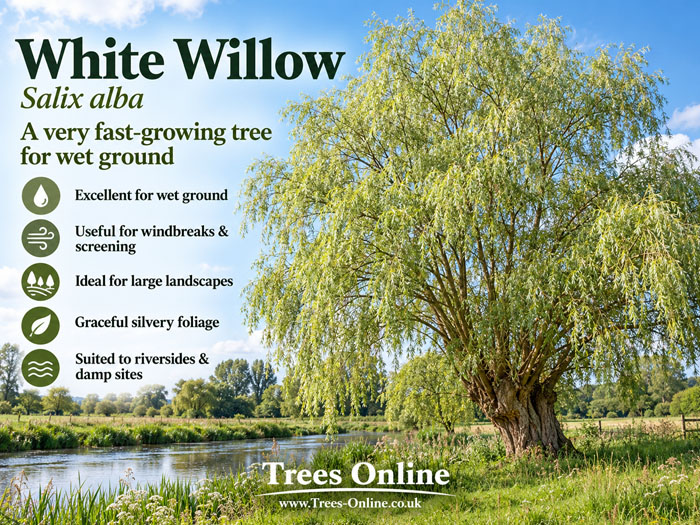
White Willow (Salix alba): A Very Fast-Growing Tree for Wet Ground
White Willow is a large, very fast-growing deciduous tree particularly suitable on wet ground where many other trees might not thrive as well. [1][2] Its narrow leaves have silky, pale undersides that give the canopy its characteristic silvery appearance, while spring catkins provide an early food source for pollinating insects [1][4] which supports local wildlife.
Salix alba is a substantial tree so it needs some space to spread. [1] White Willow is particularly suitable for windbreaks [3], and its combination of fast growth, hardiness and tolerance of poor drainage makes it especially useful for larger rural and landscape planting schemes. [1][2] It is well suited to sites where the ground stays moist or wet for long periods such as:
- low-lying ground
- poorly drained fields
- damp hollows
- valley bottoms
- beside rivers, streams, ponds and lakes
It is also a strong choice for wet woodland, woodland edges, flood-prone areas that are periodically inundated, and larger screening or shelterbelt schemes on heavy, moisture-retentive soils.
Because White Willow naturally develops into a very large, vigorous tree, reaching up to around 25m, [1] we do not recommend it for conventional clipped hedging. Keeping it as a neat, compact hedge would require considerable pruning. It is much better suited to informal screening, windbreaks and larger boundary planting where its fast growth and eventual size are advantages.
Soil, Site Conditions and Hardiness for White Willow Trees
For best results, plant in full sun and moist or wet soil. Salix alba can grow in chalk, clay, loam or sand, in acid, neutral or alkaline conditions. [1]
Although tolerant of a wide range of soils, its best position is one where the roots have reliable access to moisture and the crown receives full sun. [1] Avoid planting close to buildings as White Willow roots draw substantial amounts of water from a wide surrounding area. [1]
The species is rated RHS H6, corresponding to approximately −20°C to −15°C and hardy throughout the UK. [1]
White Willow is listed by the RHS as suitable for coastal windbreak planting. [3] However, it should not be planted where seawater or strongly saline water regularly reaches the roots during the growing season. In experimental research, just one week of saltwater exposure in spring or summer reduced height growth by up to 96% and stem growth by up to 95%. [5] In the same experiment, exposure during autumn and winter had little effect. [5]
Growth, Mature Size, Screening and Shelterbelts
Salix alba is a genuinely large tree. RHS records an eventual height of up to about 25m and a maturity period of around 20–50 years. [1] Van den Berk gives a mature spread of approximately 14–18m. [9]
Growth rates have been reported as high as 100cm a year, which is unlikely to be average. [7] A more reasonable range will be around 60cm a year. [6][7][8] This fast growth makes White Willow useful as a screening tree or fast-growing tree for privacy where there is enough room for its eventual size.
Click image to enlarge
Show sources
[1] RHS — Salix alba / White Willow
Used for: mature size, soil types, pH, moisture, drainage, full sun, hardiness and root considerations.
[2] RHS — Trees and Shrubs: Native to Britain / Archaeophytes
Used for: very fast-growing classification and White Willow information.
[3] RHS — Windbreaks and Shelterbelts
Used for: suitability for windbreak and coastal windbreak planting.
[4] Woodland Trust — White Willow (Salix alba)
Used for: foliage, catkins and wildlife value.
[5] Experimental Study on Seasonal Salt Stress in Salix alba
Used for: effects of saltwater exposure during different seasons.
[6] Kolozsvári, I. et al. (2021) — Utilization of Fish Farm Effluent for Irrigation Short Rotation Willow (Salix alba L.) under Lysimeter Conditions
Used for: measured annual growth exceeding 60cm under experimental growing conditions.
[7] Hinckley National Rail Freight Interchange — Landscape and Visual Baseline Assessment
Used for: professional UK landscape modelling using approximately 1 metre of annual growth for Salix alba.
[8] Guillemot, P.-M. B. (2024) — Computational Study of the Feasibility of Baubotanical Structures
Used for: published Salix alba annual growth-rate evidence around 60cm per year.
[9] Van den Berk Nurseries — Salix alba / White Willow
Used for: mature dimensions, including approximately 20–25m height and 14–18m spread.
Delivery
Due to courier unpredictability, we advise having your trees delivered AT LEAST 3 days before you actually need them.
Returning Cell Grown Trees
For Phytosanitary reasons, cell grown trees cannot be returned to the nursery.
Delaying Planting Cell Grown Trees
If you cannot plant straight away, take the trees out of the packaging and stand upright next to each other in a sheltered location outside. November to March, no need to water unless they start to dry out and these would be ok for up to 6 weeks. During Spring and Summer, you can do this for up to 3 weeks.
Site Conditions And Evergreen Tree List
Our tree chart details which site conditions suit which trees and also which are evergreen or semi-evergreen.
Feeding Or Fertilizing Hedges
This is a task that can easily be over done. Any nitrogen based fertilizer will do such as 20:20:10 but the longer lasting ones which take 18/24 months are better as they are regulated by the weather and moisture therefore release slowly.
Woodburning Chart
If you are one of those lucky people that lead an eco lifestyle (VERY jealous if you are) and want to buy trees to burn, then maybe our wood burning chart (excel spread sheet) will help you decide. Ash, Eucalyptus Gunnii and Willow are worth looking at for their growth rates and calorific values.
Adding A Bit Of Colour And Attract Wildlife
Honeysuckle (Lonicera periclymenum) is very attractive, fragrant and attracts more wildlife to your garden. A bit on the vigorous side but worth the effort. A great addition to your project.
Tree Spacing
Broadleaf wood planting would be around 3m between each tree. Christmas tree planting for a commercial crop is around 1m.
Factors Detrimental To Cell Grown Trees
Too much/little water, animal Urine, excessive wind exposure (will slow growth), salt spray, frost on new growth, herbicide drift and over application of fertilizer.
Growing Willow For Bio Fuel
If you are in the enviable position of having enough land, then click the link grow your own Bio Fuel.
Canker On Willow Trees
Canker can show itself in the form of black leaves and bark, almost looking like they have been burnt. This is something transmitted by the weather, birds and animals etc and affects thin barked trees in particular. It can get it through wounds to the tree and there is no effective treatment other than cutting the diseased part out and allowing the tree to grow again.
Keeping the tree healthy in the first few years will help the tree fight off infection so fertilise and control weed infestation.
Water Logged Conditions And Willow Trees
So long as you do not have permanent standing water e.g. your local diving and sailing club meets on your lawn then Willow, Alder, Birch and Poplar will be ok to plant and maybe even help lower the level.
Willow Tree Sexing
We are unable to provide the sex of the Willow Trees. We have tried watching to see which toilet they go into but as tree bladders go, these are pretty resilient. Our "watcher" needed to go before they did and gave up.