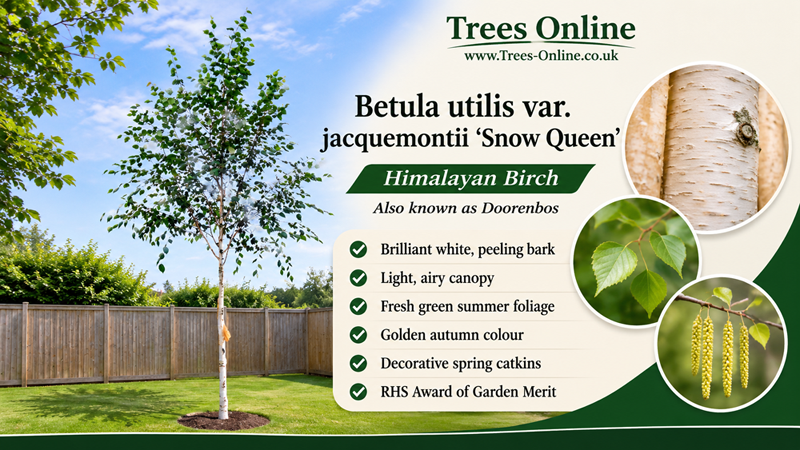
Bare Root / Rootball Betula Snow Queen or Doorenbos, Himalayan Birch Tree
Available all year are our potted Betula Snow Queen.
Our bare root Betula Snow Queen Himalayan birch brings outstanding colour and contrast to the garden throughout the year. Its brilliant white bark develops while the tree is still young, creating a striking (attention-getting, not refusing to work!) feature against dark evergreens and winter skies. Growing to around 14 m tall with a spread exceeding 8 m, this elegant deciduous tree forms an oval crown that provides light summer shade as many birch trees do. Also known as Betula Doorenbos, Snow Queen has received the Royal Horticultural Society's Award of Garden Merit.[1][2] If it were any more of an excellent tree, it would have been knighted, creating the contradiction of Sir Snow Queen.
Snow Queen Birch – Brilliant White Bark and Seasonal Colour
What makes Snow Queen birch particularly special is the speed at which its bark becomes white. While some birches take longer to develop their characteristic colouring, Snow Queen produces exceptionally white, peeling bark from a young age. Even the branches develop this distinctive colour, giving the tree an attractive appearance long before it reaches maturity.[2]
Spring brings slender male catkins, which can reach 15 cm long, followed by fresh green leaves. During summer, these form an airy canopy before turning golden yellow in autumn. After leaf fall, the exposed trunk and branches provide the tree's most impressive winter display.[1][2]
Betula utilis Snow Queen makes an excellent specimen tree where its changing appearance can be enjoyed from the house or garden. Planting several together creates a particularly striking effect, with their pale trunks standing out against darker foliage or a woodland background.[2]
Where to Plant Bare Root Betula Snow Queen
Snow Queen grows in full sun or partial shade and is suitable for a wide range of garden soils, including chalk, clay, loam and sand. It tolerates acidic, neutral and alkaline conditions, preferring moist but well-drained ground. Both exposed and sheltered positions are suitable, and the tree is hardy to temperatures below -20°C.[1] In short, this is not a fussy tree.
Although adaptable, it is best to avoid permanently waterlogged soil. Give the tree sufficient room for its expected 8m spreading crown, particularly when planting near buildings or other established trees.[1][3]
Plant bare-root and rootball trees while dormant, generally between November and early March, avoiding frozen or waterlogged ground. Keep the roots moist before planting and water thoroughly afterwards. Regular watering during the first growing season is important, with additional attention during prolonged dry spells over the following two years.[3]
Mulching around the base helps retain moisture and reduces competition from grass.
Once established, Snow Queen requires little routine pruning. Damaged or diseased branches can be removed in early winter while the tree is dormant, but heavy pruning should be avoided. Birches can bleed sap heavily when cut at other times, particularly during late winter and spring.[3]
Betula Doorenbos – The Interesting History Behind Snow Queen
Betula Snow Queen is widely also known as Betula Doorenbos, another name associated with this distinctive Himalayan birch. Its botanical names include Betula utilis var. jacquemontii 'Snow Queen', Betula utilis var. jacquemontii 'Doorenbos' and Betula utilis subsp. jacquemontii 'Doorenbos'. These reflect differences in botanical naming rather than different ornamental characteristics.[1][4]
The two names have an interesting history. Kenneth Ashburner, who maintained the National Collection of Betula, explained that the Dutch botanist Piet de Jong named the selection 'Doorenbos' in the Netherlands, while British nurseries commonly sold it as 'Snow Queen'. Both names have remained in use, which explains why gardeners may encounter the same selection advertised under different names.[5]
The botanical name has its own history. 'Utilis' means useful, while 'jacquemontii' commemorates Victor Jacquemont (1801–1832), a French botanist and explorer. The parent Himalayan birch originates from the Himalayas, but Snow Queen is a cultivated selection rather than a naturally occurring British tree.[4][6]
One unusual advantage of white-barked birches is that their trunks can be gently cleaned when dirt or algae dulls their appearance. The RHS recommends warm water and a soft sponge, allowing the naturally pale bark to regain its brightness without damaging the surface.[3] Furniture polish, chrome cleaner and grinders with 1600 grit polishing discs are not recommended. We are talking ESPECIALLY to the hard-core DIY blokes out there.
Snow Queen is propagated vegetatively, including by cuttings or grafting, to preserve the characteristics of the original selection. Trees grown from seed may differ in their bark colour or growth habit, which is why correct propagation matters when purchasing a named cultivar.[1][3]
Show sources
[1] Royal Horticultural Society – Betula 'Snow Queen'
Cultivar description, botanical synonyms, mature dimensions, foliage, catkins, soil, exposure, hardiness, cultivation, pruning, pests, diseases and propagation.
[2] Royal Horticultural Society – Birch Trees for Winter Interest
Early development of white peeling bark, summer foliage, autumn colour, mature height, ornamental uses and the Doorenbos name.
[3] Royal Horticultural Society – How to Grow Birch
Planting season, soil requirements, watering, mulching, pruning, bark cleaning and propagation.
[4] Royal Horticultural Society – Betula utilis subsp. jacquemontii 'Doorenbos'
Alternative botanical naming and identification of the cultivar.
[5] International Plant Propagators' Society – Kenneth Ashburner, Propagation Methods and Policy for the National Collection of Betula
Historical account of the naming of 'Doorenbos' by Piet de Jong and its use under the name 'Snow Queen' in Britain.
[6] Royal Horticultural Society – Betula utilis subsp. jacquemontii
Parent species, Himalayan origin and botanical background.